
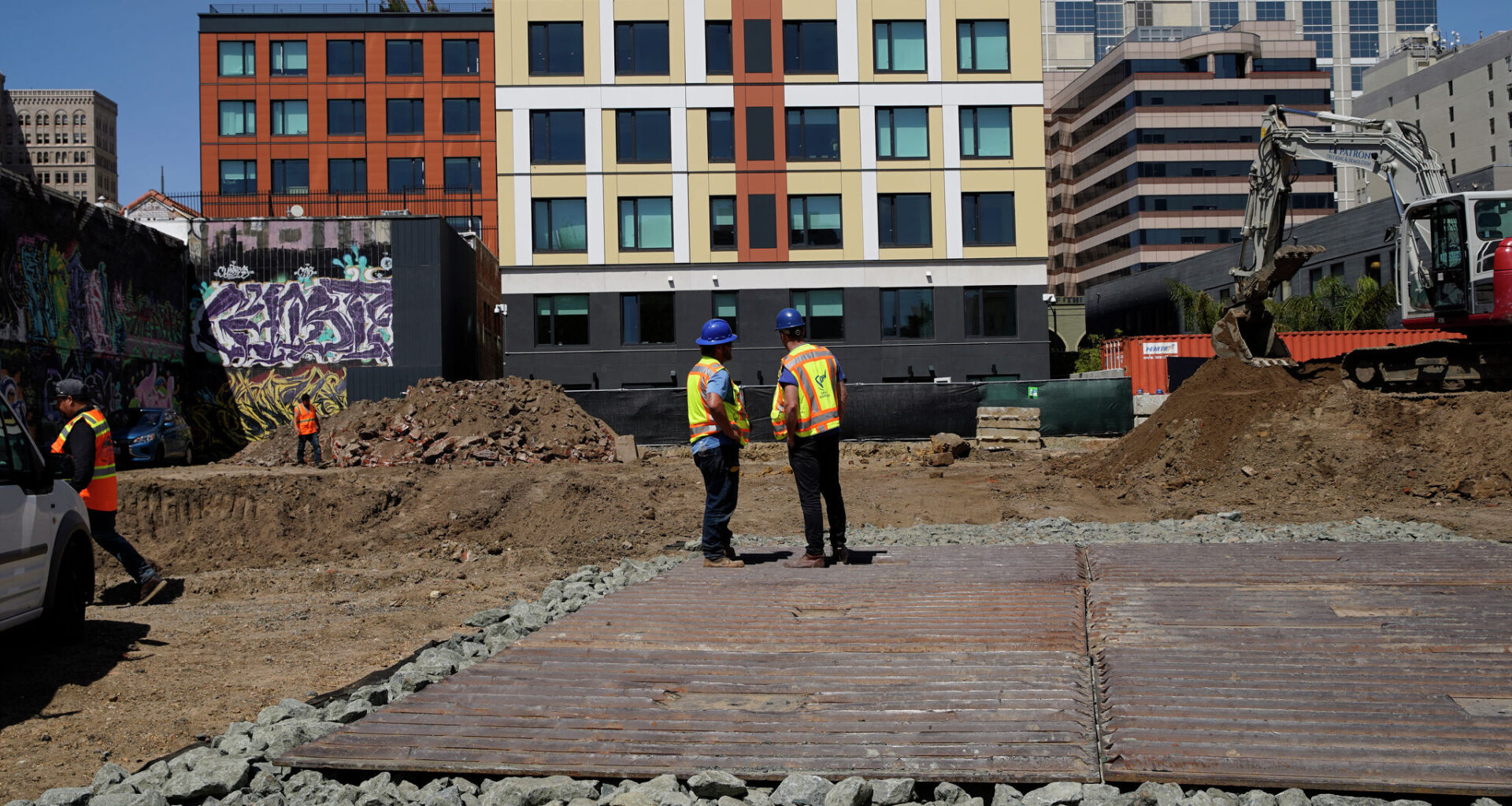
Developer oWow has broken ground on a new affordable housing project on Harrison Street in Oakland.
Giselle Garza Lerma/S.F. Chronicle
On a quiet stretch of Harrison Street in downtown Oakland, a chain-link fence has long guarded a surface parking lot, one of several gaps in a neighborhood where investment seems to come in waves. This month, construction finally began to fill it.
The parking lot at 1523 Harrison St., now giving way to the foundation for an 11-story building with 284 income-restricted apartments, was purchased by local developer oWOW for $10.5 million late last month. A week later, excavation was underway.
What appears sudden is actually the culmination of years of groundwork and several big revisions: oWOW has been fine tuning its use of prefabricated, standardized building components, drawing from lessons learned from its earlier mass timber, market-rate housing tower next to the Harrison Street site, where it initially planned a 20-story tower.
Article continues below this ad
As marked conditions worsened, the team faced delays as it reworked plans that were later expanded into a 28-story, nearly 500-unit project on Harrison Street, before ultimately pivoting to a smaller, all-affordable building that could actually be financed and built.
Last week, the project’s hard-won momentum came to an abrupt halt, after the remnants of a residential structure were discovered during excavation work on the site. The findings were ultimately deemed as not being historically significant, according to Danny Haber, oWOW’s CEO.
Danny Haber, CEO of OWow, talks with OWow workers in Oakland.
Giselle Garza Lerma/S.F. Chronicle
“We had to get an archeologist and like the city out there, and it was almost a crisis,” he said. “The archeologist did her research, and we were able to resolve the issue within the same day.”
San Francisco Chronicle Logo
Make us a Preferred Source to get more of our news when you search.
Add Preferred Source
Construction crews poured back onto the site to ramp work back up on a project that serves as a bit of a test case for the affordable housing construction industry: oWOW’s building is projected to cost roughly $300,000 per unit — about a third of comparable affordable housing projects in the region.
Article continues below this ad
The project proceeds with no gap financing in the capital stack, meaning no direct subsidy from the city of Oakland or Alameda County. Instead, it relies on a streamlined mix of tax credit equity, debt and institutional partnership: Community HousingWorks, one of California’s largest nonprofit affordable housing developers, is a joint venture partner; Freddie Mac provided tax credit equity; National Equity Fund syndicated the credits; and Lument arranged the debt.
Developer oWow is constructing an 11-story building with 284 income-restricted apartments on Harrison Street in Oakland.
Giselle Garza Lerma/S.F. Chronicle
The absence of local subsidies is the premise of oWOW’s development strategy.
For decades, affordable housing in California has depended on layers of public financing to close what developers call the “financing gap” — the difference between what projects cost and what restricted rents can support. That gap can run into the tens of millions of dollars per building and is usually bridged with public dollars, and competition for those funds routinely delays affordable housing projects for years or prevents them from being built at all.
The recent expansion of Low Income Housing Tax Credits (LIHTC) has made affordable housing development more financeable, resulting in some market-rate developers like oWOW crossing over into the space. The developer secured a competitive allocation of the credits after committing to serve households earning between 30% and 70% of Area Median Income (AMI) at 1523 Harrison, which unlocked the financing needed to start building.
Article continues below this ad
Danny Haber, CEO of OWow, and Caleb Cooper, Super, on site of the new OWow affordable housing project on Harrison Street in Oakland.
Giselle Garza Lerma/S.F. Chronicle
oWOW has framed the project’s success as having implications extending beyond its site. By forgoing local subsidies, scarce public funds can be redirected to other developments, effectively increasing the total number of affordable units that can be financed across a city or region, Haber said. That argument comes at a moment of strain in California’s housing pipeline, where thousands of approved units — both affordable and market-rate — remain unbuilt, held back by high construction costs, elevated interest rates and persistent financing gaps.
With the Harrison Street project’s construction no longer a question of financing, the clock is now ticking on how quickly it can be built before market conditions shift again. The team has said it can construct its tower on an accelerated timeline of 14 months. Its completed Webster Street tower next door, which rises to 19 stories, took 24 months to prepare for occupancy.
Developer oWow’s previous affordable housing project is on Webster Street in Oakland.
Giselle Garza Lerma/S.F. Chronicle
While the Webster Street building features a concrete core and shear wall, the Harrison Street project will rely on a three-story, prefabricated steel brace system, which the team says not only lowered costs, but will also allow it to construct three floors per day.
Article continues below this ad
The goal is to deliver the building for under $240 per square foot — and to have a crane in the sky next month.
Chronicle Staff Reporter Aldo Toledo contributed to this report.