
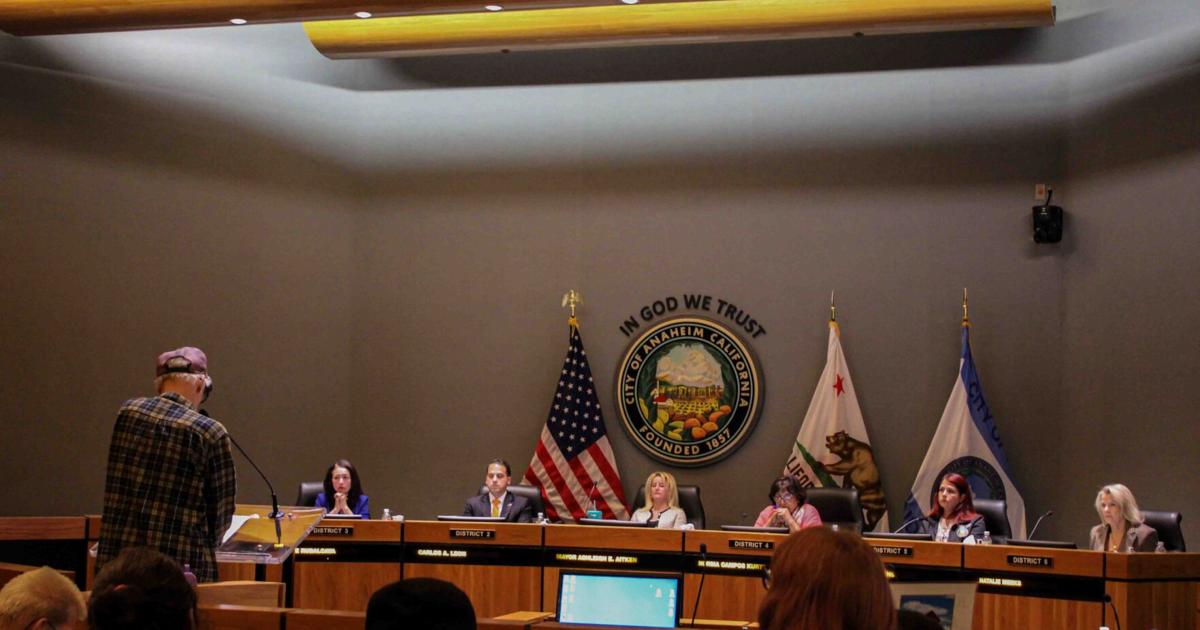
Anaheim city council voted unanimously to expand the city’s Automated License Plate Reader program Tuesday night, acquiring 72 additional mobile cameras and equipment provided by Motorola Solutions.
According to city documents, the installation of new cameras is part of an initiative to “protect critical infrastructure, deter and mitigate potential acts of terrorism and support crime prevention efforts.”
The Anaheim Resort area will have 11 cameras installed with funding provided by donations from the Anaheim Police Foundation.
To combat crime and organized retail theft, 20 of the cameras will be positioned in other areas around the city, funded by the California Board of State and Community Corrections’ Organized Retail Theft grant.
The remaining 41 cameras will be positioned throughout the Orange County operational area.
The effort also includes sustaining the 18 ALPR equipment that are already positioned throughout the OCOA, which was funded by the Urban Area Security Initiative in 2012 by a competitive request for ALPR systems.
Since the initial award, ASAUA has expanded the ALPR program via the purchase of additional cameras across the county. The expansion would total the number of cameras to 90 in the city of Anaheim.
Neighboring cities have previously installed ALPR systems including the city of Orange in 2024, leasing 43 license plate readers and 13 video cameras, following Costa Mesa’s effort of an additional 15 cameras in 2024 to their ALPR program, which was launched in June 2022. Santa Ana followed suit and added 57 cameras to their ALPR systems in November 2025.
“All the data we’re collecting is stuff that’s happening in public view and in public places where from a legal standpoint, there’s no expectation of privacy,” said Police Chief Manuel Cid.
The information captured by the ALPR will be stored in a database with analytical software on Motorola Solutions LEARN server platform and will not be run through any criminal justice information system.
The Anaheim Police Department will serve as the administrator for the ALPR system, with data typically being stored for one year, besides instances where data is connected to a criminal case.
The purchase from Motorola Solutions for the mobile cameras, associated software, accessories and hardware warranty is budgeted to $736,334.32.
During the public comments, speakers shared concerns with data from the ALPR being shared with federal agents as an immigration enforcement tool.
“People are afraid. Families are afraid, that fear is real, it’s legitimate,” said Mayor Pro Tem Carlos A. Leon. “We’re living through a period of federal enforcement that has separated families, disrupted schools, shaken the sense of safety in our community and the sense of safety that every person in our city deserves to feel.”
The police department affirmed they do not share the data or cooperate with immigration enforcement with any federal entity, including U.S. Immigration and Customs Enforcement.
Under Senate Bill 54, the California Values Act, state and local resources are not allowed to be used to assist federal immigration enforcement. California state law disallows the sharing of data outside of the state where state laws may be different and in a position to share information with ICE.
Data is shared only with other local agencies including schools, police departments, sheriff’s departments and state entities.
“We don’t share any of our data with any federal agency, which is really above and beyond what the law requires, but from our own practice and philosophy, we don’t share with any federal entity,” Cid said.