
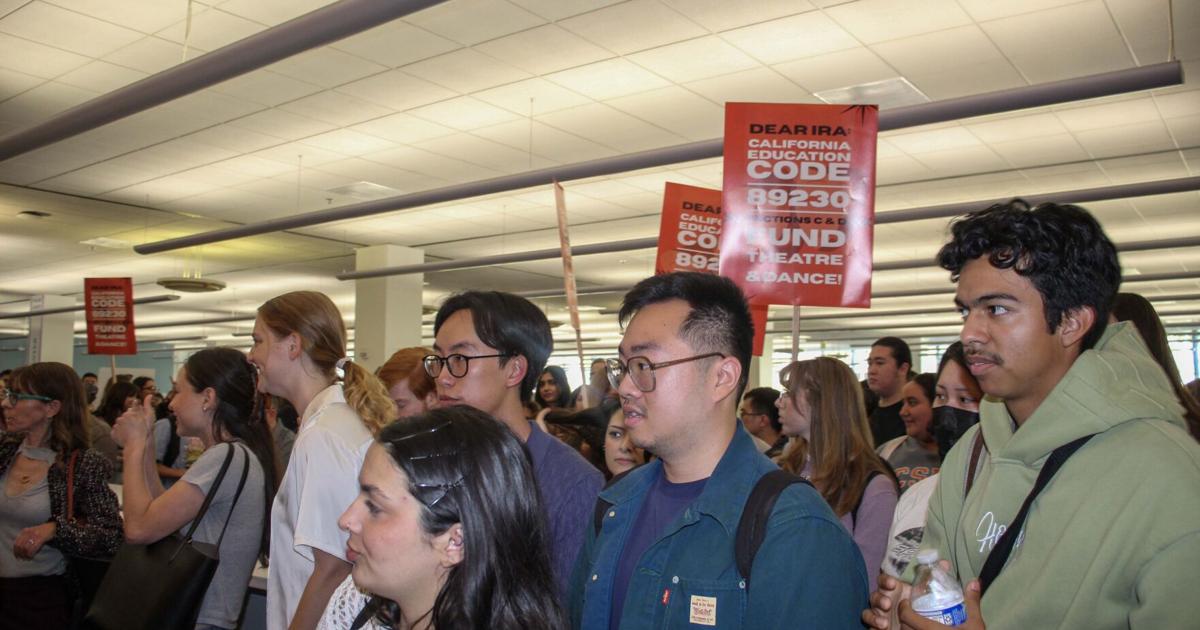
Cal State Fullerton students from various campus organizations affected by the Instructionally Related Activities cuts flooded the Academic Senate room on Thursday afternoon, advocating for a reevaluation of the IRA committee decision and additional funds.
Ultimately, the senate passed an amended resolution, suggested by Stacy Mallicoat, proposing “a committee to review funding options for Instructionally Related Activities.”
The amended motion substituted the original resolution which asked President Ronald Rochon to reject the IRA funding recommendations and restore the budget of existing programs to the same levels as academic year 2025-2026.
Additionally, it asked for the governance documents of the IRA committee to be re-written to always provide stable and adequate funding to programs.
Finally, it asked for “a written policy for referendum” so that other programs could guarantee funding to students related to academic programs similarly to how athletics can.
“We are saying to take away, to basically throw away their (IRA committee) recommendations and ignore their concept of shared governance that is demonstrated from the work of a year,” said Senator Zia Salim. “Asking an administrator to take away a committee’s recommendation is at some level, could be construed by some members of the senate, as overreach.”
During the meeting, Rochon stated that he would not follow with the resolution and undo what the IRA committee has done.
“I appreciate shared governance more than anyone, but this president has frequently vetoed the recommendations of committees, and to accept the one recommendation that would destroy so many campus programs, is not being done because of a respect for shared governance,” said Senator Jon Bruschke.
The 2026-27 IRA awards faced a 40% to 60% cut, after requests totaled at $7.8 million and only $4.2 million was available for allocation. 36% of the available funding — $1.3 million — was automatically allocated to Titan Athletics after a 10% administrative fee was taken out, leaving only slightly over $2.4 million to be distributed to other programs.
“Meeting the requirement of ‘stable and adequate’ funding could easily be provided this way: athletics gets its cut, roughly a third of the available funds,” reads an editorial published by Bruschke and Katie Wilson on the academic senate blog. “To be clear, the obvious solution has repeatedly been presented to the IRA committee, various Vice Presidents of Student Affairs, and Presidents themselves.”
Several members of the affected programs, which include the Daily Titan, OC News, Moot Court, the dance team and the university’s Forensics Speech and Debate Team, attended the meeting to advocate for funding.
The IRA is funded through student fees. This spring semester, the IRA fee was $47.41. It will increase to $49.12 in the upcoming fall semester.
Although the revision of the IRA funding was not on the agenda, Senator Erika Thomas brought forward the urgent business for revision to which Wilson seconded. Members of the senate yielded their speaking time to students which, according to an email from the Academic Senate Chair Matthew Jarvis, is not usual.
The IRA committee is composed of eight student representative members (one from each college), eight faculty representatives and the chair. Non-voting members include representatives from the university president, student affairs, administration and finance, academic affairs, the provost and the IRA administration team.
“Out of those eight colleges, there are only three affected. So in the committee being only eight students that are affecting the entirety of the IRA budget, there are only three that want something to pass to help,” said Jon Vital, a jazz piano major. “They were trying to sweet talk you, saying, ‘Don’t get mad at us, they did it, your people, your students, your peers did that.’”
During a budget meeting of the Academic Senate on the following Friday, Salim brought forth a statement drafted collectively by the IRA committee on April 17, prior to learning that an academic senate meeting would be dedicated to IRA funding.
The statement reiterated the role of IRA and the breakdown of cuts for the upcoming academic year, but noted that these cuts impose uneven restrictions on student opportunities and called on the university to increase IRA funding or establish an equivalent funding structure to meet student needs.
“The IRA committee operates with the belief that they are under an obligation to fund every program that is conceivably eligible for funding,” reads the editorial by Bruschke and Wilson. “This idea is supported by no document, no rule, no rationale and is in fact the opposite of both the education code and the Chancellor’s coded memorandum. Such a process will very predictably lead to exactly the crisis we are currently facing.”