
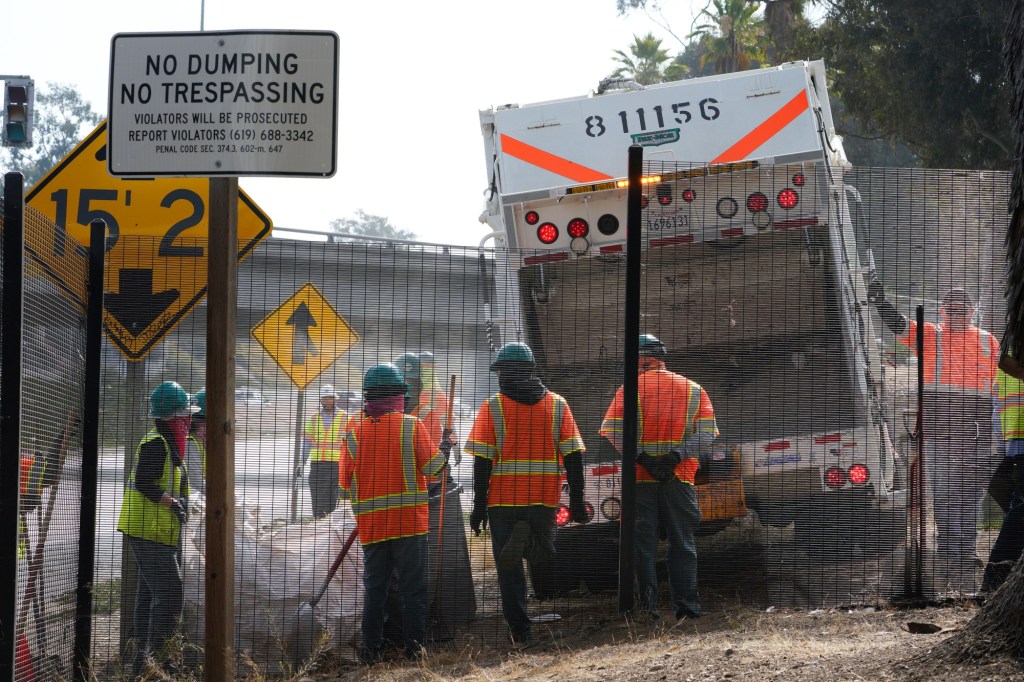
San Diego crews have cleared 184 encampments near freeways since the city got access over the summer to state land through a new agreement with the California Department of Transportation.
Officials said at least 54 homeless people at those sites accepted some form of shelter and two individuals had so far made it into permanent housing.
Yet the total number of sweeps include many areas that have been cleaned repeatedly, as broken fences make it easy for people to return to the same spot, while larger economic forces like a shrinking social safety net and the ongoing government shutdown increase the risk that residents become homeless.
“This is not ‘mission accomplished,’” Mayor Todd Gloria said Tuesday at a press conference near a now tent-free stretch of land by Interstate 5 downtown. “We aspire to be able to show Caltrans, the governor, the Legislature that when working with localities like the city of San Diego, we can bring change to these very, very important pieces of property.”
“We hope that we can expand this agreement so we can do more of this,” Gloria added.
For years, San Diego was largely barred from taking down encampments next to highways because that land is overseen by Caltrans and therefore under state jurisdiction. This became more of an issue in 2023 when the San Diego City Council passed a camping ban that boosted penalties for sleeping on local sidewalks. In the months that followed, many tents appeared to pop up on freeway on- and off-ramps.
The jurisdictional limits also affected outreach workers offering aid. Ketra Carter, program manager for San Diego’s Homelessness Strategies and Solutions Department, said her teams could sometimes only “yell through fencing” when they saw people on Caltrans land.
That changed mid-July, when city and state officials signed a delegated maintenance agreement that allowed local crews onto a roughly 5-mile stretch of property through downtown, Little Italy, Sherman Heights and Barrio Logan. The contract said San Diego could be reimbursed up to $400,000 over the next year, although it looks like the city may hit that limit long before the 12-month mark.
Just in July and August, San Diego tallied about $110,000 worth of cleaning expenses it will ask the state to cover, according to Franklin Coopersmith, the city’s deputy director of environmental services. That doesn’t even include everything the city spent at those sites, as some work, like homeless outreach, is not reimbursable.
Crews have thrown out 151 tons of debris, officials said.
Proponents of the deal argue that cities can address homelessness faster and more effectively than state agencies. Tuesday’s press conference included Catherine Blakespear, a state senator who’s long pushed for legislation that would require closer collaboration between municipalities and Caltrans. While that bill has so far not passed, some places are nonetheless following San Diego’s lead, including San Francisco and Riverside. Chula Vista is also reportedly in talks with Caltrans.
Encampment fires are a real risk, data show. So is the chance that somebody sleeping outside is hit by a car. Walter Bishop, San Diego’s director of government affairs, said he hoped the California Legislature would eventually free up more money for cities willing to tackle freeway encampments.
At the same time, more people countywide lose a place to stay each month than the number of homeless residents who get housing, and there are nowhere near enough shelter beds for everybody asking.
Outreach workers often have more success getting people into San Diego’s designated camping areas, which are known as safe sleeping sites. But while those spots come with services like showers and security, some residents have become so concerned about living conditions that they recently sued to force reforms on the program.
For those without any shelter, there’s always the risk that valuables or important documents will get tossed during a cleanup, and public records show that city crews are rarely flagging belongings for storage. During more than 6,400 encampment sweeps last year, there were just 36 documented instances of personal effects being preserved or catalogued for someone to pick up later.
One 60-year-old woman said last month in an interview that she’d once lost kidney medication during a sweep.
She’d since moved to a spot by Interstate 5 that’s owned by Caltrans. A city crew had recently come by to clear the area. But once the garbage trucks left, the tents came back.