
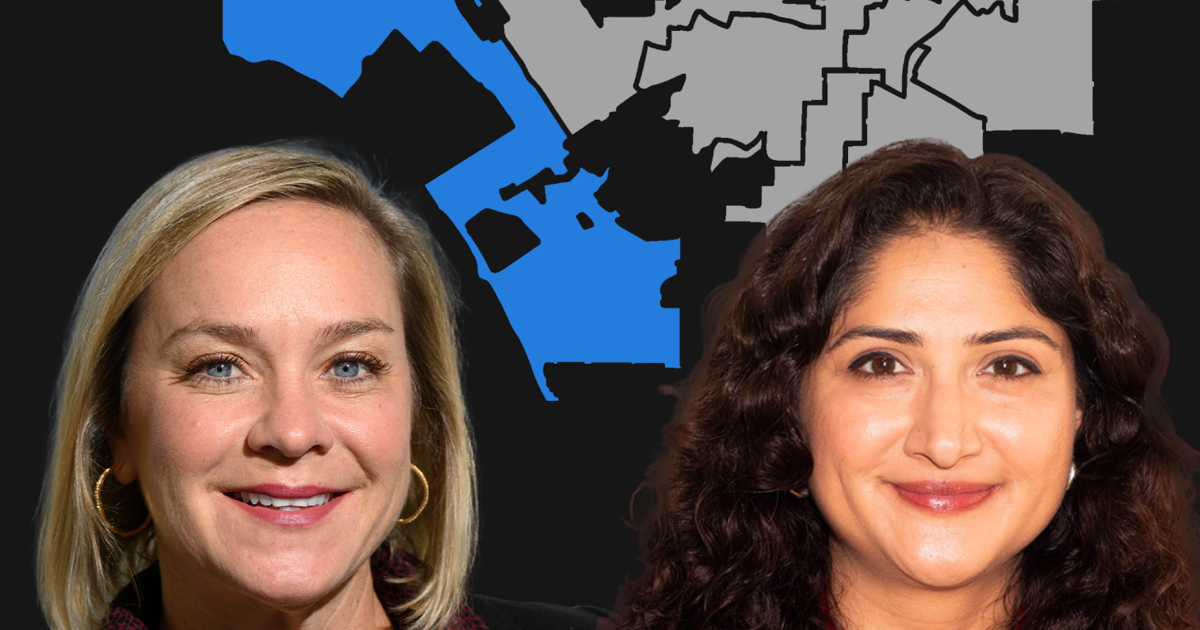

The District 11 Los Angeles City Council race between incumbent Traci Park and challenger Faizah Malik will conclude on June 2, 2026 — Election Day.
As the race for Los Angeles City Council District 11 enters its final stretch, the current councilmember Traci Park — known for policies emphasizing public safety, enforcement-based approaches to homelessness and opposition to certain high-density housing developments –– faces a challenge from democratic socialist and attorney Faizah Malik, whose campaign has gained momentum among young voters and college students on the west side.
District 11 includes Westchester — home to LMU — as well as Playa del Rey, Venice, Mar Vista, Pacific Palisades, Del Rey, Brentwood, Playa Vista and Sawtelle, placing college students directly within the boundaries of the race.
With housing affordability, homelessness and the cost of living dominating the conversation, both candidates are fighting for the engagement of individuals who are directly affected by these concerns prior to Election Day on June 2, 2026. While city council elections attract less attention than national elections, experts and students believe the decision could have a direct impact on local college communities — particularly those dealing with rising prices and limited off-campus housing alternatives.
Concerns in District 11 reflect broader citywide discussions over affordability and quality of life, making this campaign an important test of how local leadership responds to rising demand for housing and services.
The two candidates have different approaches to these concerns. Park has advocated for measures that emphasize encampment removals, stronger policing in certain neighborhoods and a more cautious approach to new housing developments. Malik has highlighted tenant protections, extending affordable housing and community-based solutions to homelessness, which have sparked interest among younger voters and students.
Fernando Guerra, Ph.D., professor of political science and Chicana/o Latina/o studies and founding director of the Thomas and Dorothy Leavey Center for the Study of Los Angeles (StudyLA), said candidates in the District 11 race have largely relied on traditional outreach methods rather than innovative strategies to engage younger voters.
“Most of what I’ve seen has been very traditional and conventional lawn signs, community events at well established organizations and a lot of discussions with influencers that are older,” said Guerra. “That’s all typical [of] campaigns.”
While campaigns have made some effort to involve younger audiences, Guerra noted that outreach tends to focus on two main areas.
“First and foremost is trying to get volunteers from young folks … and then also trying to engage young voters with social media, generically, young volunteers and social media are the two areas for young voters,” said Guerra.
Despite these efforts, Guerra described general youth participation in local politics as low, particularly in comparison to older voters. He shared that it is tough for young people to understand the impact of politics in general — specifically local politics.
Guerra added that many college students feel disconnected with local elections because they are not from Los Angeles and may not plan to stay long. Alongside this, there is the disconnect between young voters and the perceived importance of local government, Guerra said.
“There’s a tremendous disconnect,” said Guerra. “I would argue … that local politics has a much greater impact on you, your quality of life … everything that you touch every single day is actually impacted more by local politics than national politics.”
Still, Guerra noted that while obvious, issues like housing are not always a high priority for students in practice.
“While they talk about the affordability of housing … it’s still not something that [students] are … focused on too much,” said Guerra. “It’s not at the forefront.”
He added that candidates often prioritize outreach toward consistent voters instead of younger populations. “[As a candidate,] I am going to spend my time, my effort … on people who voted in the last five elections,” said Guerra.
Brianne Gilbert, managing director of StudyLA and senior lecturer of political science, said in an email to the Loyolan that declining trust in government is another major challenge in mobilizing young voters.
“A huge issue any candidate faces is getting young or first time voters, or anyone really, to think it’s worth their time,” said Gilbert in an email to the Loyolan.
According to a StudyLA survey in 2024 led by Gilbert and Guerra, younger residents are less confident in local government, reflecting a larger drop in trust. Gilbert shared that trust in the city government has declined among citizens aged 18-29, falling from 54% in 2018 to 34% in 2024 — a 20% drop in six years. This decline creates a fundamental challenge for candidates trying to increase turnout.
“Voting is important. Candidates need to explain why voters can trust them, and our democracy is worth fighting for. But that doesn’t mean it’s easy,” said Gilbert.
According to Sean Sparks, political science major and president of California College Democrats (CCD) at LMU, housing is one of the most important factors influencing the competition for college students on the west side.
“From what I’ve seen … the biggest issue is housing,” said Sparks. “Especially on campus, [but] to be fair, that’s always a prevailing issue when it comes to LMU.”
When asked about candidate engagement, Sparks stated that Malik has been the most visible to students.
“[Malik] has reached out to a lot of students on campus,” said Sparks. “She’s participated in the non-tenure track protests these past couple months … she met with student community leaders on campus to talk about canvassing efforts.”
Matthew Smith, international relations and journalism double major, former Loyolan staffer and president of LMU’s chapter of Young Democratic Socialists of America (YDSA), said student awareness of the race is growing, but engagement is still inconsistent across campus.
“I’m not entirely sure how much there is a willingness to do anything about [voting],” said Smith.
Smith also shared the importance of connecting students to local issues that have a direct impact on them, particularly housing and cost of living.
“It’s obviously affecting our community [Westchester], but so much is happening at the local level, in our City Council, with our mayor’s office, all of that is more directly affecting college students,” said Smith. “I think that’s something that’s important for political organizations on campus to encourage students to consider what’s happening in their area.”
Mail-in ballots are to be distributed in early May, providing voters several weeks to participate before Election Day on June 2, 2026. Candidates that receive more than 50% of the vote will be inducted into office in December 2026. If no candidate exceeds that amount, a runoff between Park and Malik will be held Nov. 3. With only two candidates on the ballot, the race is likely to be determined on Election Day.