
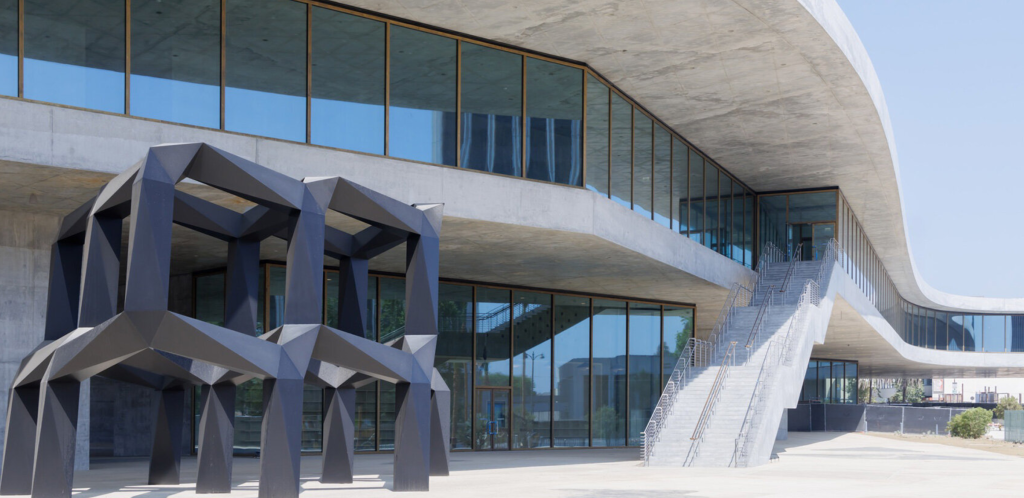
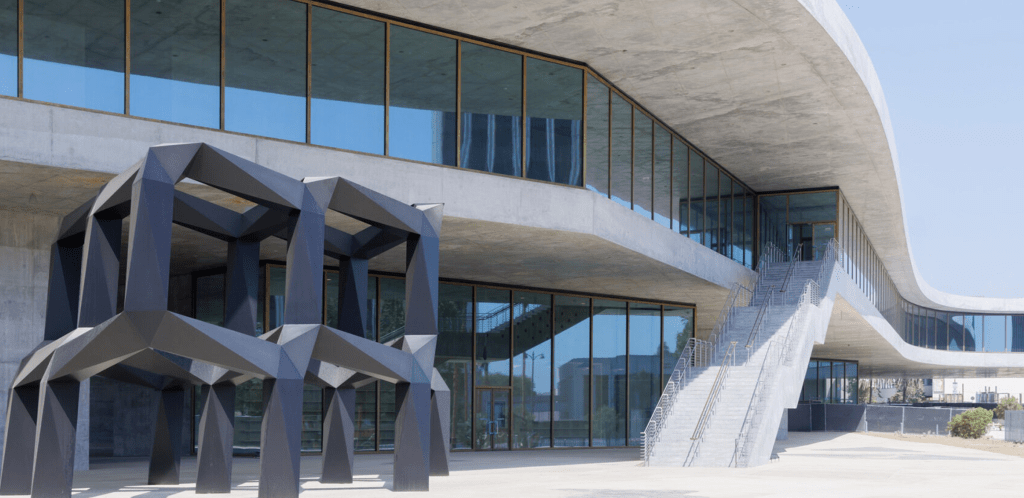
David Geffen Galleries at LACMA; exterior view from East West Bank Commons southeast toward Wilshire Boulevard with Tony Smith’s Smoke (1967) in foreground. Images by Iwan Baan.
April 28, 2026
By Lydia Ringwald
The Los Angeles County Museum of Art (LACMA) has experienced many incarnations during its long history as a cultural art center for the City of Los Angeles.
From art exhibits originally confined to the upper floors of what is now the Museum of Natural History, to the William Pereira-designed buildings on Wilshire Blvd. in the 1960s, to the addition in the 1980s of the Art of the Americas Building, to the Japanese Pavilion opened in 1988, to the Eli Broad Contemporary Art Museum building in 2008 and, in 2010, the Resnick exhibition space; each expansion represents a step forward in the development of Los Angeles as a world-renowned cultural haven.
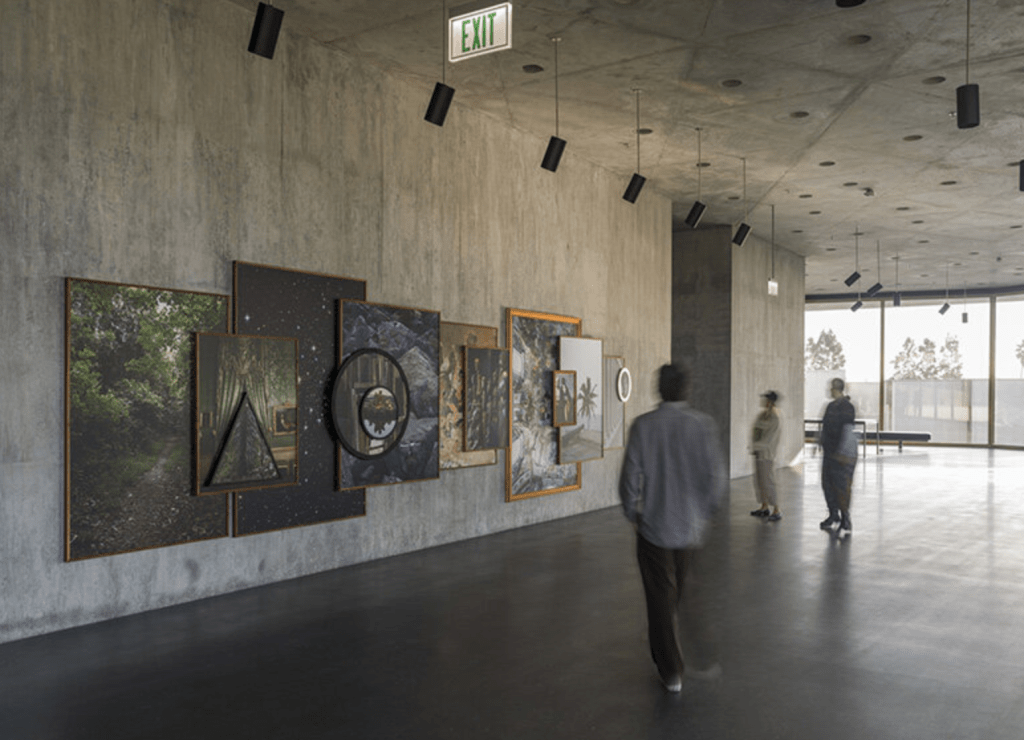
Visitors in the David Geffen Galleries with Todd Gray’s Octavia’s Gaze, 2025, Los Angeles County Museum of Art, gift of the 2024 Collectors Committee, © Todd Gray | image © Museum Associates/LACMA, by Jonathan Urban
The vision for Los Angeles in the arts has continued to expand in our time, with a monolithic project on the LACMA Wilshire Blvd. site that razed more nondescript conventional structures and replaced them with a new, innovative, unique, and futuristic “one of a kind” museum building that is emblematic of Los Angeles—a true landmark.
That mission was accomplished this year with a site-specific new art museum by Swiss architect Peter Zumthor, whose breathtaking design features rows of floor-to-ceiling windows and spans Wilshire Blvd. with soaring lines 30 feet above the iconic Miracle Mile.
It is a building so stunningly beautiful that it is itself a work of art.
The new Los Angeles County Museum of Art, which includes some of the world’s greatest works of art, is itself a sculpted architectural masterwork.
LACMA celebrated its inaugural events with a gala dinner and ribbon-cutting and opened to museum members and the public this week on April 20.
Museum patrons may now wander through intriguing corridors lined with floor-to-ceiling windows overlooking Wilshire Blvd. and surrounding landscaped gardens, leading into a maze of interior galleries warmed by muted coloration and carefully controlled lighting that displays rare works from the museum’s extensive permanent collection of over 155,000 art objects.
Individual galleries are arranged to explore the art of cultures that evolved around maritime trade routes in the Indian Ocean, Atlantic Ocean, Mediterranean Sea, and Pacific Ocean, showcasing unique works that illuminate the many facets of the human experience.
The installations of art from ancient civilizations, along with works from Asian, Middle Eastern, Latin American, and European cultures, honor the myriad ethnicities and cultural expressions across time.
Museum visitors may linger in a European historical art gallery before Georges de La Tour’s The Magdalen with the Smoking Flame and be transported to 17th-century France, or view an ancient Greek statue and reflect on a civilization that has continually influenced and empowered the world.
The thoughtfully curated exhibits, which include rare historical treasures, also feature contemporary works that reflect, respond to, and reinterpret past cultures through modern artistic expression.
Museum patrons have the opportunity not only to experience original works of art, but also to gain insight into their lasting cultural impact on later generations. Designed benches strategically placed along the large glass windows of the museum corridors create spaces where patrons may reflect on the diverse art treasures or simply gaze out at the streetscape and gardens below.
A café, bookstore, and restaurant add ambiance and create an inviting museum complex—a place to linger, reflect, and appreciate art.
The monumental new Los Angeles County Museum of Art offers opportunities for repeated visits and now welcomes visitors to enjoy an inspiring collection showcased in a uniquely immersive museum experience.
For more detailed visitor information, please visit lacma.org.
Related
Discover more from Los Cerritos Community News
Subscribe to get the latest posts sent to your email.