
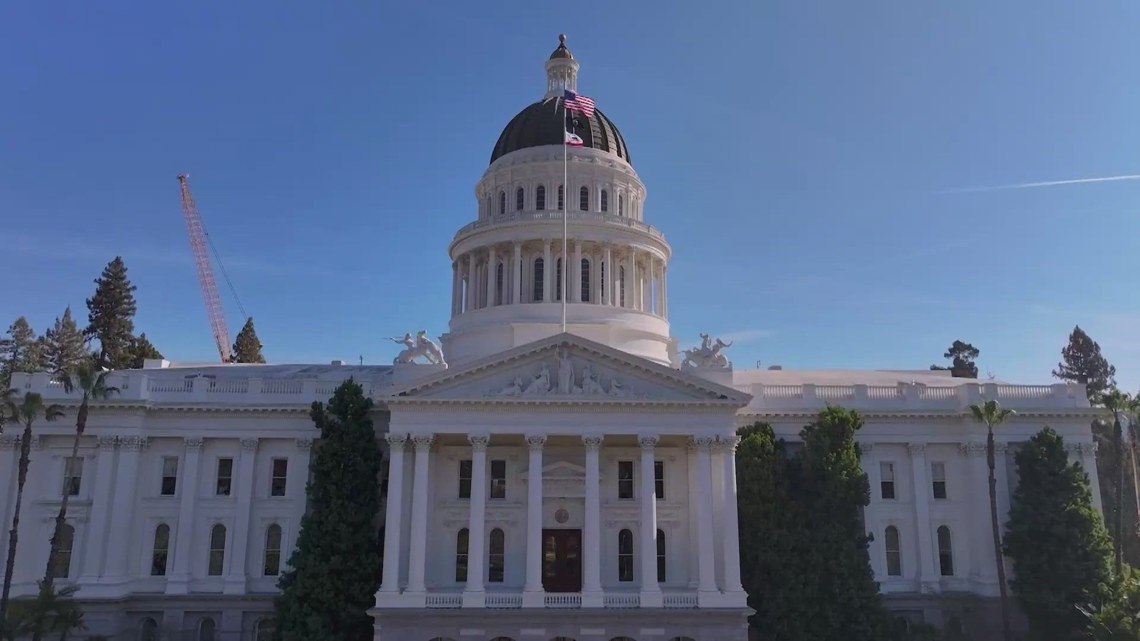
Supporters announced Monday they’re submitting more than 1.5 million signatures of support. Opponents say they’re ready to spend big
SACRAMENTO, Calif. — California’s debate over a proposed wealth tax on billionaires intensified Monday as supporters say they submitted more than 1.5 million signatures of support in an effort to qualify the measure for the November 2026 ballot, setting up a high-stakes political fight with well-funded opposition already mobilizing.
The proposal, a one-time 5% tax on the net worth of California’s more than 200 billionaires, has drawn sharp divisions across the state’s political and economic landscape.
Gov. Gavin Newsom has fiercely opposed the measure — primarily on the basis that such a push at the state level would drive away tax-paying corporations out of state, thereby driving away critical funding for education, public safety and health care.
He does, however, support national efforts to tax billionaires more.
Yet, some members of the Legislature and candidates for governor back it, including Democratic candidates billionaire Tom Steyer and Superintendent of Public Instruction Tony Thurmond.
The healthcare union SEIU-UHW is the proponent of the measure.
Supporters like healthcare worker Mayra Castañeda say the tax is needed to offset what they describe as a looming $100 billion cut to healthcare programs tied to the so-called “Big Beautiful Bill,” warning of widespread consequences if funding gaps persist.
“Longer emergency room wait times. Fewer healthcare workers. Rural hospitals shutting down. Delayed care. And, lives lost that could have been saved,” Castañeda said of what funding cuts would mean.
Proponents argue the tax would generate that $100 billion over five years, helping stabilize healthcare services across California.
“[Billionaires] can afford to invest a little more in keeping California running,” Castañeda said.
Opponents, however, say the proposal is already having negative effects, warning it could and is driving wealthy residents and businesses out of the state.
“It’s already done damage, even though it hasn’t officially qualified yet,” said Jon Coupal with the Howard Jarvis Taxpayers Association. “The concept of a wealth tax is an idea that’s not ready for prime time.”
David Lesperance, an adviser to ultra-high net worth clients throughout California, said some of his clients have already relocated.
“They’re doing everything they can to fight the fire,” Lesperance said, adding that eight clients have moved to Florida, Texas and Nevada, while 10 more are preparing to leave.
Because the tax would be retroactive, those who still lived in the state as of January 1, 2026, could still be taxed after moving. Lesperance and fellow opponents argue that the tax’s retroactive nature likely violates the Constitution.
Opposition groups are also ramping up campaign efforts. Roger Salazar, with the political action committee Golden State Promise — formed specifically in opposition to the billionaire’s tax — warned of broader economic fallout.
“When businesses leave California, thousands of good-paying jobs disappear, paychecks shrink, communities suffer,” Salazar said.
Lesperance agreed, noting, “California relies on the top one percent of taxpayers for over a third of their revenue.”
And that general revenue is a significant part of the state’s overall budget, which the nonpartisan Legislative Analyst’s Office has acknowledged.
State campaign filings show Golden State Promise has raised $10 million from two major donors: tech company Ripple Labs and its co-founder, Chris Larsen.
“We’re ready with an eight-figure statewide communications effort to educate voters,” Salazar said, when asked how the PAC would react to the ballot initiative’s qualification.
Another opposition group, Stop the Squeeze, formed after Newsom spoke out against the proposal, has raised a couple hundred thousand dollars so far, according to a spokesperson. The opposition group is led by two high-profile Sacramento strategists familiar with the Newsom campaign, Dan Newman and Brian Brokaw.
Stop the Squeeze will also focus on voter education as a key part of their opposition efforts, the spokesperson said.
Meantime, there are three ballot initiatives largely considered countermeasures to the wealth tax: the Improving Transparency, Effectiveness, and Efficiency in California Government Act of 2026 (aka Transparency Act); the Protect Schools and Taxpayers Act of 2026 and the Retirement and Personal Savings Protection Act of 2026.
Simply put, those proposals would require that portions of new tax revenue go to schools and state public education and would ban taxes on wealth (rather than income), as well as retroactive taxes, limiting how California could implement new tax policies in the future.
A separate political action committee, Building a Better California, backed by wealthy Silicon Valley investors including Google co-founder Sergey Brin, has spent $77 million supporting those measures. But a spokesperson for Building a Better California emphasizes the committee has not officially weighed in on the wealth tax.
California Business Roundtable is a formal opponent of the wealth tax. In response to SEIU-UHW’s announcement of more than 1.5 million voter signatures gathered, Rob Lapsley, President of the California Business Roundtable, said, “The California Business Roundtable and a broad and bipartisan coalition in California are organized and ready to defeat this initiative in November.”
“Our campaign will ensure every Californian understands the consequences, Lapsley added.
With both sides expected to pour more money into the fight, state officials are set to decide by June 25 whether the wealth tax measure will officially appear on the November ballot.
Opponents also argue the momentum in California has encouraged nationwide conversations over a federal wealth tax. For instance, federal lawmakers are pushing for “The Ultra-Millionaire Tax Act,” which proponents say would generate $6.2 trillion in revenue.
According to Washington Congresswoman Pramila Jayapal’s website, the act would ask the wealthiest 260,000 households in America — or the top 0.15% — to pay their fair share.
WATCH MORE: Gas prices climb across California, nearing highs since Iran conflict began
ABC10: Watch, Download, Read











1
/
12