
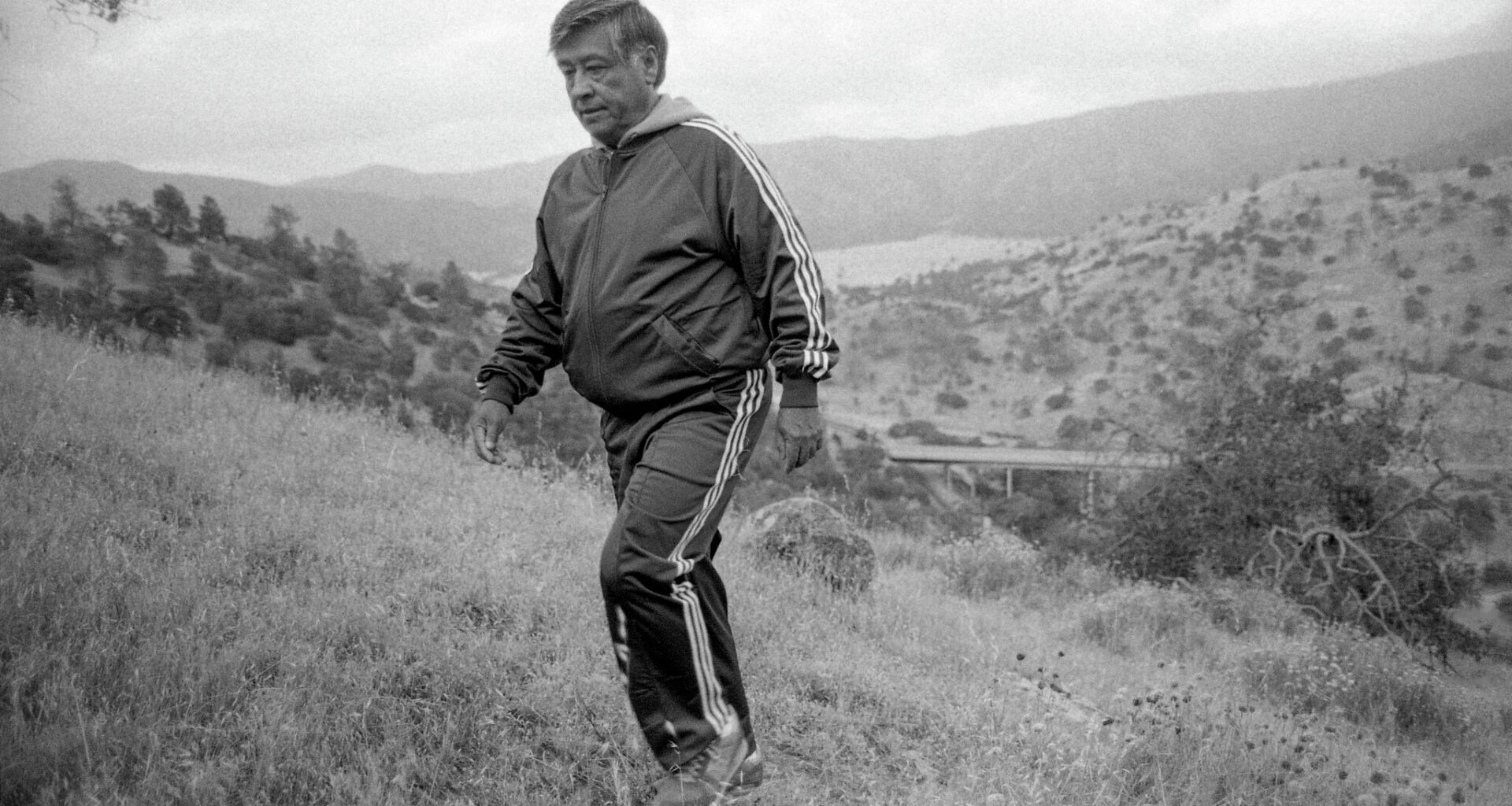
Cesar Chavez on a walk through the landscape near the UFW headquarters in Keene, Calif., in 1987.
Casey Christie/For the S.F. Chronicle
Add one more twist to the complicated legacy of disgraced civil rights icon Cesar Chavez: A reroute around his gravesite has inflated the cost of California’s high-speed rail project by nearly $1 billion.
The change, one of many to hobble high-speed rail over the years, stemmed from good intentions. Policymakers from California High-Speed Rail Authority had to get the train through the Tehachapi Mountains, an important, geologically-challenging terrain separating the San Joaquin Valley from the Mojave desert. And they needed to cut a path without causing too much disruption to the Cesar Chavez National Monument, a 187-acre compound, former headquarters of the United Farm Workers and final resting place for the once-celebrated leader.
But now, amid allegations that Chavez raped and abused women, Californians have been forced to reconsider the streets, institutions and infrastructure that bear his name, including the planned high-speed rail detour. Originally framed as an act of preservation and a concession to the farmerworkers’ movement, the rerouting has taken on a more fraught meaning. It’s another stark example of how politics and threats of litigation have warped the state’s marquee transportation megaproject.
Article continues below this ad
“There have been all these opportunities for people to comment on the high-speed alignment, and demand that things be mitigated,” said Adriana Rizzo of Californians for Electric Rail, an organization advocating for faster construction of sustainable rail projects, including bullet trains. She’s watched people throughout the state call for redesigns that wind up delaying the timeline for high-speed rail and preventing its construction.
A rendering of the kind of electrified high-speed rail train California plans to run in the San Joaquin Valley.
California High-Speed Rail Authority
Ironically, Chavez’ monument already sits on a key rail corridor that carries about thirty-six freight trains each day through the rugged Tehachapi. A single track loops around the property, creating a constant rumble for anyone walking among the Mission-style buildings and courtyards where Chavez lived and organized grape field workers.
San Francisco Chronicle Logo
Make us a Preferred Source to get more of our news when you search.
Add Preferred Source
High-Speed Rail Authority had envisioned building a second, adjacent track to whisk bullet trains along Tehachapi Pass, north to Bakersfield or south toward Los Angeles. But lawyers and representatives of the National Cesar Chavez Center protested the idea, insisting the new electric railroad would be noisy and mar the landscape. They had already pressured the state to scale back plans that would have increased freight capacity through the pass in 2013. The same arguments could be wielded for passenger trains.
Article continues below this ad
Through letters and stakeholder meetings, the Chavez Center and Foundation successfully lobbied for a bespoke alignment called the “refined Cesar Chavez National Monument design option,” which moved the track about three-quarters of a mile away from the monument boundary. Shaped as a wide curve rather than a straight line, the route would pass over viaducts and access roads and through two tunnels, each one longer than a mile and a half.
To build it, the authority would need more track, more tunneling, and — on top of everything — a massive dirt berm, stretching about 1,700 feet, to conceal the train and blend with the desert hills.
“Under the Refined CCNM Design Option, impacts would be less than significant during construction and no impact would occur during operation,” high-speed rail officials wrote in environmental documents that explained why this new route was less invasive than any other.
Rizzo saw it differently. She worried a curve would slow the train down, and saw the wall as an unnecessary addition, just so people would not have to witness new infrastructure.
The gravesites of labor leader and civil rights activist Cesar Chavez and his wife Helen are seen at the Cesar E. Chavez National Monument in Keene, California. The monument’s lobbying to push the state’s high speed rail project further away from the site caused the project’s costs $1 billion higher.
Justin Sullivan/Getty Images
“I have been to the monument,” Rizzo said, “and it is right next to a freight corridor. So I don’t really understand why this quieter, less-polluting train would have to be invisible.”
Article continues below this ad
All of those elements combined added $815 million to the project tab in “2020 dollars” — more than $1 billion today, when adjusted for inflation. Board directors for High-Speed Rail Authority adopted the alternative design in 2021, as part of a final environmental impact report for the 80 mile Bakersfield to Palmdale section.
High-speed rail planners have tweaked their maps many times before, aiming to protect an animal habitat, quell opposition from a community group or powerful landowner, or in this case, bypass a beloved historical landmark. Documents from the rail authority suggest its staffers may have been especially deferential to Chavez, a homegrown labor leader whose photograph was displayed in Gov. Gavin Newsom’s office. Top HSRA officials traveled to Kern County multiple times to visit the Chavez monument, called Nuestra Señora Reina de la Paz, and meet with preservationists. The rail authority scrapped several track designs through Tehachapi Pass before landing on the “refined” option. It called for such profound changes to the original plan that residents of nearby communities complained the monument was getting special treatment.
“Why does the Cesar Chavez National Monument get sound barriers and rural residential areas of Tehachapi not get them?” a resident named Diana Palmer wrote to the rail authority in 2021, before the board voted to approve the track design.
Now, some HSRA staff or board members might call for a do-over.
“We are constantly reviewing decisions that we’ve made along that alignment,” said board director Henry Perea, pointing to other potential revisions, like the relocation of a future train stop in Merced. Plans that are really lines and dots on draft paper are always subject to change, Perea noted, particularly if policymakers are seeking to save money, or trying to acknowledge a historical wrong.
Article continues below this ad
Another board director, Martha Escutia, said she is “always willing to reopen current commitments to ensure we get the best savings for taxpayers.”
Recently, the route around the monument has sparked “a very fluid discussion,” said a third board director, Ernest Camacho.
“This is a billion dollars we don’t have,” Camacho said, referring to the added cost. “There are a lot of other things we need. If there is a better route, we’re always open.”
Cesar Chavez on a walk through the landscape near the UFW headquarters in Keene, Calif., in 1987.
Casey Christie/For the S.F. Chronicle
Last month after an explosive New York Times investigation revealed allegations of Chavez’ past crimes, the fate of his monument suddenly became uncertain. It did not seem appropriate for visitors to tour his office dwelling, knowing that people had been abused there. Two Republic senators introduced a bill to “abolish and defund” the monument, contending that it should lose its federal designation and no longer be sustained by taxpayer money.
Article continues below this ad
Whether Democrats will join the effort sponsored by Texas Sen. John Cornyn, and his Louisiana colleague, Bill Cassidy remains unclear. Members of the National Parks Conservation Association oppose the legislation, saying the senators wrote it without consulting surviving activists or farmworker communities.
“This bill would not only abolish a vital National Park unit focused on Latino and Asian American history but also erase the nationally significant story of the broader Farmworker Movement, including the many leaders, activists, and workers who fought for dignity and fair wages,” association staff wrote in a public letter. Conservationists have expressed similar fears that high-speed rail could undermine the monument’s history, if board members undo the current plan and opt instead to run track next to the La Paz site.
Spokespeople from the National Parks Service, which manages national monuments and other federal lands, did not respond to inquiries from the Chronicle, and representatives of the Cesar Chavez Foundation did not answer requests for comment. A spokesperson for U.S. Sen. Alex Padilla, D-California, said the senator is working to remove Chavez’ name from La Paz, among other places, “as an initial step toward accountability.” But the spokesperson did not indicate what would happen to the monument beyond a symbolic renaming.
On Tuesday morning a receptionist answered the phone at the Cesar Chavez National Monument visitor’s center and said it remained open for business seven days a week.
If Congress were to pass legislation abolishing the monument, “it may prompt a different discussion” about that specific segment of high-speed rail line, Perea said.
“Are we actively looking at it from that perspective? I would say no,” he clarified. “I think the best answer is we are always looking up and down the alignment for efficiencies.”