
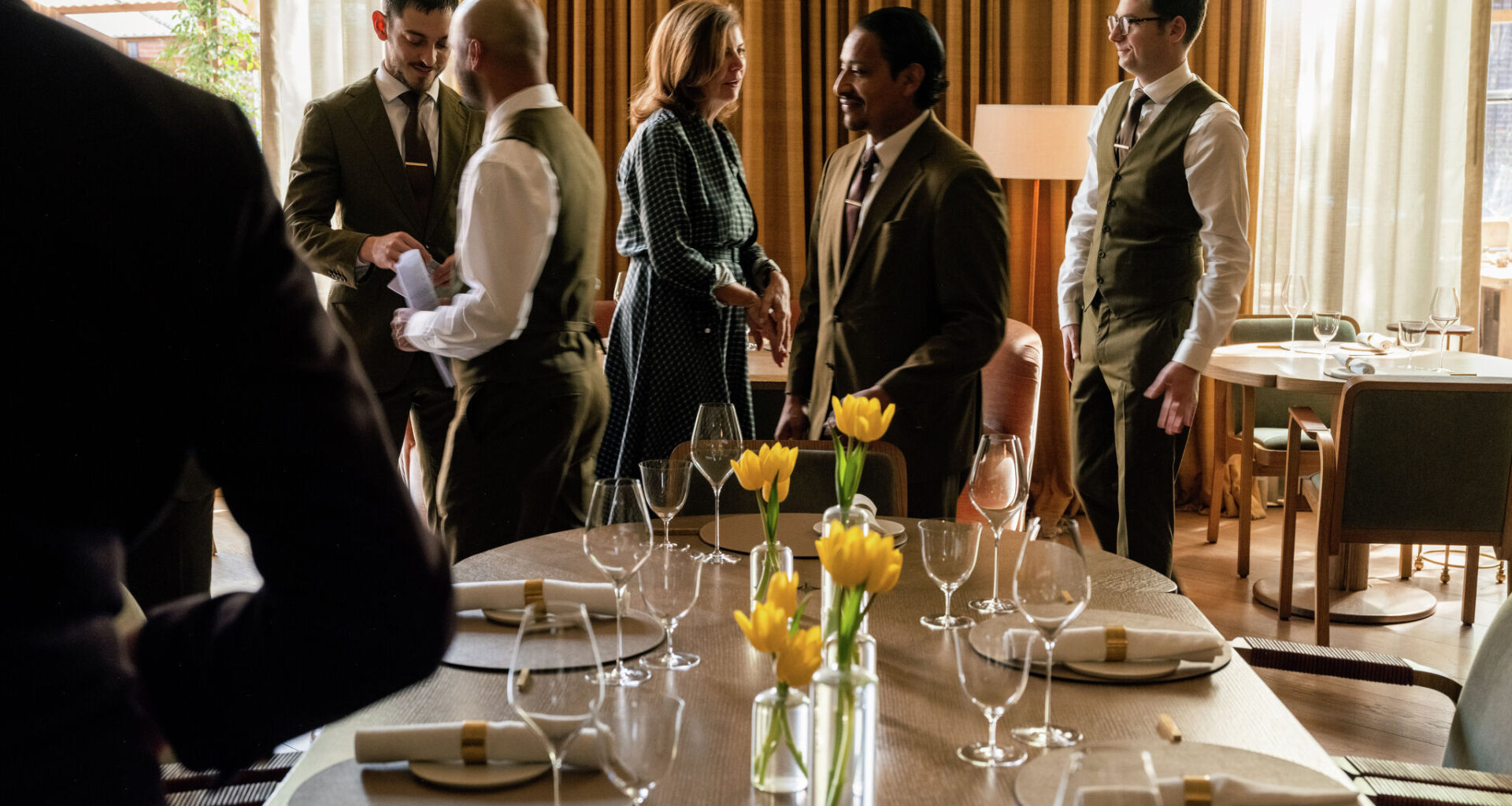
Lindsay Tusk (center) oversees the front of house for Quince, the three-Michelin-star restaurant she co-owns with her husband, the chef Michael Tusk.
KELSEY MCCLELLAN/For the S.F. Chronicle
Before each service, the team at Quince gathers to be briefed on guest preferences and allergies.
KELSEY MCCLELLAN/For the S.F. Chronicle
The service style at Quince is intentionally “conversational” rather than “presentational.” Staff are trained to engage in dialogue with customers, not to recite the menu or details about the wine. “We’ve all had that sommelier that can enjoy having an audience,” Lindsay Tusk said.
KELSEY MCCLELLAN/For the S.F. Chronicle
Fine dining at the Michelin-star level attracts a “small, select group (of workers) that have an understanding, a reverence” for the details involved in that kind of service, Lindsay Tusk said.
KELSEY MCCLELLAN/For the S.F. Chronicle
Lindsay Tusk attends the details of the restaurant’s plateware, fabrics and other details with same level of meticulousness that her husband, the chef Michael Tusk, applies to ingredients.
KELSEY MCCLELLAN/For the S.F. Chronicle
When I arrived for lunch at Quince in San Francisco last month, I was intimidated by the prospect of dining at a three-Michelin-star restaurant. But once I was seated, a waiter asked me about my weekend plans in a way that seemed so genuine it disarmed me. Staff members brought out our plates in choreographed fashion, yet without a level of precision that made me want to hold my breath. Small side tables held carafes of different shapes for sparkling versus still water, poured without fanfare. It wasn’t until afterward that I realized how frictionless the entire experience was. Rather than feeling out of place, as I had feared, I felt relaxed.
That’s all by design, said Lindsay Tusk, who oversees the front of the house for Quince and co-owns it with her husband, chef Michael Tusk. Tusk’s goal is to make the diners feel warm and welcome, while barely noticing the efforts that go into service.
“Service is what you do. Hospitality is how you make people feel,” Tusk said.
Article continues below this ad
Service staff are trained for at least three weeks before they’re allowed on the floor alone, and education continues with weekly sessions on the service of wine, cheese and nonalcoholic beverages.
KELSEY MCCLELLAN/For the S.F. Chronicle
The Chronicle’s restaurant critics highlighted those qualities when awarding Quince for Best Hospitality as part of the Chronicle’s 2026 Top 100 Restaurants. At Quince, “there was a certain friendliness or approachability that I think is missing at a lot of fancier places that can come across as formal and stuffy,” critic MacKenzie Chung Fegan said.
The personal atmosphere that Quince aims to create stems from its early days in a small former apothecary on Octavia Street, where it first opened 23 years ago, and when it was a more casual restaurant — with many regulars. A “conversational” rather than “presentational” style is emphasized in employee training; staff are instructed to engage in a dialogue with diners, not performatively sound off about food or wine details. “We’ve all had that sommelier that can enjoy having an audience,” Tusk said.
San Francisco Chronicle Logo
Make us a Preferred Source to get more of our news when you search.
Add Preferred Source
Quince moved to its current location in Jackson Square in 2009 and acquired three Michelin stars in 2017; it’s now one of five restaurants in the Bay Area and eight in California with Michelin’s highest rating. Despite the high cost of entry, with tasting menus that run between $280 and $390 at dinner, there are still regulars — including one person who lives in San Francisco part time and comes in every night he is in town. “Because it started as a neighborhood restaurant it’s never lost that kind of DNA,” Tusk said.
Article continues below this ad
“Lindsay (Tusk, left) is a wonderful host,” said Quince general manager Davide Franco (right). “I like the way she keeps everything aligned with the style of the restaurant and what the chef is doing.”
KELSEY MCCLELLAN/For the S.F. Chronicle
The Tusks also own the more casual Cal-Italian restaurant Cotogna next door to Quince and nearby wine bar Verjus; all three restaurants made this year’s Top 100 Restaurants. They plan to open a café called Bar Coto in the fall.
Tusk got her start in hospitality as a restaurant hostess in high school. “I loved restaurants,” she said. “I enjoyed being around people, and I enjoyed the energy of the dining room.”
While getting a master’s degree at UC Berkeley, she bussed tables at Chez Panisse. That’s where she met Michael, and after a few other jobs — including as a manager at Boulevard in San Francisco and stints together on the East Coast, then back in California — they decided to go into business together.
At Quince, the “sequence of smallish rooms and lush upholstery feels so much to me like dining in a home — a home owned by a very rich person with great taste,” MacKenzie Chung Fegan, the Chronicle restaurant’s critic, said. “The hospitality is part of that.”
KELSEY MCCLELLAN/For the S.F. Chronicle
Just as Tusk’s husband obsessively seeks out ingredients, sending staff to a Santa Barbara farmers’ market for produce in advance of the Bay Area spring season, she meticulously sees to the furniture, the fabrics, glassware and plateware, and arranges some of the floral bouquets along with Momo Mossavar of La Lavande. Tusk has gotten so many questions about the origin of the restaurant’s ceramics and steak knives that she created a web store to sell them.
Article continues below this ad
Following a 2023 remodel, diners now enter the restaurant through a foyer with potted plants that change with the season, such as blossoming orange and lemon trees that emit a honied jasmine scent in spring. The dining room is full of vintage furniture the Tusks have collected in their travels, while silk drapes Tusk selected diffuse the sunlight, adding a golden glow to the earth-toned decor. The overall effect is that eating at Quince “feels so much to me like dining in a home — a home owned by a very rich person with great taste,” Chung Fegan said. “The hospitality is part of that.“
Tusk compares having all of the parts of service organized to the kitchen’s mise en place. “You know that glass is going to get set correctly, you know the wine that goes with that dish is going to be poured,” she said, “and it allows you to focus on the guest and not so much what’s happening right here on the table.”
The plants in the entryway of Quince change seasonally. For spring, they include blossoming orange and lemon trees that give off a honied jasmine scent.
KELSEY MCCLELLAN/For the S.F. Chronicle
Tusk has maintained a database on the likes and dislikes of its customers since the restaurant opened in 2003. During training — which lasts for three weeks before new service employees are allowed on the floor on their own — staff are taught to read diners’ body language to see if they look “comfortable and self-assured at the table,” Tusk said. If not, she said, “You always think, ‘OK, how can I assist?’” That might be telling a joke to break the tension, or making sure that a diner hosting a business client looks really good.
After my lunch, I walked through the foyer and its citrus trees once more and was handed a to-go cup of herbal tea, scented with turmeric and lemon so that the restaurant’s fragrances stayed with me all the way home.
Article continues below this ad
The experience of eating the food itself will be fleeting, no matter how well-executed lunch or dinner is, Tusk said. But, “if they have a memory of a meal where it was joyous and they had a sense of wellbeing and they were well cared for,” she said, “That is hospitality.”