
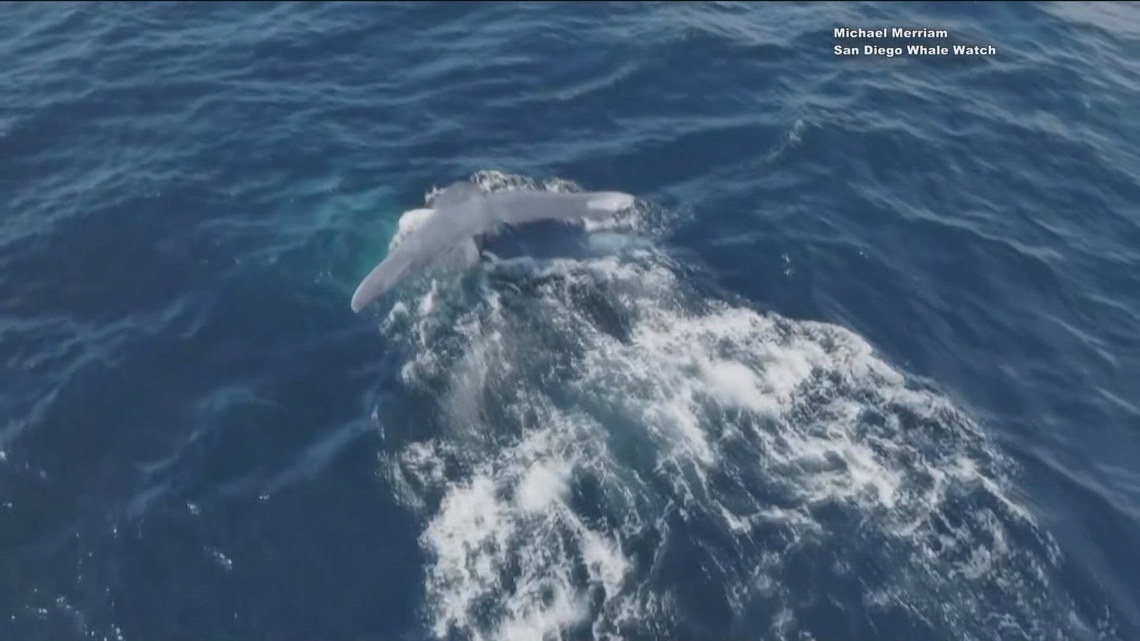
Blue whale season typically begins in early summer but San Diego Whale Watch witnessed the first sighting in April.
SAN DIEGO — A blue whale spotted seven miles southwest of Point Loma Monday marks an unusually early arrival for the species.
San Diego Whale Watch captured the whale on video during a field trip carrying 70 middle school students aboard the Privateer. Captain Michael Merriam, who piloted the vessel, witnessed the remarkable encounter.
“It’s always incredible seeing the first blue whale. You think about the blue whales all year long, until the next season, and you could easily forget the massive size that they are. As soon as they pop up next to your boat or even see it in the distance,” said Capt. Merriam.
“We saw a tail from two miles away, and we knew immediately that it was a blue whale,” he added.
Upwelling creates ideal feeding conditions in the sighting area. Nutrient-rich currents rise from the ocean depths to the surface through this natural process, generating an abundant food supply for marine life. The whale traveled at approximately 5 knots, likely heading toward areas with substantial food sources.
Blue whales feed primarily on krill, tiny crustaceans that have already begun booming in population this year. The increased krill availability has drawn fin whales and now, sooner than expected, blue whales to the region.
“Blue whales actually very light gray in color, but when they’re at the subsurface of greenish bluish water, they glow this beautiful turquoise blue. So often times you can actually point out a whale before it even surfaces,” said Capt. Merriam. “[A] 90 foot long animal just glowing turquoise under the water that, in itself, is so cool to see, and passengers definitely have really nice reactions when they do. We’re so happy we’re able to show that to people.”
The blue whale season typically does not begin until late spring or early summer, making this early arrival noteworthy. Scientists are monitoring the development closely. Earlier krill blooms and changes in ocean conditions could indicate a broader environmental shift, though research into the phenomenon remains ongoing.