
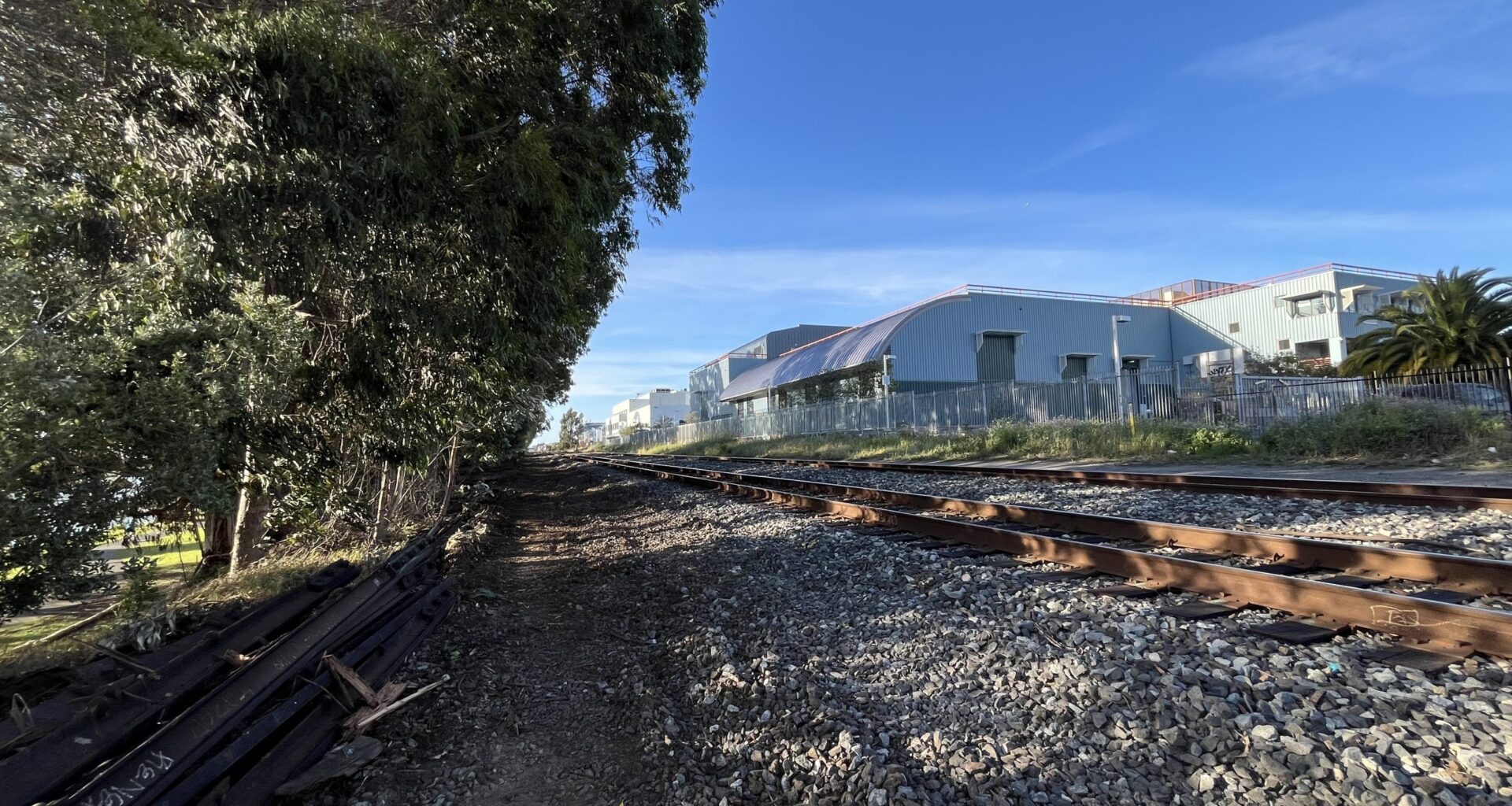
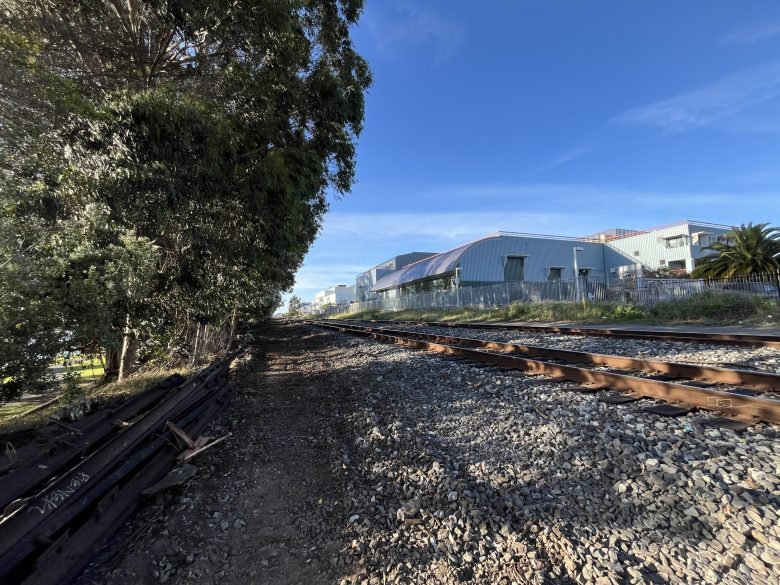
 The revival of a dormant railroad track abutting West Berkeley’s Aquatic Park will help Union Pacific maintain train capacity during the rebuilding of an aging 90-year-old train overpass above 7th Street in Oakland, a main road in and out of the port. Credit: Kate Darby Rauch for Berkeleyside
Correction: A previous version of this story, and its headline, misstated the number of trees that will need to be removed. While the 400 trees and 600 understory plants will be replanted near Aquatic Park, the city says the number being removed is “far less” but couldn’t say how many.
A swath of thick brush and tall trees along railroad tracks at the eastern edge of Berkeley’s Aquatic Park will soon be cleared as one small part of a major county project to improve truck and car access to the Port of Oakland, about four miles to the south.
The dense vegetation slated for cutting, including a number of trees, buffers the park from the busy Union Pacific tracks, a key north-south route for freight and Amtrak, and lies entirely on railway property, covering a steep slope down from the tracks to the park.
The area will be replanted with 400 large trees and 600 understory plants, with the city taking the lead, according to Scott Ferris, Berkeley’s parks director. Three baskets in the park’s 18-hole disc golf course will also be relocated. Ferris said that, in a flurry of recent negotiations with Union Pacific, aspects of the project are still getting clarified, including the exact start date and area for the cutting.
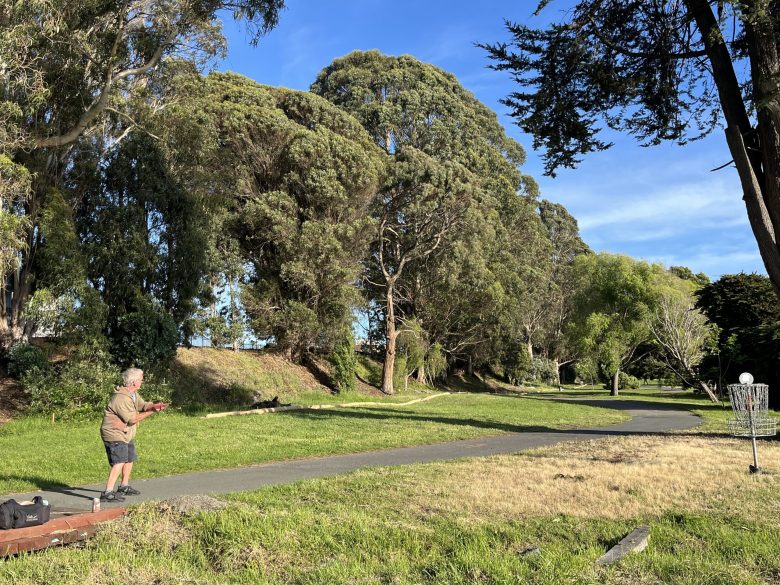 The raised berm on the eastern edge of Aquatic Park will be expanded, necessitating the uprooting of a number of trees. Credit: Kate Darby Rauch for Berkeleyside
The Berkeley section of work, taking place along approximately .17 of a mile of railroad roughly from Bancroft Way to the Emeryville border, involves restoring a dormant set of tracks built as a side (or in railway terms “drill”) track off the two main lines to allow space for car train reorganization, or shuffling, without interfering with main traffic.
Bringing the dormant drill track back to use will help Union Pacific maintain train capacity during the rebuilding of an aging 90-year-old train overpass above 7th Street in Oakland, a main road in and out of the port, according to the Alameda County Transportation Authority. The roadway under the overpass will be widened vertically and horizontally to enhance truck and car passage. A bike and walking pathway will also be added that connects to the West Oakland waterfront.
This is one element of a complex multi-year transportation authority project, already underway, aimed at improving port access for all modes of travel, called GoPort.
The Berkeley work involves expanding and bolstering the berm, or elevated, strip, supporting the train corridor westward toward Aquatic Park — an area now thick with vegetation, including several tall Eucalyptus trees.
The raised rail right-of-way will be closer to the park, but active train lines won’t, said Remy Goldsmith, assistant director of government affairs for the transportation authority.
Berkeleyside has asked the transportation authority and Union Pacific several times for details on how the Berkeley restoration helps train capacity when the 7th Street overpass is closed, and if the line will stay open once it’s opened up again, and hasn’t heard back. We’ll update the story if we learn more.
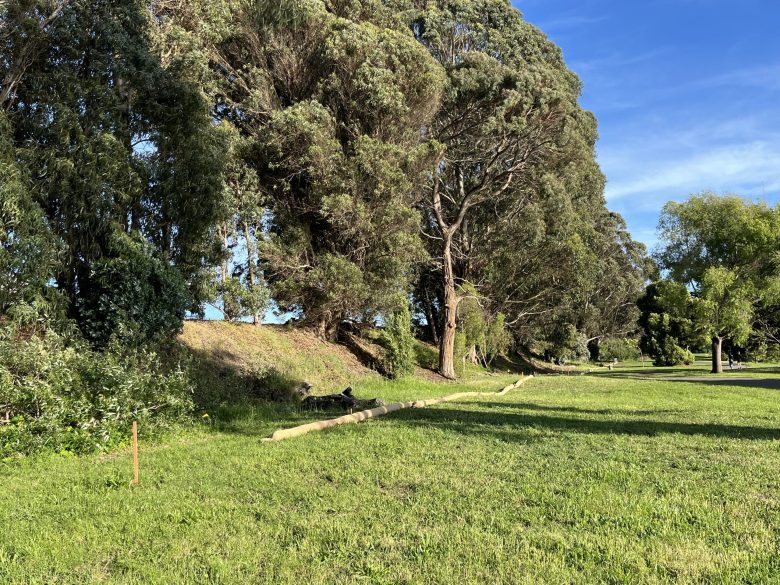 Orange markers in Aquatic Park delineate the boundary of city-owned land. Credit: Kate Darby Rauch for Berkeleyside
The full project, which has received all required permits and approvals, is slated for completion in around 2029. Berkeley’s section should be done at the end of summer.
Access to the port will continue during the multi-year project for all modes of transit — vehicles, trains, pedestrians and bikes using modified routes.
The transportation authority will cover the cost of replanting, irrigation and moving disc golf baskets — a total of about $200,000, Ferris said.
Paul Buddenhagen, Berkeley’s city manager, called the removal of trees and vegetation unfortunate in a memo to the City Council earlier this month.
“The western most portion of UPRR property is a part of what traditionally has been viewed as part of Aquatic Park and the [project] will have visual and structural impacts to users of the park,” he wrote.
Berkeley officials said they were a little surprised by the start date of the railroad berm work and vegetation removal, noting they hadn’t heard much about the project for a couple of years, when the last community meetings were held. “From my perspective, I don’t think there was a whole lot of public process that I was aware of,” said Ferris. “They were focused on the 7th Street process, and not on the area of Berkeley,” he said.
Once the city was notified that work would start in April and involve significant vegetation removal, Buddenhagen informed the City Council on April 6 and, with Ferris, shared the update with Berkeley’s Parks Recreation and Waterfront Commission, setting off alarm among some park advocates.
Toni Mester, a West Berkeley resident long involved with Aquatic Park, said her primary concerns are “the loss of the trees, the visual impact, the interruption of park use.” She also bemoaned the need to relocate the disc golf baskets.
The nonprofit youth job development organization, Waterside Workshops, located at Aquatic Park not far from the railroad, may oversee the replanting work as a training opportunity for young people. The nonprofit, with city support, is applying for a community benefit grant from Union Pacific to help fund the concept. Typical awards are $5,000 to $30,000, with decisions made by August.
Related stories
Man, woman found dead Sunday in Berkeley’s Aquatic Park
April 23, 2026April 28, 2026, 4:01 p.m.
Berkeley’s Waterside Workshops reduces staff, cuts bike shop hours as funding dips
November 17, 2025Nov. 17, 2025, 10:55 a.m.
Berkeley gets $4M to help clean Aquatic Park’s polluted lagoon and stop I-80 from collapsing
April 7, 2025April 7, 2025, 4:45 p.m.
“*” indicates required fields