
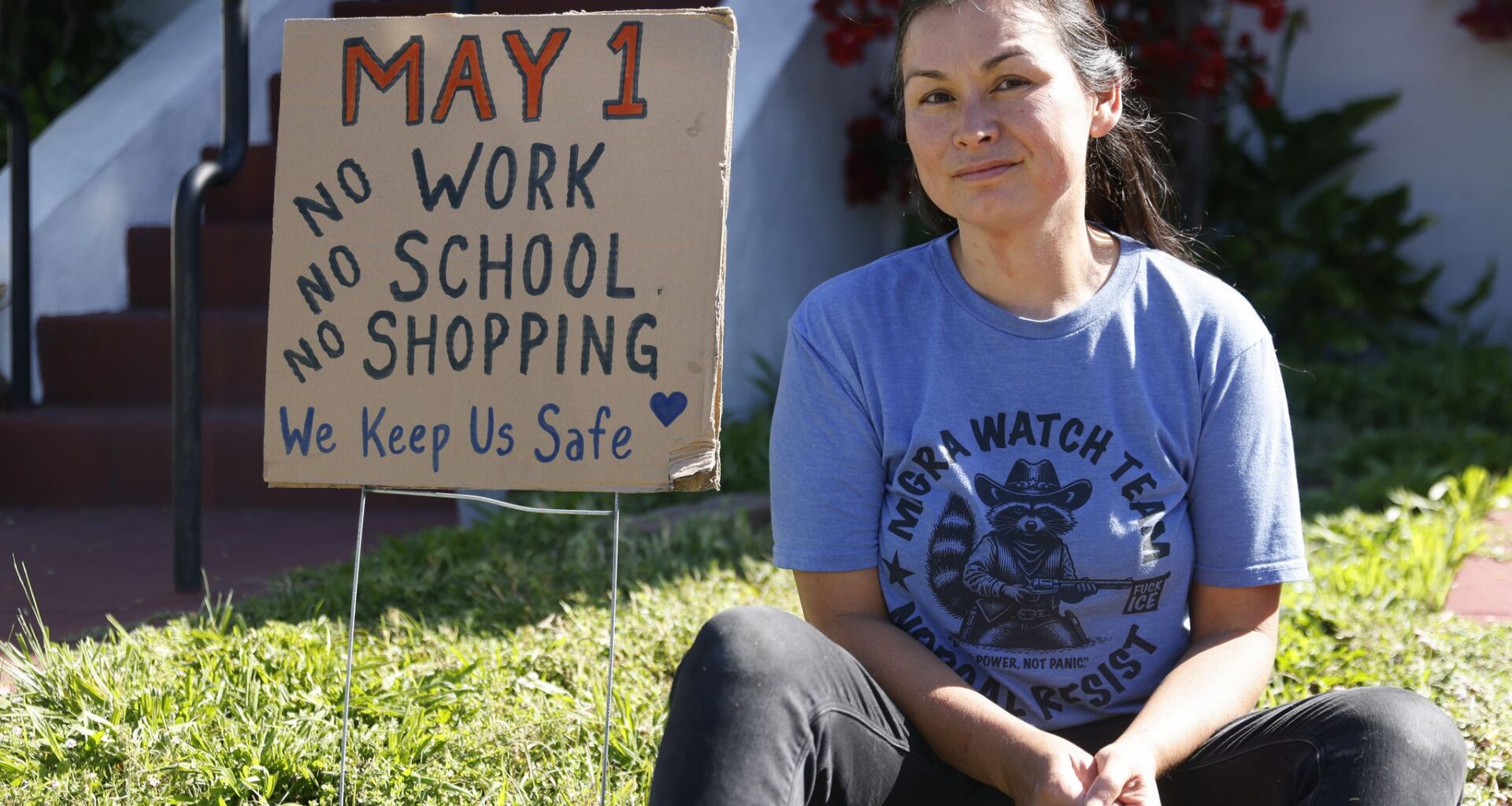
Sakura Saunders is a co-facilitator of the MaxPod in East Oakland, which has roughly 40 members and has been doing neighborhood-level activism since President Donald Trump’s return to office in January 2025.
Jessica Christian/S.F. Chronicle
On a Saturday in June, Sakura Saunders and her neighbors met outside a dingy office building in San Francisco’s South of Market and dared it to open.
A day prior, immigrant families in the area had received unusual text messages summoning them to 478 Tehama St. — the headquarters for Cypress Private Security, which reportedly works with Immigration and Customs Enforcement and whose parent company has booked billions in security contracts with ICE’s parent entity, the Department of Homeland Security.
Suspecting an ICE trap, progressive coalition Bay Resistance called on a network that has ballooned with volunteers since President Donald Trump’s reelection. Around 7 a.m., hours before that day’s No Kings protests, about 200 people picketed the building and made legal referrals to the roughly two dozen immigrants who answered the texts. The office didn’t open.
Article continues below this ad
“We basically shut it down,” said Saunders, an Oakland mother of two and veteran activist who belongs to one of a growing number of neighborhood watch-style groups aimed directly at the Trump administration.
Or, as Bay Resistance organizing director Jane Martin put it, “You can’t implement fascism when everyone comes out and watches.”
Bay Resistance, an umbrella organization for some 190 neighborhood-level resistance groups around the Bay Area, called on its network to disrupt a feared immigration enforcement operation in June 2025, when immigrant families received unusual text messages to show up to an office building in San Francisco.
Manuel Orbegozo/For the S.F. Chronicle
Rapid response teams. Community defense networks. Neighborhood action pods. Whatever they call themselves, these friendly neighborhood resistance cells have grown in number and confidence since the winter, when they drove out the federal platoons that outnumbered and outgunned them in Minneapolis. With whistles and smartphones, ordinary residents disrupted enforcement operations and documented the killings of Renee Good and Alex Pretti, turning public sentiment and spurring the dismissals of Border Patrol leader Greg Bovino and Homeland Security Secretary Kristi Noem.
San Francisco Chronicle Logo
Make us a Preferred Source to get more of our news when you search.
Add Preferred Source
While the Trump administration has paused high-profile raids in blue cities, community defense organizers say they are under no illusions that they’ve won.
Article continues below this ad
In recent online training sessions, organizers urged volunteers across the U.S. to remain on high alert for immigration enforcement incursions, and recommended using the Freedom of Information Act to uncover proposed detention expansions, law enforcement agreements and contracts with private surveillance companies. Despite the lopsided odds — the federal government’s largest police force vs. part-time activists and multitasking parents — a cautious optimism has taken hold.
“We can win this fight,” Jill Garvey, the Chicago-based co-director of States at the Core, which trains front-line groups, said at an April 15 webinar. “I wouldn’t have said that a year and a half ago.”
The first year of Trump 2.0 was dominated by a narrative of institutional capitulation — by Congress, Big Tech, big law firms, elite universities and media conglomerates. Grassroots resistance, manifested in record-size protests, was often dismissed as symbolic. On the eve of the “Workers Over Billionaires” protest on Friday, May 1, when organizers hope a wide swath of Americans participate in a nationwide strike and boycott, the narrative is shifting.
Since the November 2024 election, STAC has trained more than 40,000 people across the U.S., Garvey said; 190 neighborhood action pods have formed in six Bay Area counties, Martin said: Alameda, Contra Costa, Marin, San Francisco, San Mateo and Santa Clara. Twenty-five came online in just the past month. While Martin can’t confirm the number of members, she said 8,000 people signed up to join the pods through Bay Resistance and estimated that 3,000 to 5,000 are active.
Movement leaders say they are building something they expect to outlast the current tempest. They describe it as a block-by-block public power infrastructure informed by labor organizing tactics, committed to nonviolence, animated by local priorities and sustained by in-person relationships.
Article continues below this ad
“They have an authoritarian playbook,” Martin said, referring to the Trump administration’s embrace of Project 2025, “but the movement has a playbook, too.”
‘Power in cooperation’
In some ways, it began with a prayer.
On Nov. 16, 2024, progressive coalitions Bay Resistance, California Calls and the Million Voters Project held an open strategy meeting inside a 100-year-old Oakland church with a busted boiler. Hundreds of people attended, including Saunders, whose family had recently moved back after more than a dozen years in Canada.
“I saw a bunch of people that I knew,” Saunders said.
Article continues below this ad
Those who wanted to do more than commiserate about the election were organized into neighborhood-level teams. Saunders joined MaxPod, named for the hilly Maxwell Park neighborhood in East Oakland. She quickly noticed that many members had prior activism experience, like her.
In 2007, Saunders was working for the elbow-swinging Oakland muckraker CorpWatch when a report she wrote about Barrick Gold, the Canadian mining giant, blossomed into “a big passion project of mine,” she said. Saunders traveled to Toronto to organize against Barrick, quit her job, took one in Philadelphia “just so that I could be close enough to Canada to bother” Barrick and eventually made the move with her family up north, where Saunders organized campaigns in countries pitted by Barrick’s open mining operations.
Following stints in Ontario and Nova Scotia, the family returned to Oakland in August 2024. When one of MaxPod’s leaders had to step back, Saunders, whose husband is a labor organizer, became a co-facilitator.
“I’m not one of those people at a protest saying I would be at brunch if Kamala (Harris) was elected,” she said. “I definitely see a need beyond the immediate need for these networks to exist.”
At MaxPod’s first meeting in January 2025, members united around a goal of fighting fascism, then spent the next few months deciding what forms that fight should take.
Article continues below this ad
Building consensus and setting clear goals are good strategies, say movement organizers.
“We can’t compete with the state’s force,” Gabe Gonzalez, who founded the Chicago-area Protect Rogers Park neighborhood defense group in 2017, said in a March 18 training webinar. “We have power in cooperation.”
After the gradual start, MaxPod members have conducted ICE patrols at local schools and sites frequented by day laborers, supported local resolutions opposing the Trump administration’s rumored plan to turn the Dublin Federal Correctional Institution into an immigrant detention center and raised donations for various mutual aid funds as well as a family in Gaza.
When ICE started arresting people from immigration courthouses last year, MaxPod’s members joined an effort at the Concord Immigration Court, accompanying immigrants to their hearings, documenting what happened and rallying outside. More recently, on Feb. 7, Saunders said about 400 people attended MaxPod’s “Love Your Neighbor” party at Allendale Park, an effort to train more Oakland residents to report ICE sightings.
“It can be incredibly awkward to knock on someone’s door and want to start a political conversation,” Saunders said. “But it’s a lot easier to knock on someone’s door and invite them to a party.”
MaxPod officially has 43 members, though eight to 15 attend most meetings, Saunders said. When interest has swelled beyond the pod’s ability to accommodate it, like when the U.S. Coast Guard base in Alameda saw an influx of federal troops in October or amid conflicting reports of a Super Bowl ICE surge around Santa Clara, Saunders and her co-facilitator have helped establish new pods.
Meetings occur at members’ homes, typically over potluck dishes and with children running about. There are formal agendas and informal bonding, another best-practice hallmark of the suburban activist model under Trump 2.0, leaders say.
Around the region, resistance groups have been involved in other campaigns, lobbying leaders in Alameda County, San Francisco and Oakland to prohibit ICE from using local government property; opposing ICE detention takeovers of Alcatraz Island and Travis Air Force Base; organizing boycotts of Target and Home Depot; pressuring PG&E to end its contract with surveillance giant Palantir; and pushing Santa Cruz and other California cities to cancel contracts with Flock, the Atlanta-based surveillance company whose license-plate scanning technology is used by more than 5,000 policing agencies and stored in databases accessible by federal authorities.
“ICE can’t function without contractors,” Martin said, echoing a sentiment shared by other advocates.
Jane Martin, organizing director for Bay Resistance, speaks about mass resistance during an October training event at Oakland Technical High School.
Bryan Banducci/For the S.F. Chronicle
A number of groups also run regular street patrols at their kids’ schools and areas where immigrant residents might feel scared to walk alone. Maria Moreno, campaign director for workers rights group Jobs with Justice SF, has been involved in training hundreds of Bay Area residents to do this work.
“Things haven’t been super horrible so far. We’ve been lucky,” she said. “Having shifts that are quiet is what we want. We don’t want ICE in our communities abducting people.”
‘After the storms’
There aren’t many precedents for this strain of civil resistance, say scholars on authoritarianism.
According to the Varieties of Democracy Institute at Sweden’s University of Gothenburg, the United States in 2025 experienced its biggest democratic backslide in the country’s history, dating all the way back to 1789. The authoritative tilt was so pronounced, V-Dem concluded in its annual assessment, that the U.S. almost single-handedly dragged the global democracy score to 1978 levels.
Freedom House, another organization that measures global democratic trends, also found the U.S. to be in decline, due to “increasingly extreme assertions of executive authority,” weakening anti-corruption safeguards, and eroding legal protections for immigrants and minorities.
Lawrence Rosenthal, chair of UC Berkeley’s Center for Right-Wing Studies, warned that the U.S. is walking a similar road as pre-Nazi Germany, with some important caveats. He stressed that Germany had only 15 years of representative democracy before the Weimar Republic gave way to Adolf Hitler. And once that happened, there was essentially no internal resistance.
Here, Rosenthal said, Trump can’t even keep Jimmy Kimmel off the air.
“The U.S. for all its blemishes and shortcomings has had 250 years of liberal democracy,” he said. “The climb to undo that is much more steep.”
Counterintuitively, the increasing willingness of everyday Americans to gather in one another’s homes and plot against the government may embolden institutions with far more resources to do the same. During the March 24 session of “The Breakdown,” a webinar series they co-host, Harvard Kennedy School professor Erica Chenoweth said that Congress and courts take their cues from the public.
“Large-scale shows of discontent and resistance are very important during backsliding episodes,” said Chenoweth, a scholar of political violence and civil resistance. “The movement is the foundation of the other two institutional domains in which pro-democracy gains can be made.”
In an era of increasing economic inequality and resurgent inflation, the work-life-resistance balance isn’t a light lift, Moreno acknowledged.
“I’m just doing my best. If there’s a time for me to throw myself at my work, that time is now,” she said. “Oh, and I got a pet”: a 7-month-old kitten named Melocoton, Spanish for “peach.”
Saunders doesn’t expect her pod’s neighborhood patrols to stay uneventful. She talks about a time “after the storms have passed,” but thinks the real storm is still approaching.
“The attitude of a lot of people is that it hasn’t hit as hard as it’s going to hit, and we’re prepared for it,” she said. “And between now and then, we’re building stronger communities.”