
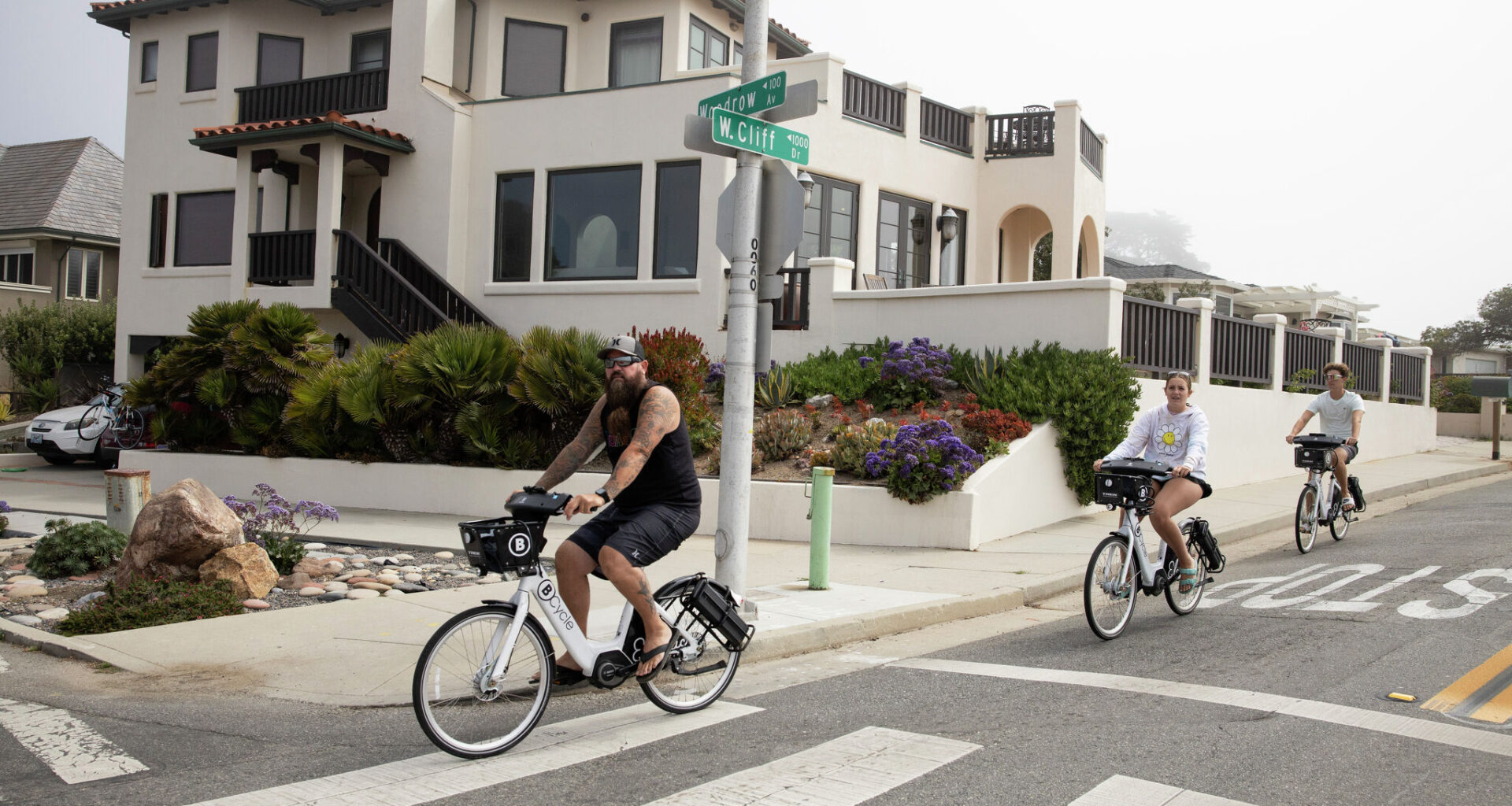
Cyclists ride e-bikes in 2023 along West Cliff Drive in Santa Cruz. The rising popularity of e-bikes and scrutiny of their safety are prompting calls for additional regulation in California.
Laura Morton/For the S.F. Chronicle
As I write this, I’ve just finished a 25-mile electric bike ride. My 60-pound e-bike used about 15 cents’ worth of electricity, and I barely broke a sweat. This has been my primary means of transportation for more than five years. My recent ride imposed low environmental costs, was nearly risk-free to anyone else and occupied a mere sliver of road.
Because e-bikes fall into a convoluted mix of transportation policies, they remain contentious and unable to fulfill their potential. In the U.S., we have treated small, powered two-wheelers as recreational devices for far too long, and just as e-bikes are proving their value as real transportation, lawmakers in Sacramento are moving to make them slower and weaker.
At the same time, four-wheeled vehicles are becoming ludicrously heavy and fast. The growing presence of 3-ton, 700-horsepower vehicles that may have a stuck throttle or a loose 90-pound wheel should terrify every other road user. Our concrete barriers, guardrails, crumple zones, airbags and helmets are simply inadequate to cushion the enormous amount of energy these vehicles can impose on their surroundings when something goes wrong.
Article continues below this ad
By contrast, the overwhelming majority of e-bike injuries are suffered by riders themselves. It’s insane that the 60-pound e-bike is usually separated from vehicles 100 times heavier and 1,000 times more powerful by nothing more than paint — yet it’s the e-bike that requires the speed and power limiter.
In addition, bicycle lanes in the U.S. often end abruptly or are littered with debris, forcing cyclists awkwardly into mixed vehicle traffic, and an e-bike capable of quick acceleration is often the best way to stay out of harm’s way when traffic is moving. Today’s high-powered e-bikes are simultaneously illegal, hard to identify and difficult to catch. But making these vehicles illegal altogether means that e-bike commuters, merely acting in self-preservation, can find themselves treated like hooligans.
San Francisco Chronicle Logo
Make us a Preferred Source to get more of our news when you search.
Add Preferred Source
At the federal level, electric bikes with motors under 750 watts that can travel 20 mph are unambiguously regulated as bicycles by the Consumer Product Safety Commission, but above 20 mph or 750 watts, it is not as clear. Most states regulate e-bikes according to a three-tiered system that restricts their speed and acceleration, while the National Highway Traffic Safety Administration interprets Federal Motor Vehicle Safety Standard language on moderately powered two wheelers rather interestingly: If a motorcycle or motor-driven cycle (defined as having up to 5 horsepower, or ~3,700 watts) is capable of a top speed of 20 mph or greater and is equipped with components (such as lights, mirrors, and turn signals) that are needed for on-road use, NHTSA will regard it as having been primarily manufactured for such purposes.
This language seems to create the incentive to omit safety equipment — which is precisely what’s happened. To include the equipment would immediately classify high-power e-bikes as motor-driven cycles designed for on-road use and saddle the buyer with significant licensing and insurance requirements.
Article continues below this ad
A cottage industry of 750-watt to 3,500-watt (e.g. just under 5 horsepower) electrified two-wheelers now exists. And because of the National Highway Traffic Safety Administration’s existing definitions, they are often sold without lights, mirrors or turn signals. These vehicles are capable of traveling much faster than 20 mph, but for now, they face no additional requirements from the Consumer Product Safety Commission, either.
I happily add my name to a growing chorus of transportation experts who are also enthusiastic advocates for the role of e-bikes in the transportation ecosystem. These small, capable two-wheeled electric vehicles are a rare “have our cake and eat it too” solution: They’re incredibly convenient for point-to-point travel and a powerful tool to address the climate, accessibility, congestion and public health problems.
For now, California legislators are debating legislation that would only restrict e-bikes further. What’s more, Assembly Member Diane Papan, D- San Mateo, the sponsor of that bill, is proposing age limits on Class 1 and Class 2 e-bikes, even as residents in her district want a greater focus on pedestrian safety at a dangerous intersection. Papan’s bill will lead to more kids facing unnecessary police interactions and more costs for people just trying to find a way to get around.
Guest opinions in Open Forum and Insight are produced by writers with expertise, personal experience or original insights on a subject of interest to our readers. Their views do not necessarily reflect the opinion of The Chronicle editorial board, which is committed to providing a diversity of ideas to our readership.
Read more about our transparency and ethics policies
Treating e-bikes as transportation means finding a better place for them in safety standards, travel lanes and licensing schemes. They should also be readily identifiable to law enforcement, and riding them at high speed near pedestrians or casual cyclists should be prohibited.
Article continues below this ad
While cars and trucks continue to get bigger and more powerful, those outside them are being killed at nearly record-high rates. We need to take a new approach to break this cycle of escalation. It starts by making sure that the most efficient vehicles on the road can also be affordable, safe and convenient — and they don’t have to stop being fun, either.
Stephen Zoepf has spent 20 years working in mobility and policy at MIT, Stanford and the Department of Transportation. He is CEO of DZCO.tech, a startup designing new user interfaces.