
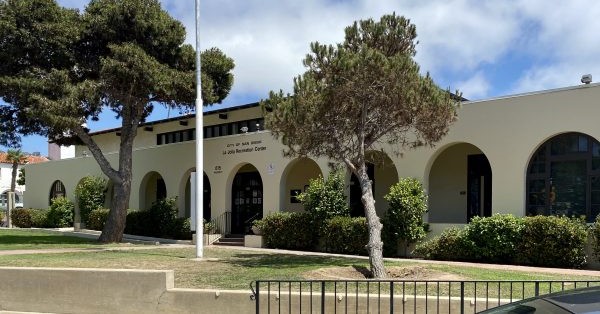
With San Diego Mayor Todd Gloria proposing city budget cuts that in some scenarios could result in reduced hours at La Jolla’s library branch and full closure of the Recreation Center, some community residents pushed back this week against the mayor’s notion that those local facilities are among the least needed in the city.
A new 40-page analysis that Gloria issued April 27 does not recommend specific cuts and must be reviewed by the City Council before any of the measures could take effect. The council’s budget committee is scheduled to discuss the proposed cuts next week.
The analysis ranks each of the city’s 37 library branches and 56 recreation centers based on what the report considers its importance to the nearby community and uses those rankings to provide the City Council with possible scenarios.
The rankings put the La Jolla/Riford Library at 7555 Draper Ave. at the top of the list of least-needed branches in the city while placing the La Jolla Recreation Center at 615 Prospect St. third on the list of least-needed rec centers.
Thus, La Jolla’s rec center — which opened in 1915 and was originally commissioned by renowned La Jolla philanthropist Ellen Browning Scripps and designed by famed architect Irving Gill — is one of 16 around the city that would face possible closure in one proposal.
The La Jolla library would lose its Saturday hours (9:30 a.m. to 6 p.m.) to help provide money to fully preserve existing hours at three branches in low-income areas: Malcolm X in council District 4, San Ysidro in District 8 and City Heights in District 9. Also as part of that, the Linda Vista branch would close on Mondays.
Bob Evans, former president of the La Jolla Parks & Beaches board, which meets at the library, expressed hope that there would be no reduced hours or closures.
“There are so many community groups — large and small — that rely on and use the two busy meeting rooms [at the library] on a daily basis,” Evans said. “Last year when library closures and [hour] reductions happened, there was much scrambling in trying to secure suitable meeting space.”
 The La Jolla Parks & Beaches group meets at the La Jolla/Riford Library. (Ashley Mackin-Solomon)
The Parks & Beaches board changed its monthly meetings at the library from Mondays to Tuesdays in anticipation of the branch closing on Mondays beginning last September, when more than half of San Diego’s library branches lost their Monday hours because of budget cuts. La Jolla was scheduled to be among them.
But the nonprofit Friends of the La Jolla Library stepped in to provide the money necessary to keep the branch open from 11:30 a.m. to 8 p.m. Mondays. The library did lose its Sunday hours beginning in July.
Friends Chairman Chris Hallman said last year that the funding commitment would last two fiscal cycles unless the city’s budget constraints eased.
“It is important to the Friends that anyone who wants access to the library receives it,” Hallman told the La Jolla Light. “Our library serves far more than just book lovers. Children, students and seniors all depend on our branch to hear stories, do homework, socialize, learn a new skill, appreciate art and music and find a bargain on a used book, among countless other things.”
Alan Dulgeroff, president of the La Jolla Community Recreation Group, the advisory board for the Recreation Center, said he plans to address council members during budget hearings about the “criticality of our Recreation Center.”
An emergency meeting of the CRG also is planned to share information and discuss options to keep the Rec Center open, he said. The building and grounds have for years been the subject of extensive renovation plans.
La Jolla resident Igor Grant wrote in a letter to the Light that the Recreation Center “is our only facility for kids and families to exercise, other than our beaches.”
He added that the possibility of cutting funding to the library and Rec Center should add fuel to ongoing efforts in La Jolla to separate from San Diego and form a new city.
Several other community leaders, as well as people using the library this week, did not respond to requests for comment or declined to be interviewed.
The rankings in the mayor’s analysis, compiled by the city’s Performance and Analytics Department, are based on a variety of factors, including the average income nearby, the variety of programs offered at the site, the crime rate and the site’s proximity to similar city facilities.
Other factors include proximity to child care options, the education level of nearby residents and the percentage of their income that is spent on transportation.
For libraries, branches that experienced the deepest cuts last spring are mostly spared in the mayor’s proposed scenarios. The only branch facing possible closure in any of the scenarios is North Clairemont.
For rec centers, the scenarios prioritize preserving hours at facilities that have gyms, also have a senior center and host events in the city’s “Parks After Dark” program for low-income neighborhoods.
For both libraries and rec centers, the mayor lays out three separate scenarios. Generally, two options strongly consider socioeconomic factors and the new rankings, while a third proposes cuts more evenly across the city.
In a memo to the council, Gloria’s aides say he has no preference for any of the proposed scenarios.
Each scenario would save $7.8 million from libraries and rec centers that the mayor says is needed to close a projected $146 million budget deficit the city is facing for the new fiscal year that begins July 1.
When he released his budget proposal April 15, Gloria said libraries and rec centers must suffer cuts so the city can avoid severe reductions in higher priorities such as public safety, infrastructure, transportation and homelessness programs.
The memo suggests the council, which is scheduled to begin its budget deliberations Monday, May 4, with a week of department-by-department public hearings, use the library and rec center scenarios as a menu of options.
“None of the options are preferred, and all three for each have adverse impacts on our communities,” the memo states. “As the budget process moves forward, the council may want to explore additional options, and we are ready to support that work.”
The memo was signed by Rania Amen, the city engineer and the mayor’s chief community officer, and Bethany Bezak, the mayor’s chief performance and logistics officer.
Gloria’s aides emphasized that the rankings are simply a tool for the council.
“The objective of the analysis is to provide key budget decision-makers with a tool to help analyze potential community impacts of reductions to library and recreation facilities, helping to support equitable decision-making and minimize disproportionate impacts across communities,” the memo states. ♦