
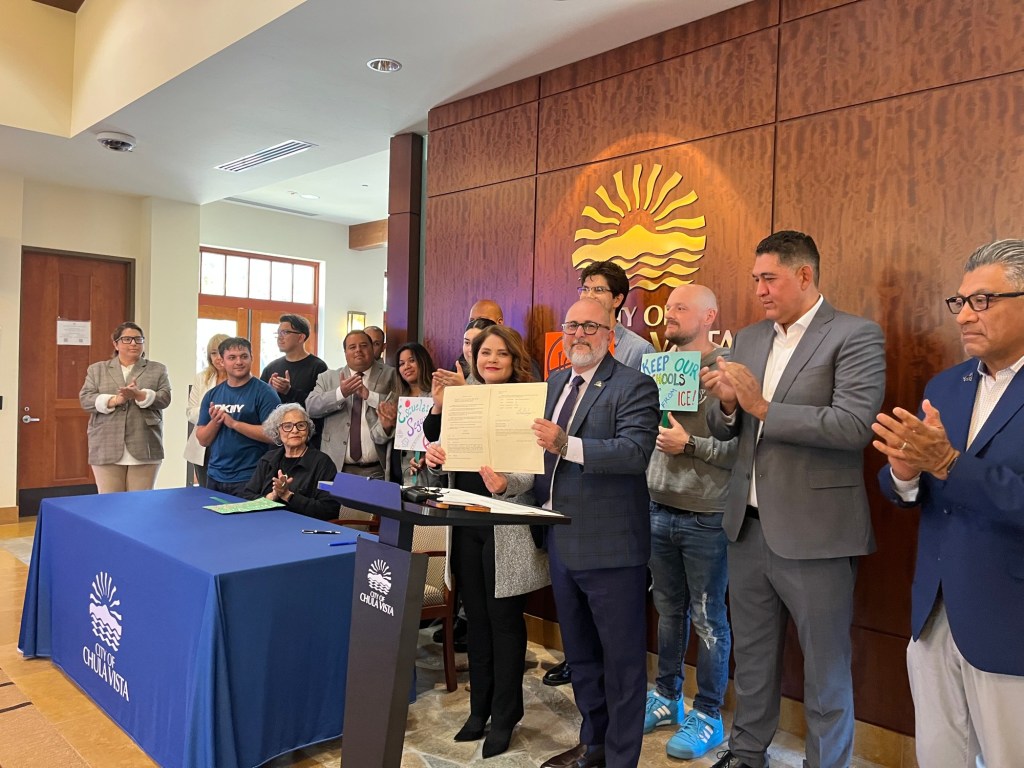
A Chula Vista ordinance restricting federal immigration enforcement personnel from accessing non-public city facilities without a judicial warrant or court order was signed into law this week — not by Mayor John McCann, but by Deputy Mayor Cesar Fernandez.
McCann, a Republican up for reelection in November, would ordinarily sign measures passed by the council. But citing his U.S. Navy Reserve service as a legal impediment, he declined to comment on, vote on or sign the ordinance. A review of the federal directive the Navy cited as governing guidance for military personnel raises questions about the legal basis for his recusal.
The measure, formally titled the Safe Neighbor Ordinance and signed into law on Monday, also prohibits the city from voluntarily sharing immigration status data or participating in joint operations involving immigration enforcement, and requires the city manager to submit semiannual reports to the City Council on law enforcement activity within city jurisdictions. The ordinance was passed 4-0 by the City Council on Mar. 17 and reinforces existing state law, particularly Senate Bill 54.
Fernandez, who signed the ordinance during a ceremony at Chula Vista City Hall, was direct about McCann’s absence.
“He declined to publicly affirm an ordinance that says our city facilities should not be used to support immigration enforcement in ways that create fear, violate rights, or undermine trust in local government,” Fernandez said. “He declined to stand up in this moment for the many residents in our city who are living with fear and uncertainty. And that matters and people deserve to hear that clearly.”
Fernandez said he was told last week by the City Clerk’s office that McCann would not sign the ordinance, adding that he’s had no contact with McCann over that period of time.
In a written response published Sunday as part of a separate report on candidates in the upcoming June mayoral primary, McCann said the resolution “was adopted while I was serving on active duty overseas with my U.S. Naval Reserve unit,” and did not directly address his refusal to sign the ordinance. He did not identify a specific legal statute or directive underlying his recusal, saying only that he would “always support a police force focused on one mission: preventing crime and protecting all residents from dangerous criminals, regardless of where those residents were born or what language they speak.”
McCann has not responded to multiple requests for comment regarding his recusal or his position on federal immigration enforcement.
When asked about the legal basis for McCann’s recusal, a U.S. Navy official referred questions back to McCann’s office, stating only that Department of Defense Directive 1344.10 is “the overarching guidance governing political activities for military personnel.”
A review of that directive shows it explicitly classifies the approval of municipal ordinances as nonpartisan political activity — a category the directive does not prohibit military members from engaging in.
The directive’s most stringent restrictions apply to active-duty military members and Reserve members called to active duty for more than 270 days. As a part-time Naval Reserve commander not serving under such orders, McCann would appear to fall outside those heightened restrictions — and under the directive’s own language, would be permitted to hold and exercise the functions of his elected office provided it does not interfere with his military duties.
McCann’s recusal has drawn scrutiny since November, when he first abstained from voting on a related resolution. At that meeting, Councilmember Michael Inzunza asked City Attorney Marco Verdugo directly whether McCann’s Naval Reserve service constituted a legal conflict.
“I am not aware of the mayor’s employment conflicting him out of this vote,” Verdugo said at the time, adding that under city municipal code, “an abstention without a qualifying reason is generally recorded as a vote in favor of an item.”
In an interview Monday following the signing, Verdugo backtracked his initial November statement, saying he does think McCann’s basis for recusal is “reasonable.” He added that he hadn’t yet analyzed the viability of McCann’s position at the time because he didn’t know the mayor was going to recuse himself.
Verdugo did not respond to follow-up questions seeking clarification on his analysis at this time.
The ordinance takes effect 30 days after final passage.