
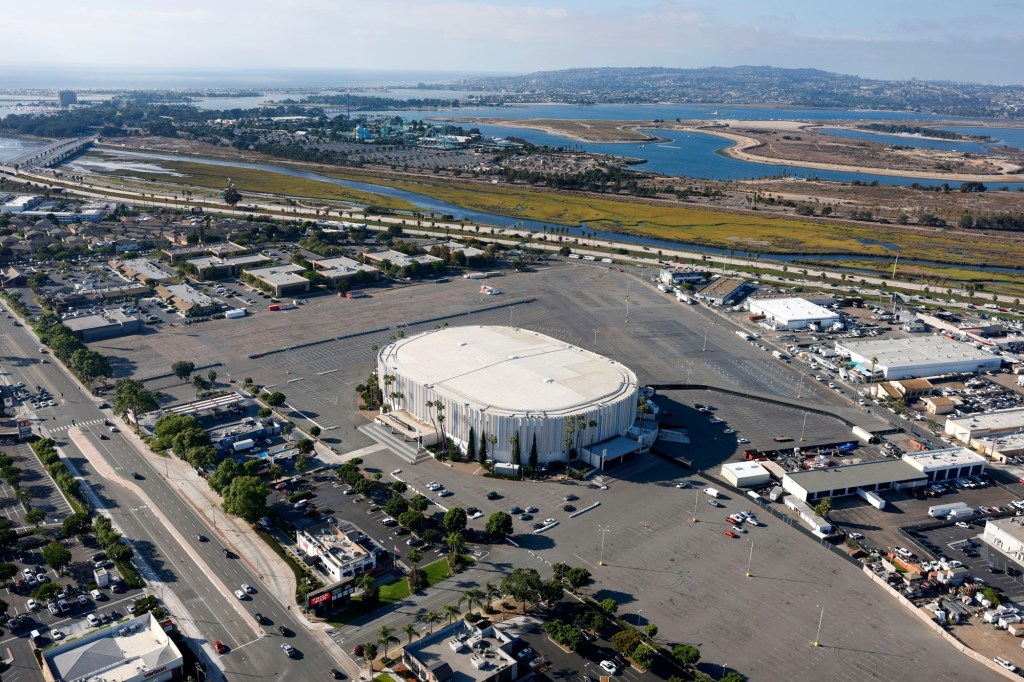
A bill working its way through the state Legislature centered on making the Midway Rising mega project possible is now more narrowly focused on rendering moot a court order that seems to prohibit the developer’s ability to erect buildings taller than 30 feet in San Diego’s Midway District.
In recent weeks, Senate Bill 958, authored by state Sen. Akilah Weber Pierson, D-La Mesa, was rewritten to block the designation of environmental impacts associated with increased building heights as significant for select projects under California’s Environmental Quality Act, or CEQA. Previously, the bill sought to provide blanket protection for the Midway Rising project from legal challenges linked to the state environmental law.
If signed into law, the bill, championed by San Diego Mayor Todd Gloria, would give Midway Rising a statutory override to the court-imposed height limit in the Midway District, making the project’s 165-foot-tall sports arena and 105-foot-tall residential buildings legally permissible.
The new language also means the law would apply to any infill development project proposed for a site that is more than 40 acres in size, has construction costs exceeding $100 million, has labor agreements in place and is subject to a certified environmental impact report.
“The bill is intended to provide clarity on how CEQA is applied and interpreted, particularly in response to court rulings with statewide implications. It was never meant to create a blanket exemption,” Weber Pierson said in an emailed statement. “As is common in the legislative process, initial language was introduced to meet procedural deadlines and later refined through amendments to reflect a broader, statewide focus rather than a single project. These updates ensure the bill remains aligned with its original purpose and continues to achieve its intended goal.”
The Midway Rising development team was selected in September 2022 to lease and redevelop the city of San Diego’s real estate at 3220, 3240, 3250 and 3500 Sports Arena Blvd. The team is composed of market-rate housing developer Zephyr, affordable housing builder Chelsea Investment Corp., and sports-and-entertainment venue operator Legends. The Kroenke Group, a subsidiary of billionaire Stan Kroenke’s real estate firm, is the entity’s lead investor and limited partner.
The development plan for the 49.2-acre property, or what’s known as the Midway Rising Specific Plan, calls for 4,254 total residential units, a 16,000-seat replacement arena, 130,000 square feet of commercial space, 8.1 acres of parks, and an additional 6.4 acres of plazas and public space. It memorializes the team’s commitment to build 2,000 residential units for households earning 80% or less of the area median income, or what’s considered affordable housing.
The specific plan was written to allow for buildings as tall as 250 feet, with the heights initially made possible by a 2022 voter-approved ballot measure that removed a long-standing, 30-foot height limit from the Midway District.
In October 2025, the height limit was ordered restored by California’s 4th District Court of Appeal. The appellate court determined that the city violated CEQA when it put the ballot measure in front of voters before sufficiently studying the environmental impacts of taller buildings in the environmental impact report prepared for the Midway-Pacific Highway Community Plan. An initial 2020 ballot measure was ruled illegal on similar grounds.
SB 958 now takes aim at the appellate court opinion, which was upheld by the state Supreme Court and set a binding precedent for CEQA case law.
“This bill would, for purposes of CEQA, prohibit the environmental impacts that are associated with increased building height alone from being considered significant impacts on the environment, if a project meets specified conditions,” the amended language states.
As such, the statute, as written, would not revive the dead ballot measures. Instead, it would make the environmental impacts associated with taller buildings legally irrelevant for projects like Midway Rising.
“SB 958 attempts to address the shortcomings of the (environmental impact report for the Midway District’s community plan) by deeming impacts related to building height not a significant effect on the environment, overturning the court’s decision,” Anton Favorini-Csorba, chief consultant for the Local Government Committee, wrote in his bill analysis.
The idea, at least as characterized by bill supporter Sen. Catherine Blakespear, D-Encinitas, is to lessen the ramifications of what is perceived as an overly broad court order.
“Midway Rising is being held back right now by a court ruling that found that the city did not do an adequate job of analyzing impacts related to building heights in the (environmental impact report). But the criteria that the judge used to assess this … set an impossible standard for developers,” Blakespear said during an April 15 Senate Environmental Quality Committee hearing. “This is the kind of thing that discourages confidence in the CEQA process, and so we end up with having to deal with it in the legislature. We want to have a CEQA process that works and to get projects like Midway Rising built.”
The bill amendments, however, weaken the projections originally proposed to insulate the Midway Rising project from all CEQA challenges.
“Future approvals related to the project may continue to experience CEQA challenges,” Favorini-Csorba wrote. “SB 958 may not be sufficient to fully insulate the project and allow it to proceed to completion.”
SB 958, introduced in February, passed out of the Senate Local Government Committee last week and is scheduled to be heard by the Senate Appropriations Committee on May 4. The bill could still be amended as it completes its path in the Senate and moves through the Assembly.
San Diego’s Land Use and Housing Committee is slated to consider a proposed real estate deal with the Midway Rising development team in mid-May.