
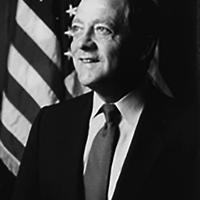
LOS ANGELES — John Seymour was the rare politician who didn’t mind harming his career if it meant doing right by his constituents.
As the newly elected mayor of Anaheim in 1978, he angered the city’s Police Department by suggesting the creation of a citizens oversight commission after residents complained that officers regularly harassed and beat them.
The lifelong Republican upset his party’s conservative base in the 1980s as a state senator, when he announced his support for abortion rights and opposition to offshore drilling.
“I’m not going to always be right,” Seymour told reporters in 1990. “Therefore, to expect one to never change a position on an issue … is too much to ask.”
Appointed to the US Senate in 1990 after Pete Wilson was elected governor, Seymour lost his seat to Dianne Feinstein two years later and never ran for public office again. He remains the last California Republican to serve in that role.
“John was a guy who had great courage, he had great goodwill and a damn good mind,” Wilson, who was mayor of San Diego when he first met Seymour in the 1970s, said Monday. “He not only enjoyed a little combat, he was willing to give the time necessary for it.”
Seymour died on April 18 at his home in Carlsbad. He was 88, and the cause was Alzheimer’s disease, according to his son John.
As his party swung to the right, the moderate Seymour had no problem with becoming a political afterthought.
“If somewhere in a footnote, history should record my public service, I would hope that they record me as one who cared more for people than for policy, one who was a no-nonsense guy who worked hard for those in need of help, but who wasn’t hesitant to knock heads of bureaucrats in order to get things done,” he told supporters at the kickoff to his Senate campaign in 1992.
Born in Chicago, Seymour settled in Southern California in the 1960s after a stint in the Marine Corps. The UCLA graduate started a real estate business in Orange County as the region transformed from farmland to suburbia. After four years on the Anaheim City Council, he became mayor in 1978.
He quickly established the pragmatic persona that would enable his rise in California politics.
Months after Seymour’s mayoral win, Anaheim police officers stormed a Latino neighborhood and beat up dozens of people in what became known as the Little People’s Park riots. At community meetings, Seymour admitted his shock at learning about the poor relations between the police and many residents.
The mayor described his approach as: “Don’t sweep it under the rug; don’t look the other way. Admit that we have a problem.”
At the same time, Seymour was negotiating with the Los Angeles Rams to move from the Coliseum to Orange County. While other OC officials proposed a new stadium, he convinced the Anaheim City Council to convert Angel Stadium into a multipurpose venue that he argued would create “the greatest opportunity for Anaheim since Disneyland and the California Angels.”
The Rams moved to the city in 1980. Two years later, Seymour was off to Sacramento as a state senator.
He became head of the Republican Senate caucus in his first year and bucked the stereotype of an Orange County GOP firebrand by largely eschewing culture war issues in favor of matters like higher pay for teachers and government support for poor parents that sometimes aligned him with Democrats. That made him few friends in his own party, with many finding his personal ambition grating — he once wrote a letter to then-Gov. George Deukmejian asking that he be appointed state treasurer — and a distraction from getting more of their own elected to Sacramento.
Seymour made no apologies for selling himself as a public servant while simultaneously seeking more power.
“I like to do things,” Seymour told the Los Angeles Times in 1987. “I’ve been a doer all my life. I don’t like to sit around sucking my thumb. I like to resolve problems.”
That year, conservative opponents deposed him as caucus chair. They snickered two years later when he announced that while he personally opposed abortion, he now supported a woman’s right to choose.