
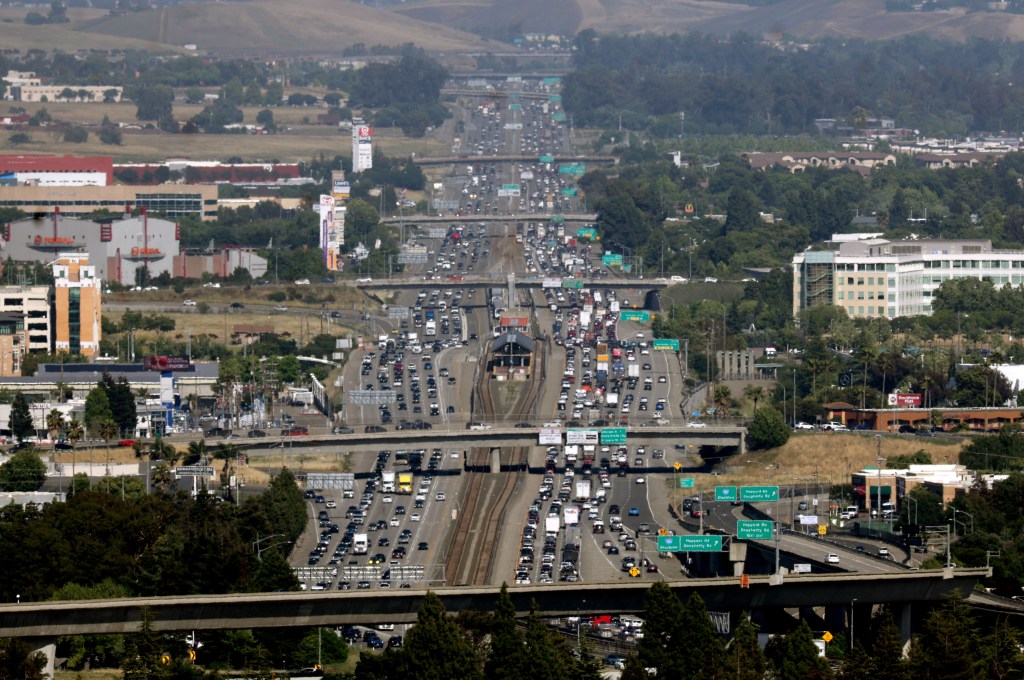
A new rail line meant to relieve roadway traffic for hundreds of thousands of Tri-Valley and San Joaquin Valley commuters still hasn’t broken ground. Instead, the project has been cut nearly in half, doubled in cost and still has no solid opening date.
Now, a complete mass transit solution remains elusive for those that spend hours in their vehicle as they travel along corridors such as the Altamont Pass.
Valley Link Rail was considered to be part of that solution. Proposed in 2018, the new rail line was meant to ease clogged roadways. Nearly a decade and tens of millions of dollars later, it’s still in the design phase.
“The traffic has come back after the pandemic with a vengeance. Even though people are telecommuting, there’s even more traffic,” said Kevin Sheridan, Valley Link Rail Authority’s executive director. “There’s no connection between ACE (Altamont Corridor Express) and BART, and that’s just ridiculous.”
The Tri-Valley-San Joaquin Valley Regional Rail Authority first proposed Valley Link Rail as a 42-mile long, zero-emission system running every 15 minutes during peak service hours from the Dublin/Pleasanton BART Station to Lathrop. A connection to Stockton also was initially considered.
As the years passed and more dollars were spent, the project has changed significantly. The length has now been cut in half and costs have now doubled.
Valley Link officials in June 2025 changed course for just 22 miles of track from the Dublin/Pleasanton BART Station to the ACE Vasco Road Station, abandoning original plans.
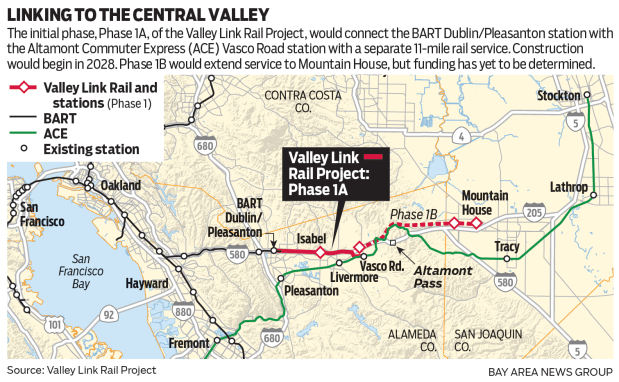
Inflating costs have driven the original $2 billion price tag to $4.4 billion, further delaying construction. The rail authority was forced to redesign the project into two phases, Sheridan said, with the second phase potentially running from Vasco Road to a new Mountain House station.
Seeking answers as to why such a project can take so long, transportation experts say it comes down to money.
“At the highest level, money is a big piece of it,” said Sebastian Petty, a senior transportation policy advisor for SPUR, a nonprofit transit advocacy organization.
Valley Link is a “comparatively less expensive project” than others, such as BART’s expansion into San Jose, Petty said, but they all compete for the same buckets of federal money.
“What happens on these larger projects then is there’s no single entity that has all of the funding to do that. It has to be cobbled together from local sources, from state sources and also from the major federal investment program,” Petty said. “All of those processes take time, securing that money takes time.”
Even before money can come from the federal level, several sources of local and state funding must be secured to prove a project will be financially viable – and “competition for funding is tight,” Petty said.
“In a broad sense, there is greater demand for funding than there is capacity,” Petty said. “What makes things slow down, stall out – none of these projects have a full tank of gas. They kind of have to increment things together to be able to move forward.”
Local officials are also navigating a tumultuous time for Bay Area transit as they plan to ask voters in November’s election to approve a 14-year, half-cent sales tax to bail out the region’s multiple transit agencies, including BART, from hundred-million dollar budget deficits and fiscal cliffs.
Petty said the outcome of that measure could seriously influence Valley Link’s future.
“From a narrow Bay Area perspective, I think the most important thing in Bay Area transit right now is to make sure that BART is operationally solvent and financially funded,” Petty said. “For Valley Link to really be a valuable project that delivers on its potential, it is essential that BART be in a healthy state.”
Another problem for the rail line is compounding inflation.
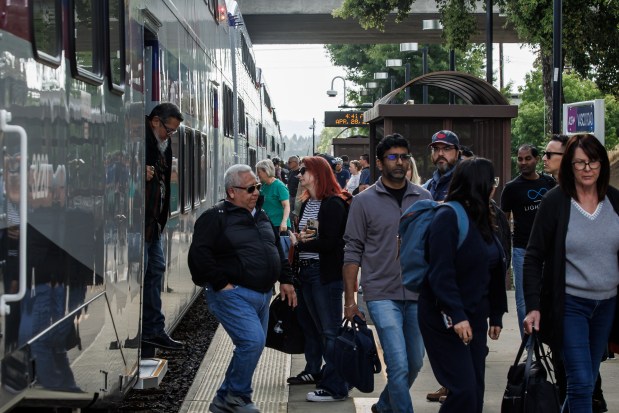 Commuters board and disembark an ACE train at the Vasco Road station in Livermore, Calif., Tuesday, April 28, 2026. (Dai Sugano/Bay Area News Group)
“One thing about cost estimates is that they are not static,” Sheridan said. “Generally speaking, the money you have is not the same 5 or 10 years from when you got it.”
Officials have secured more than $800 million in local and state funds for Valley Link. About $67 million already has been spent on preliminary studies.
Another roughly $2 billion between local, state and federal funds will need to be acquired in order to start construction. But even that amount is still not enough to get to Mountain House, Sheridan said.
“It was growing to a point where we realized that the amount to get to Mountain House was more than we had budgeted for,” Sheridan said. “We’ll continue to work on funding to get to Mountain House.”
If Valley Link eventually connects to Mountain House, that still leaves out connections to Tracy and Lathrop – which were originally promised to residents. For now, any connection to Tracy or Lathrop is on ice, Sheridan said.
“Realistically, transportation planners and state legislators are going to look at if there’s a need to go to Lathrop,” Sheridan said. “We’ll have to see in the future if there’s a desire and a reason to continue going past Mountain House to Lathrop.”
Some critics, including local commuters themselves, are disappointed that the project has shrunk in scope and rapidly climbed in price with no opening date in sight.
“They’re only talks. Nothing has actually happened as of now,” commuter Sohan Nayabu told this news organization after stepping off an ACE train at Vasco Road Station on Tuesday. “I don’t even think I want it anymore.”
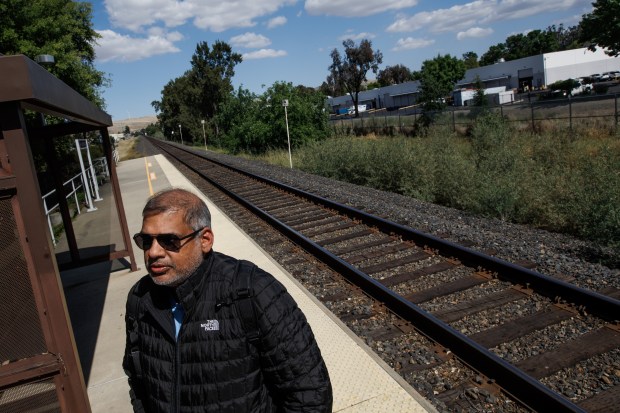 Sohan Nayabu, of Mountain House, talks about his daily 2-hour commute to Santa Clara during an interview at the Vasco Road ACE station in Livermore, Calif., Tuesday, April 28, 2026. (Dai Sugano/Bay Area News Group)
Nayabu, 43, commutes about four hours each day to and from his tech job in Santa Clara from Mountain House. He drives about 30 minutes from his house to catch the ACE train at Vasco Road Station, rides about an hour to the Great America Station in Santa Clara and then catches another company-provided shuttle the rest of the way — about two hours total, one way, door to door daily, he said.
He and his wife bought a home in Mountain House in 2018, around the same time he heard of plans to build Valley Link. He said he was excited that a new station might shave off time on his commute. But after years of delays, Nayabu said he now worries the new rail line may take longer to construct than the years he has left at his job.
“By the time they come to Mountain House, I’ll be retiring by then,” Nayabu said.
Phillip Davenport, who commutes from Tracy to the Vasco Road ACE Station to get to work in the South Bay, said he’d never heard of Valley Link until this news organization told him about it. He said any way to get him out of Altamont Pass traffic is a plus.
“With all the increases in properties at Mountain House, at 4 in the morning it’s a slog to get through the Altamont,” Davenport, 40, said. “If there’s other options other than the ACE train, that would be huge.”
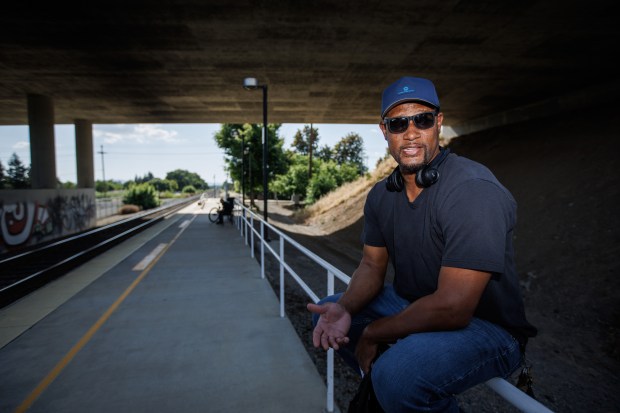 Phillip Davenport, of Tracy, who commutes on the ACE train to the Bay Area, talks during an interview at the Vasco Road station in Livermore, Calif., Tuesday, April 28, 2026. (Dai Sugano/Bay Area News Group)