
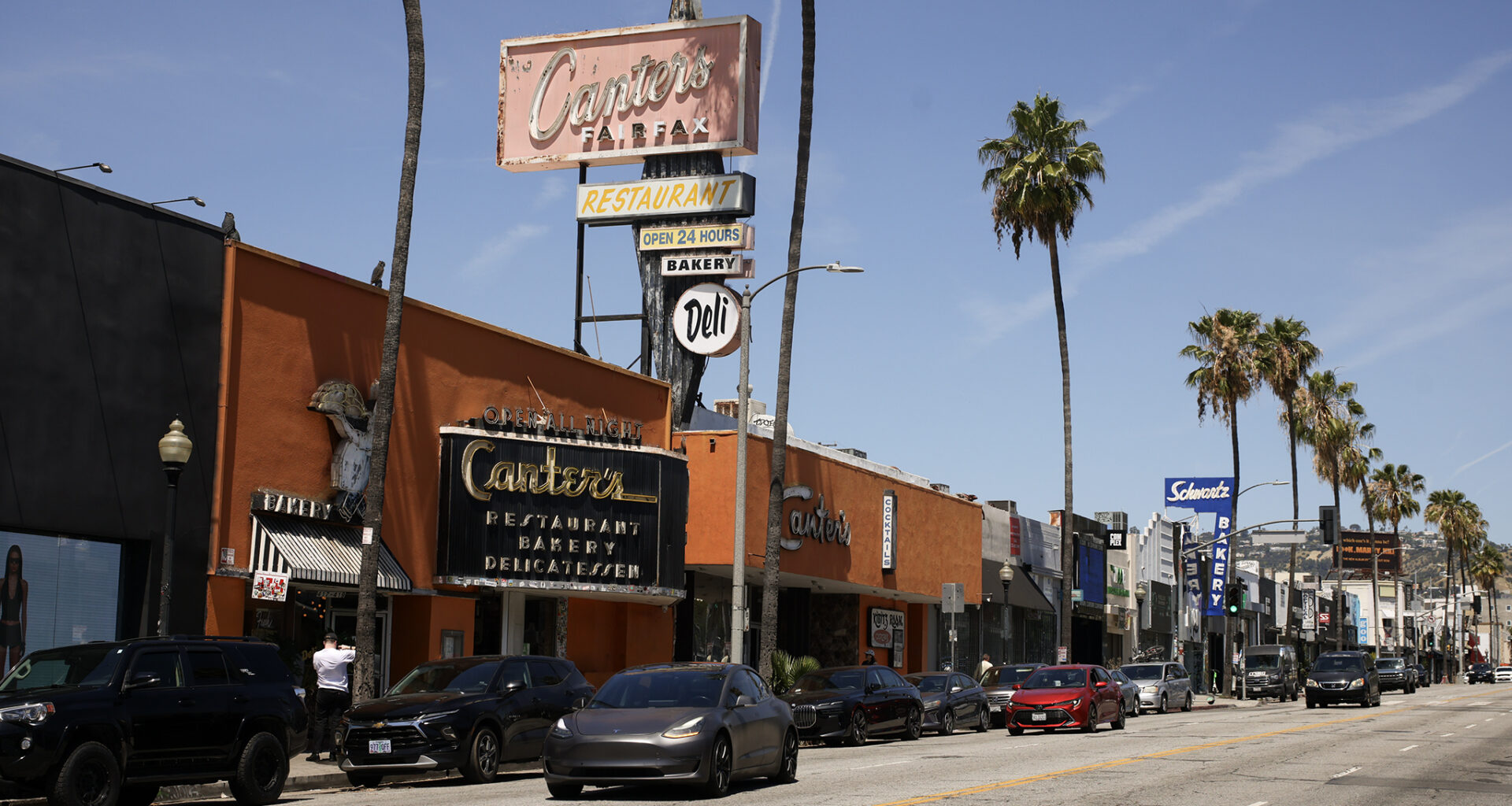
It’s impossible to walk into Canter’s Deli and not feel a little famous. The restaurant, in Los Angeles’s Fairfax District, has enough Hollywood history to fill a book (in fact, there are two). It’s hosted some of the biggest bands in the world, and has been the setting of shows from “Mad Men” to “Curb Your Enthusiasm” to, most recently, the new season of “Euphoria.” It’s most likely the oldest Jewish deli in California, and among the most recognizable in the world.

But despite its outsized reputation and enduring goodwill with locals and visitors alike, Canter’s is navigating a new phase of life these days. And it’s not alone. A century ago, similar full-service delis numbered in the thousands nationwide; today that number has shrunk to about 100, according to Marc Canter, third-generation co-owner of Canter’s.
“It makes sense if you’re a billionaire and you need a loss,” Canter said of the deli business these days. “Or it also makes sense if it’s in your blood and you have to do it.”
Article continues below this ad
Marc Canter sits for a portrait in Canter’s Deli in Los Angeles, on April 23, 2026.
Jessie Alcheh/SFGATE
Delis like Canter’s present a particular economic challenge: making signature meats like pastrami and corned beef in-house is expensive and labor-intensive. Beyond that, the curing process takes up a lot of valuable kitchen space. To Marc Canter, that’s a huge component of the decline in full-service delis. “Economically, it’s not a viable business because the food cost is too high, and the labor is too high because you manufacture,” he told SFGATE recently.
The interior of Canter’s Deli in Los Angeles, on April 23, 2026.
Jessie Alcheh/SFGATE
The interior of Canter’s Deli in Los Angeles, on April 23, 2026.
Jessie Alcheh/SFGATE
The hits have been steadily coming since the restaurant reopened from its pandemic lockdown. “It’s been probably four crazy years,” Canter explained. He co-owns the business with his sister Jacqueline Canter and their cousin Terri Bloomgarden. “Anytime there’s uncertainty in the world, people take their foot off the gas pedal and how they spend their money, and where they eat.”
Article continues below this ad
Fairfax, long one of LA’s coolest streets, has had its own struggles. Once a streetwear hot spot overflowing with high-end clothing shops and big-deal restaurants, attention on the street has declined dramatically in recent years, as customers age out or simply decide to spend their money (and their time) elsewhere. Canter’s, at the heart of the Fairfax District, has stood silent witness to emptying storefronts, including other longtime businesses like Diamond Bakery, which closed in 2023 after 77 years.
Canter’s Deli has been a fixture in the Fairfax District of Los Angeles since 1953.
Jessie Alcheh/SFGATE
Then, there are the societal factors that have made customer flow unsteady for all LA-area restaurants right now, regardless of their menus. The five-month writers’ strike in 2023, coupled with 2025’s deadly dual fires, dampened enthusiasm for dining out, as have ongoing immigration enforcement raids and rising inflation. “The fires last year hurt everybody,” Canter said, especially the decline in tourism that came after and the surge in insurance premiums. “Egg prices hurt us a lot, because we manufacture here. It’s not just an egg in your omelet. It’s an egg in your matzo ball, an egg in the potato pancakes.”
Article continues below this ad
He added, “We were hitting $25,000 a month on eggs,” at the height of the price spikes created by both avian flu-induced scarcity and inflation. “And right now we’re spending $5,000 a month on eggs. So you can see there’s a huge difference there.”
Passing the cost onto diners hasn’t been an option, Canter said. “You raise the prices and then you thin out your customers,” he explained. Instead, he’s expanding the menu to accommodate evolving diets (see: vegan corned beef/pastrami sandwiches); adding to the restaurant’s revenue streams, like working with Goldbelly to ship food nationwide; and getting the word out about Canter’s as an unexpected wedding venue for nostalgia-inclined couples. “If you want to get married and you go to a hotel, it could cost you $80,000 for a wedding,” he said. “You come here and have a wedding and by the time you’ve paid the bar bill and the flowers and the photographer and all that, you could be out $7,000 or $8,000.”
“Not too many restaurants have the space we have,” Canter added. “We have the footprint from the ’50s.”
The “middle room” at Canter’s Deli in Los Angeles has been featured in shows like “Mad Men” and most recently, Season 3 of “Euphoria.”
Jessie Alcheh/SFGATE
Cookies in Canter’s Deli in Los Angeles, on April 23, 2026.
Jessie Alcheh/SFGATE
The deli originally opened in 1931 as Canter Brothers in Boyle Heights, then moved to the Fairfax District in 1953, with the family purchasing the defunct Esquire Theater. It was there that the restaurant started to attract the Hollywood set; its proximity to the studios was appealing, but its hours (serving everything, including beer and wine, until 2 a.m.) were even more enticing. Stars like Elizabeth Taylor, Mel Brooks and Dick Van Dyke would often stop by. Walt Disney was a 5 a.m. customer, Canter said. Marilyn Monroe and playwright Arthur Miller were such regulars that “The Marilyn,” her preferred grilled cheese made with Swiss and grilled tomatoes on rye, is still on the menu today, exactly how she ordered it.
Article continues below this ad
“Richard Dreyfuss told me once … that he had so many fond memories of Canter’s in the ’60s,” Canter said. The then-aspiring actor met and connected with Miller at the restaurant. “He wanted to get into the business, and Miller guided him where to get his headshots, where to go for his agent, to help him and encourage him to do it.”
Nearly a century after its opening, Canter’s — along with Langer’s, of course — is one of the last holdouts of the heyday of the Jewish deli era in Southern California, and one of the most recognizable in the world. Katz’s Delicatessen (open since 1888 in New York City) is older, and was the setting for the infamous “I’ll have what she’s having” scene from “When Harry Met Sally,” but Canter’s has a Hollywood star power unlike anywhere else.
Marc Canter’s famous portrait of Guns N’ Roses at the restaurant hangs in the middle room.
Jessie Alcheh/SFGATE
The brushes with fame are everywhere in Canter’s. On one of my recent visits, I had lunch (the Fresser, a combination of the deli’s house-made pastrami and corned beef on rye) and stopped at the bakery counter for a black-and-white cookie on the way out. “You sat in Obama’s booth,” a longtime server said to me as I was waiting. “Secret Service came through and said that was the most secure.”
Article continues below this ad
He’s one of five U.S. presidents who have visited the restaurant. “Eisenhower was campaigning here. We had Reagan as a customer, so I don’t know if that counts,” Canter said with a laugh. “We catered a couple events for Kennedy, and then Robert Kennedy did a meet-and-greet here. … That was about a week before he got assassinated. Nixon was campaigning outside. Obama came in in 2014.”
The next time I went back, that same server sat me — Canter estimates that half of the restaurant’s 125 employees have been there for 25 years or more — and pointed out that the table I had chosen in the restaurant’s “middle room” was one that had been the setting for a scene in the episode of “Euphoria” that had aired just two days earlier. Canter believes that the deli will be in three episodes this season.
A corned beef Reuben sandwich at Canter’s Deli in Los Angeles, on April 23, 2026.
Jessie Alcheh/SFGATE
Canter’s Deli originally opened in 1931, and is one of Los Angeles’ last Jewish deli holdouts.
Jessie Alcheh/SFGATE
The middle room is a little bit like Musso and Frank’s “new room” — the more recent of the main dining rooms, but one that is still older than most of California’s restaurants. The Musso and Frank Grill’s new room (the one with the bar) dates back to 1955; Canter’s middle room didn’t come online until 1958, when the family bought out a competing deli next door and took over the space. In 1961, part of that space became the Kibitz Room, a cocktail lounge known for its drop-in performances from musical superstars. By that time, the restaurant was open 24 hours, seven days a week. (Today, the dining room is only open 24 hours a day from Friday to Sunday, though takeout is still available every day, around the clock.)
Article continues below this ad
“The rock and roll scene in the ’60s was … a whole five years of madness,” Canter said of the era known as the Summer of Love. “You had everybody here. After they played the Whiskey, they’d come here. The Yardbirds, Led Zeppelin, the Who, whatever, whoever, they came here.”
The musical star power didn’t end with the end of the Summer of Love. Guns N’ Roses famously spent their after-concert hours at the restaurant in their early 1980s days of playing the Sunset Strip, before they even had a record deal. One of the most famous photos of the band was taken in a booth in Canter’s middle room, with an old photo of the deli itself prominently on the wall just above Axl Rose, Steven Adler and Slash.
Guns N’ Roses memorabilia in the Kibbutz Room at Canter’s Deli in Los Angeles.
Jessie Alcheh/SFGATE
“Reckless Road: Guns N’ Roses and the Making of Appetite for Destruction,” written by Marc Canter and Jason Porath, details the band’s rise to fame. Slash, born Saul Hudson, is Canter’s lifelong best friend; in the book, Canter details using his parents’ station wagon to haul around his friend’s musical gear to rehearsals. He became the “sixth member” of Guns N’ Roses in those early years, as Duff McKagan said in the book, and photographed the early years religiously. The band photo, and many others, are still on display in the restaurant.
Article continues below this ad
“The thing with the musicians is you could sit here, and you wouldn’t get kicked out,” Canter said. “You could mingle around and hang out at a revolving table. Frank Zappa would come sit down with some people and then other people would come. And at some point, they would leave, but then more people would come from the rock and roll scene. They’d sit at the cool table. … Frank Zappa would come back eight hours later, the table would still be going.”
The demand might not be the same as it always was — and more and more of the business might be coming from online delivery instead of in-restaurant service — but the tables at Canter’s are definitely still going. Just ask Seth Rogen, a longtime customer, who recently filmed there for Season 2 of “The Studio.”
“He used to live around the block and come here a couple of times a week,” Canter said. “Now he’s ordering from DoorDash. So he moved; he’s not as close, but he still gets the food.”
Canter’s Deli, 419 N. Fairfax Ave, Los Angeles. Open Monday through Friday, 6 a.m.-11:30 p.m., Saturday and Sunday, 24 hours.
Article continues below this ad
Diners in Canter’s Deli in Los Angeles, on April 23, 2026.
Jessie Alcheh/SFGATE