
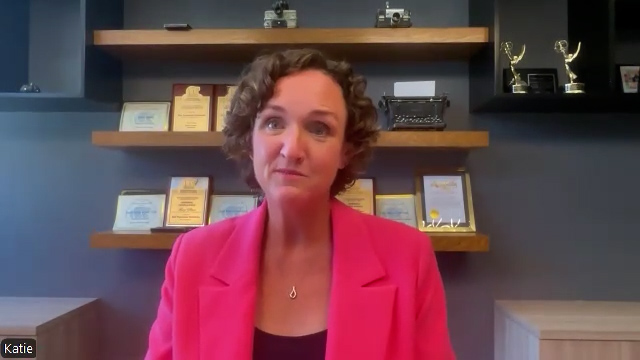
Politics reporter Sophia Bollag interviewed Katie Porter, one of the leading candidates in the governor’s race, ahead of California’s June primary.
Sophia Bollag, Wendi Jonassen, Joy Jeong
A year ago, it seemed likely that California would elect its first-ever female governor in 2026.
Prominent candidates included the first woman to lead both the California Senate and Assembly and the first woman elected lieutenant governor. The first woman elected vice president was considering jumping into the race.
Now, the calculus has shifted. Only one woman remains among the eight major candidates: former Rep. Katie Porter.
Article continues below this ad
Porter has made her identity as a working single mother a centerpiece of her campaign — joking about her minivan and touting policy proposals like universal free childcare, two years of free UC and CSU tuition for Californians and the elimination of state income taxes for people making less than $100,000. She’s proposing to pay for most of it by passing higher tax rates for the state’s biggest, most profitable companies, in a mirror of the progressive tax structure the state already uses to tax its residents.
After running unsuccessfully for Senate in 2022 and making a name for herself in Congress as a prominent Trump critic, Porter came into the race with significant name ID, and has been a frontrunner since she announced her candidacy.
But she has been haunted by a reputation for being rude to staff. The sense that Porter is difficult was propelled by two videos published during the campaign showing her yelling at a staffer and threatening to leave an interview with a journalist.
In an interview with the Chronicle, Porter acknowledged briefly losing her temper with the staffer, though she said she apologized and has continued to have a good relationship with her. And she suggested that her sometimes aggressive demeanor, which helped propel her to national prominence during her tough questioning of Trump administration officials armed with her signature white board, would be an asset.
Article continues below this ad
“This is a moment when we’re dealing with Donald Trump. We’re dealing with really big problems. We need to be unafraid to push,” she said. “Californians do deserve more from their government. But you’re only going to get there if you respect and honor the people that work with you.”
Here are the highlights from Porter’s interview with the Chronicle, part of a series the paper is conducting with the leading candidates in the race for governor. The conversation below has been edited for length and clarity.
Chronicle: I want to start with one of your policy proposals related to affordability. You’ve called for creating free childcare for all. How much do you estimate that would cost and how do you plan to pay for that?
Porter: Childcare is a big expense for families that have kids, often even bigger than their mortgage. The cost of childcare today in California is more for a year than the cost of in-state tuition, and you don’t get 18 years to save up for it. You get nine months. We already provide a lot of childcare subsidies in California, and that’s something that some people don’t know. So, we’re already spending some. This is about plus-ing it up to cover everybody to treat it as an investment in growing our economy. So the first thing I would emphasize is whether you have kids or you don’t, whether you chose to stay home or your kids are long gone, every Californian benefits from a stronger economy and so every Californian is going to benefit when people are able to go to work and stay at work. So this is probably going to be funded through a combination of things. One of the possibilities could be a small payroll tax that we all pay into equally. Because again, it’s about investing in the state.
One of the things I want to emphasize that sometimes isn’t clear to people is it’s really important that we have a lot of different kinds of childcare providers. And I’m a single mom of three teenagers, I’ve had to work my entire children’s lives to support my family, and I have had them in every kind of childcare, from an in-home care with one wonderful woman to a sort of corporate type of chain childcare and everything in between. That’s really important. The way that this would be done is to still give families that choice. The reality is California’s population is getting much older and we need to get more young people coming to California, staying in California, working in California if we’re going to support our population as it ages.
Article continues below this ad
Do you have an estimate at this point of what that proposal would cost?
I don’t have a specific estimate on this one. I do on my proposal for no California income taxes for people earning less than $100,000. That data was on the California Franchise Tax Board. And then also I have a proposal, I have a cost estimate for the two free years of UC/CSU, because I can get that data from our regents and boards of trustees. But we do have other states that are heading this direction or are in this direction. New Mexico has been moving in this direction. New York City is moving in this direction with support from the state. So I think there are places that you can look to to think about estimates for how to do this.
How are you planning to pay for your income tax proposal and for those two free years of CSU and UC tuition?
We like to talk about it as “tuition-free college degree.” And the reason is that the way this would work is paired with Governor Newsom’s California Promise, which makes two years of community college free.
(Editor’s note: The California Promise program provides financial aid for many community college students, but it’s implemented differently at different campuses and doesn’t provide free tuition to all Californians like Porter is proposing. And though Newsom supports the policy, his predecessor Jerry Brown signed it into law.)
Article continues below this ad
So what we’d be providing here is year three and year four for those who transfer to a UC, a CSU or a Cal Poly. This would apply only to California residents. Our out-of-state folks and our international students need to pay full freight, because they’re not paying in with tax dollars to support the system. The estimated price on that is about $3.5 billion. This is real money back in the pocket. It’s a reason for families with kids to stay here in California, and it also is something that we’re not seeing other states do. So it marks California as what we used to be: a true leader in affordability and accessibility of public education. And then the income tax piece that is I believe about $8 billion that we take in right now from families earning less than $100,000.
My proposal to pay for both of these is the same proposal. Right now, we have a flat corporate tax. I didn’t actually know this. I think of myself as a little bit of a tax nerd. We have progressive income taxes. So I assumed like when we get a bonus or we make a little more, we pay a higher rate. I just assumed that was how it worked for corporations. And most Californians, when I tell them this, are shocked that a corporation that makes one buck in profit pays the same 8.84% as a corporation that makes $500 million in profit.
I want to be really clear, this is not about taxing big businesses. This is not about taxing any particular industry. It’s about saying the same thing we say to workers: When you have an extra profitable year, you pay just a little bit higher rate. There was a bill like this, I visited with the California Budget and Policy Center about this, there was a bill like this that considered adding a little bit, moving from 8.84% to even 9.5% or 10%, just very modest, could produce all of the revenue that I need for those two proposals.
(Editor’s note: While there have been proposals to create a progressive corporate tax rate in California, they have not been formally debated as a bill in the Legislature.)
In response to a questionnaire from the group Housing California, you wrote, “I worked on housing issues in Congress, so I understand where to push our federal delegation to focus their efforts.” Where specifically would you push the federal delegation in Congress on that issue?
Article continues below this ad
One area is Section 8 vouchers, rental assistance. These are not fully funded. That’s why we have wait lists. Decade-long to get a rent-subsidy apartment. Some of our states have more public housing. California doesn’t have much public housing, we have mostly Section 8 vouchers, so there’s always that tension between where do federal housing dollars go. And so we really need to advocate for Section 8 funding, because that’s how our low-income folks find and get housing here.
Another area where I would say the delegation could work effectively is around housing finance, so when we have more expensive housing the amount you need to get to 20% just is a bigger number. So if your housing costs $1 million, 20% is $200,000. If your housing costs $500,000, it’s $100,000. That’s just the math. After the subprime crisis, we were sort of bounced all the way back to that traditional 20% down payment, which was incurred in the 1930s. There’s actually not a lot of research — I’ve written about this in my day job as a professor — there’s not a lot of research behind why you have to have a 20% down payment. It’s very true that 0% down payments, send in whatever you feel like, pick a payment loans — I was on the ground, I was ground zero on that disaster, both in terms of my research but also my public service running the state-wide mortgage foreclosure settlement program. But 3%, 5% down payment, that’s what our FHA program has at the federal level, that’s what our VA program has, and they have some of the lowest default rates. So I think pushing our federal housing, Fannie Mae, Freddie Mac, all of those entities to think about moving from a 20% to a 10% down payment, for example, would make a huge difference here in California.
Housing is not a one-level-of-government problem. It is a city, a county, a state and a federal problem. So nobody gets a pass here. We say that about every city has to be part of building more housing. The same is true about every level of government. So the state, I think, has done a lot. California is the largest revenue source for the federal government, so it’s wholly appropriate that we are asking the federal government to pay for things that we need.
What else did you learn during your time in Congress that you think would shape your approach to the governor’s office if you’re elected?
I drive a minivan with a California license plate, and it spells out oversight, O-V-R-S-I-T-E. I was really excited in a state with this many millions of people that it was available. But that, I think, is an area where there’s real opportunity for the governor and the Legislature to do some improving. Congress does a lot of things badly, and we do some things well. One of the things I think we do pretty well is we take the GAO (Government Accountability Office)’s reports very seriously. If Congress, regardless of what committee I was on, if we asked the federal government to give us an answer, to give this data, to come testify, they showed up with answers. That’s not always the case in the California Legislature. So that’s an area where I want to make sure every agency in California understands that the relationship with the Legislature isn’t adversarial, it’s cooperative. We should be showing them what’s going well, what’s not going well. Where we’re spending the money, what’s working. And I think that we’re seeing some interest. There’s been discussion about whether the Assembly, for instance, should create an oversight committee.
I think the other thing is trying to set shared goals. So right now we have so many bills that get passed and a whole bunch of them then get vetoed. I’d like to be in conversation right upfront. And it’s beyond just saying, let’s work on affordability. It’s really saying, ‘What are the components of affordability that we’re going to work on this year? ’ And I think sometimes having been a legislator, which is important in this era, that important perspective that I bring here is that the committee structure doesn’t always help with that. Because every committee wants to do its thing. So one of the things the governor can do is help set some priorities in any given year. And the last piece of that is: Listen to the Legislature if this is what they’re working on. And that’s gonna mean that we’re gonna ask a department or an agency or a commission to do something more than what they do or to change how they do something, the governor needs to be thinking about, ‘What does that look like for staffing, for personnel, for budget resources? ’ so that when that law is passed, it works on the ground from Day One.
The progressive corporate income tax that you would like to implement, that would be a fight in the Legislature. You noted that there’s been efforts before and they haven’t worked. And so I wonder, to your point about working with the Legislature and your experience in a legislature, and understanding how that works, how would you approach convincing lawmakers to support that policy that they will have donors and constituents who oppose it?
Yeah, I mean, I don’t take corporate contributions. So I am very, very clear that I’m going to do what’s best for California. That means I’m doing what’s best for California’s economy, which means making sure corporations are thriving here. Those things are not inconsistent, but I’m not for sale and I’m not bought and paid for.
So what I would say to the Legislature is, look, you have a lot of things that you want to accomplish. You think the state should be doing this, investing in this, changing this, solving this problem. That all costs money. So we face a choice. We’re either gonna cut some of our spending, or we’re gonna find more revenue. And that should be a discussion and it will probably be, if we’re being honest, Sophia, a little bit of both.
I spent my career working on affordability, families in bankruptcy, families facing foreclosure because of predatory lending, families who can’t afford prescription drugs. Affordability is always a two-part problem. And the same is true for the state’s budget, right? It’s a mismatch between what you’re spending and what you are taking in. And so it’s a mismatch between wages for families and the expenses families face. It’s a mismatch in the state’s case between the tax revenue we’re taking in and what we’re spending it on. So I think you just have to take a big whiteboard. It’s a big budget. But I think helping people see that there are trade-offs. I should be respectful to the Legislature’s perspective on those trade-offs because they are closest to these problems and many of them are policy experts in their own right because they’ve chaired committees because of the background that they bring. But ultimately we have to make some choices about: What do we wanna accomplish as a state, and where are we gonna find that revenue? And so that’s gonna be a trade-off.
Our budget instability comes a lot from our progressive income tax because we rely a lot upon the market and when capital gains are high, our wealthy pay more. And so that’s another area we’re working with the Legislature.
You faced some criticism for being too demanding with your staff or treating them harshly. What do you think about that criticism that you’ve received and the way that it’s become a factor in this race for governor?
I am really proud of the work that my staff and I did. Every whiteboard moment that anybody has ever seen wasn’t because of me, it was because of my staff, the staff preparation, the role playing, the ideas, the research, we did all of that together.
I don’t think anybody should be judged by one minute, especially a minute that they apologized for, not just after the fact, but in the moment. I’m deeply proud that that staffer and I continued to work together for four years after that incident. She texted me last night. She watched the debate. She said, ‘If I were a California voter, I’d vote for you.’ That meant the world to me. So, nobody should make any mistake, I can be tough. I can push. And I think this is a moment when we’re dealing with Donald Trump. We’re dealing with really big problems. We need to be unafraid to push. Californians do deserve more from their government.
But you’re only going to get there if you respect and honor the people that work with you. And I’m proud of the teams that I have built and the accomplishments that we’ve had together. When I wrote my memoir, the memoir was published a couple years ago, and it’s dedicated to my staff and dedicated to my volunteers. And so that tells you something. Books are big projects. I’ve obviously got three kids that that book was not dedicated to, not because I don’t love them, but because a lot of what I’m writing about the book is my time in Congress. I’m really proud that I received an award from the Congressional Management Foundation for the opportunities that I gave very young staffers including first job out of college and interns. And then the last piece is my staffers have talked about publicly what it’s like to work for me, and how I’ve supported them both professionally and personally.
You’re running on your track record in Congress fighting Trump. What are the biggest tangible wins for California that you secured through that work?
First and foremost, because I believe it did save lives, is successfully pushing in the first couple of weeks of the pandemic to get free COVID testing for every single American, regardless of immigration status, regardless of insurance status. I was the 47th or 48th of 48 people to question in a hearing that stretched over two days. And I was the person who got the tangible policy change. And it was because I did not give up. There was already existing law on the books. It was about pushing government to pick up a law and use it to help people exactly as it was intended.
I would also point to my role holding polluters accountable. I successfully pushed to raise the royalty and rental rate when polluters extract on our public lands for the first time in decades, passed bonding reform to make sure that when people drill they have to clean up their own messes rather than sticking the taxpayers with the cost when they’ve pocketed the profits.
(Editor’s note: This policy was enacted during President Joe Biden’s term as part of a rulemaking process following the passage of the Inflation Reduction Act.)
You’ve said that you would not support banning social media for kids under age 16, which is something that lawmakers are currently considering in the Legislature. So if you were governor right now, would you plan to simply veto that measure if it reached your desk, or would there be specific amendments you would be proposing or trying to negotiate to get that bill to a place where you would sign it?
Look, the governor is only gonna be successful in partnership with the Legislature. We have multiple branches of government, and respecting those checks and balances and trying to create partnerships is so important. So I think I would try to communicate, ‘Look, is 16 the right age? ’ I would ask respectfully, ‘How did you come to that age? How did you make that decision? What data did you look at? Are there other states or countries that we’re modeling off of? ’ I would have the same conversation with social media companies, I think there is an age at which social media is inappropriate, just patently inappropriate. As a mom of three teenagers, I’m not sure 16 is the right age.
Betting markets like Kalshi have increasingly been cited as a metric sort of for gauging this governor’s race as well as other, political races. And I’m wondering, what do you think of that dynamic?
I think our democracy should not be for sale. So I am concerned that people can flood this market. Supporters of somebody could flood this market.
We’ve actually seen, as you know, three federal candidates who have been suspended and are being investigated for market manipulation here. And so I think it’s important to put checks and balances on this if we’re going to continue to have these markets.
As someone who’s always been very vocal about fighting for campaign finance reform as a candidate that does not take corporate contributions, I think it’s important that there is a full investigation. Ideally this gets regulated at the federal level to make sure that we’re not seeing any perversions of our democracy.