
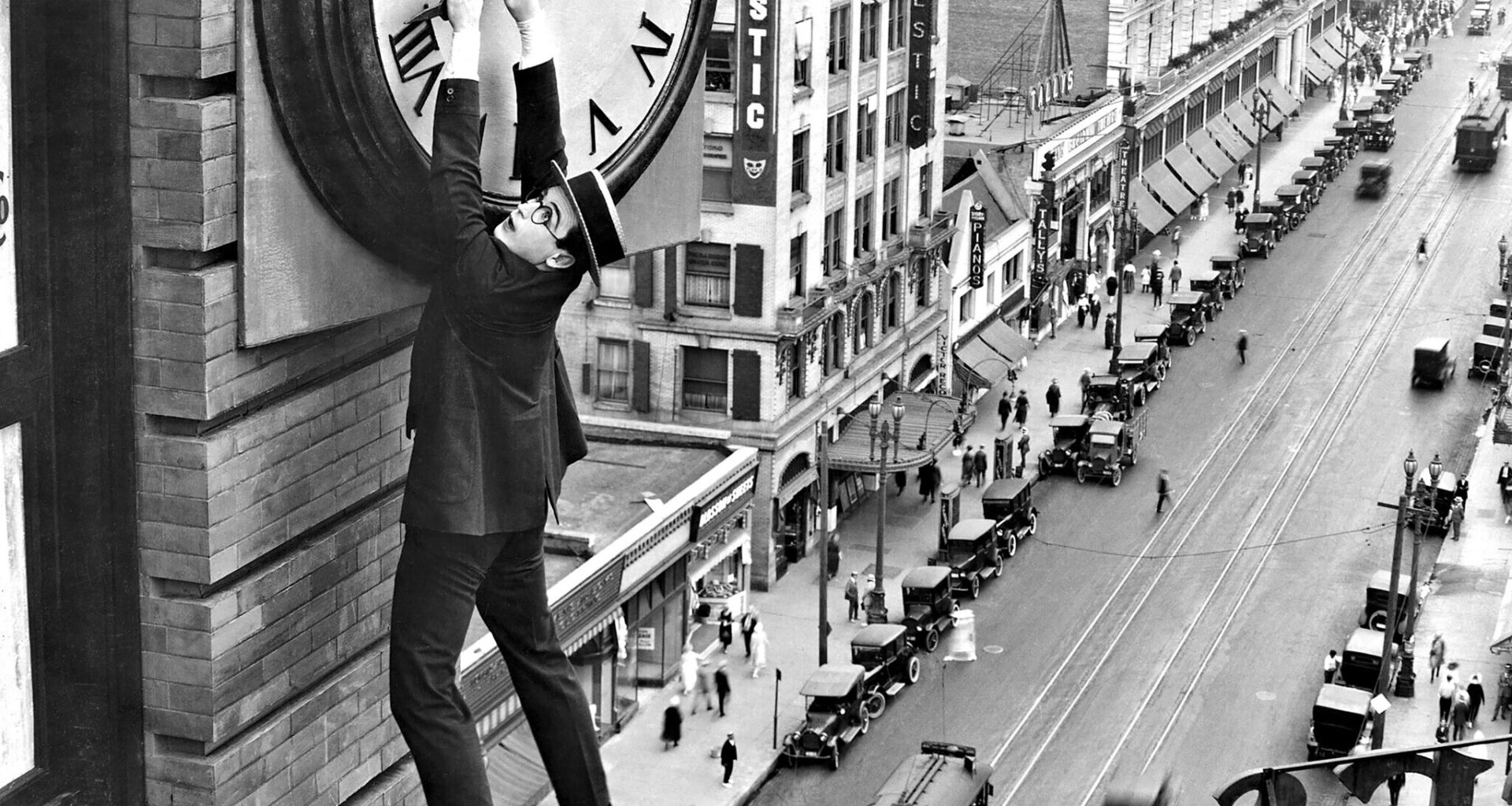
Without silent films like “Safety Last,” there’s no Tom Cruise dangling from the Burj Khalifa in “Mission: Impossible — Ghost Protocol.”
Michael Ochs Archives/Getty Images
In the digital era’s never-ending tsunami of information, sounds, images and text accompany us nearly every minute of every day. We have become a species drowning in content, and even those born before the advent of the iPhone can scarcely recall the days when anything less than on-demand, headphone cacophony could make us feel content.
But as a teacher of film history, I can assure you that, yes, there was a time when screens didn’t fit into your pocket. They once illuminated our imaginations and didn’t dim our wits. If you don’t believe me, may I recommend attending the San Francisco Silent Film Festival (May 6-10), where you’ll have a window into the pre-algorithmic world.
“As generative AI videos seep into our everyday lives, early films provide the promise that everything you see was made by and for humans.” Serena Bramble, a tech worker by day, told me about the allure of silent films.
Article continues below this ad
The San Francisco Silent Film Festival is the largest festival of its kind in North America and will once again be held at the Castro Theatre, which recently reopened after a two-year, $41 million restoration. Though no longer an exclusive venue for movies (live performance and music now alternate with film presentations), the Castro, with its grand organ and lavish, art deco details, remains the perfect venue to see a silent film.
Anita Monga, who joined the festival in 2009 as artistic director, said the refurbished auditorium is “exquisite,” adding that the movie palace upgrades make it “as beautiful as it was in 1922, but with top-notch projection, sound and better sight lines.”
San Francisco Chronicle Logo
Make us a Preferred Source to get more of our news when you search.
Add Preferred Source
Today’s insular, online film experience, by contrast, is antithetical to the communal experience one finds at the festival.
“The audience laughter becomes part of the soundtrack, adding to the experience,” said Ryan Gordon, a government worker who has missed only two festivals since 2008.
Article continues below this ad
Sterling Hedgpeth, film programmer at the California Film Institute, and a 30-year festival veteran, said he “loves to see young audiences’ amazement at how strongly these century-old films resonate in today’s world,” with themes centered on gender equity, marital infidelity, the housing shortage and other concerns of our day.
In part, that’s because visual storytelling in the silent film era was often more economical and engaging. Absent computer-generated gimmickry, silent films also became a template for how to engage an audience.
Guest opinions in Open Forum and Insight are produced by writers with expertise, personal experience or original insights on a subject of interest to our readers. Their views do not necessarily reflect the opinion of The Chronicle editorial board, which is committed to providing a diversity of ideas to our readership.
Read more about our transparency and ethics policies
“Without Harold Lloyd hanging from a clock tower (in 1923’s ‘Safety Last’), there’s no Tom Cruise dangling from the Burj Khalifa (in 2011’s ‘Mission: Impossible — Ghost Protocol’),” Bramble said. “Without King Vidor’s 1928 ‘The Crowd,’ there’s no ‘It’s A Wonderful Life’.”
While the San Francisco Silent Film Festival may seem to some like a hopelessly outdated novelty, for the rest of us, it is a badly needed balm for our dystopian Gilead. That it will once again take place at the Castro Theatre means that it’s two digital-age balms for the price of one.
Article continues below this ad
KD Davis is a semiretired senior film programmer for the Mill Valley Film Festival and professor emerita of cinematic arts at California State University Monterey Bay.