
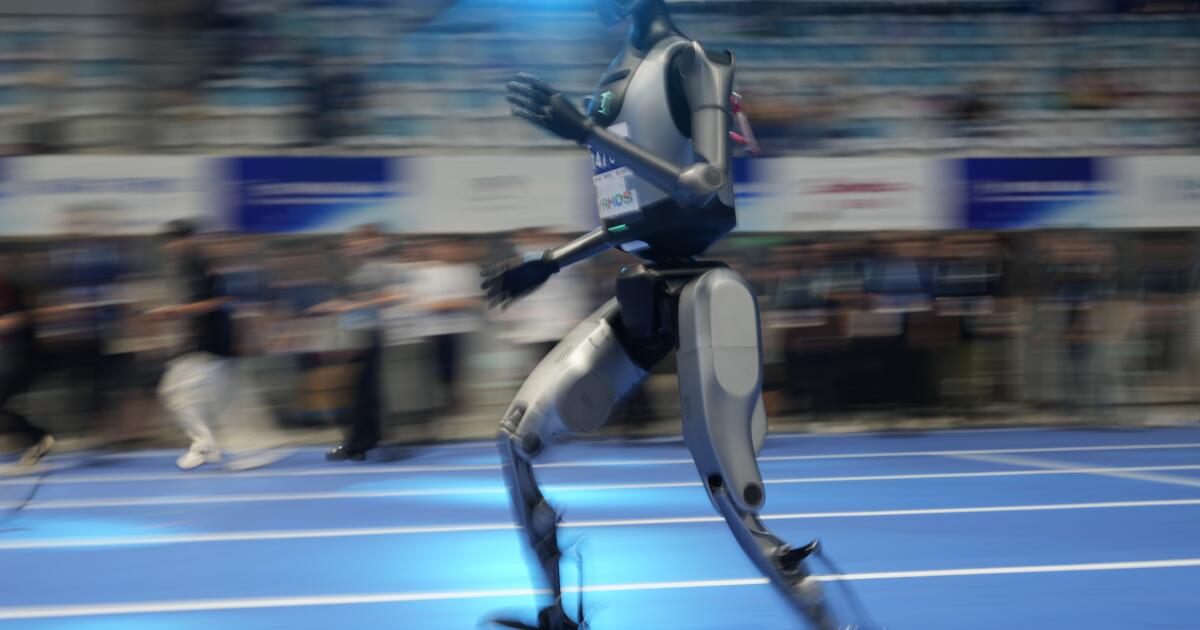
1X Technologies AS, the Norway-founded robotics startup backed by OpenAI, has opened a new 58,000-square-foot factory in Hayward, California, where it aims to be among the first to build humanoids for consumers at scale.
The facility, completed over the course of a few months, will serve as a manufacturing hub with the capacity to build 10,000 robots in its first year, according to 1X executives. The company said it plans to make 100,000 robots by the end of 2027, as it works to complete construction on a larger manufacturing facility in San Carlos, California. Shipments are expected to begin by the end of this year.
In a virtual tour of the facility seen by Bloomberg, the company offered some details about its as-yet unannounced next-generation humanoid, which brings some optical improvements and other upgrades.
The startup, which moved its headquarters from Norway to Palo Alto last summer, also said it plans to relocate again — this time to San Carlos — as it has outgrown its current space, said Dar Sleeper, 1X’s vice president of design, product and marketing, in an interview.
Robotics companies have drawn billions of dollars in investments in recent years, with many working on humanoids — people-inspired machines that can either walk or roll on wheels. They have so far found a home in some manufacturing facilities, where they complement existing industrial robots that can perform tasks such as assembly and transporting materials. But humanoids for the home and other consumer uses are less common.
1X’s “Neo” humanoid, which is currently available for pre-order at $20,000, has generated buzz on social media for its soft, human-like body, designed to help with domestic tasks like folding laundry and tidying up. It can talk and learn new skills over time. The company hopes it will someday be able to assist with elder care.
The startup last raised about $100 million in financing in January 2024 in a Series B round led by EQT Ventures, with a total fundraising haul of $123.5 million. (1X declined to share a valuation.) EQT AB, the private equity firm, plans to deploy 10,000 of the robots to its portfolio companies.
Beyond a handful of US companies, such as Tesla Inc., Figure AI Inc., Agility Robotics Inc. and Apptronik Inc., the humanoids market is largely dominated by Chinese firms: The country accounted for the majority of the 13,000 units shipped worldwide last year. The bulk of humanoids are also manufactured there, meaning US factories in this segment are relatively rare.
1X’s US manufacturing push comes at a time when a growing number of tech companies are rethinking their global supply chains and investing locally. Although many still import some components for their products, 1X said it is taking a more vertically integrated approach by manufacturing its parts in-house, including spinning copper coils, making motors, electronics and batteries. This strategy was designed to allow for a fast development loop, where the company can analyze data collected by the robots and introduce new updates more quickly.
“The level of vertical integration here is unmatched, not just in the humanoid space, but in the hard tech space,” Sleeper said.
Bernt Børnich, the company’s founder, said he believes humanoids will reach a critical mass in society in as little as two years.
“We need a lot of skilled labor in the US to be able to really ramp up manufacturing the way we want, and there’s likely going to be more of these machines than there are people,” he said. “If we’re going to get there, we need a lot of hands that know how to help build.”
The factory currently doesn’t use Neo humanoids to build more Neos, but Børnich said that’s the long-term goal.
Some of the Neo heads coming off the line have notable differences from the public-facing version, including an optimized eye socket to expand the field of view, improved lenses and a soft head that can be squeezed, according to Sleeper.
They contain a custom camera module, electronics made in-house, and an Nvidia Corp. Thor chip for processing.
Final assembly involves mounting parts to a spine, followed by the Neo performing what Sleeper calls “morning stretches” to check movement and quality. (Think squats and yoga poses.) The Neo is then wrapped in a soft, clothing-like fabric exterior designed to make it soft enough to be around people. It will ship in a large white protective cover resembling a human-sized AirPods case.
The company on Thursday also published a video of the facility to provide a more honest look at the state of humanoid robotics. For all the hype around humanoids, their makers seldom offer transparency on their production processes. Notably, the video features a lot of people.
“It’s incredibly important to be very honest and transparent about what is the current state of things,” Børnich said. “We don’t want to overpromise on what we can deliver. We promise what we know we can do, and then we can be optimistic about what the future is like.”
Kelly writes for Bloomberg.