
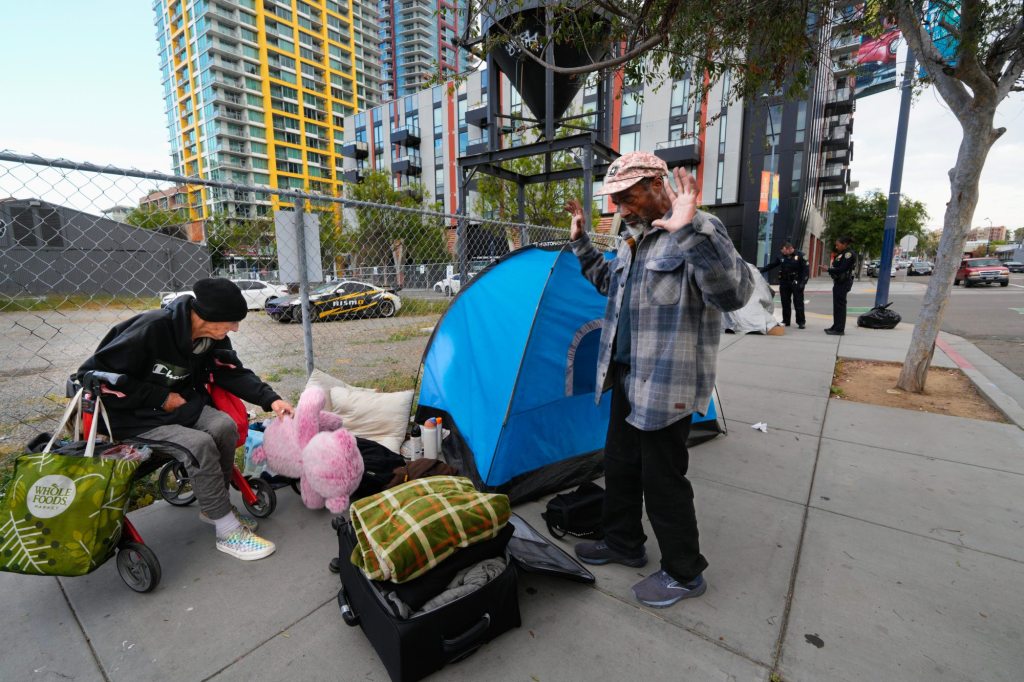
San Diego County has fewer people living on the streets and more in temporary shelter programs this year, according to results released Friday from the annual Point in Time Count, but the number of unhoused elderly people and families continues to increase.
The annual count conducted by volunteers on a single morning in January is a snapshot of homelessness in the region. It’s one of many tools to indicate the overall need for housing, and it’s a federally mandated element in many assistance programs.
Overall, homelessness decreased by 1% in the county, from 9,905 individuals in 2025 to 9,803 in 2026, according to the information provided by the Regional Task Force on Homelessness, which oversees the count.
The number of people in shelters increased from 4,191 in 2025 to 4,695 this year, up 12%, the results show. People contacted on sidewalks and in cars, parks, abandoned buildings and outdoor camps declined from 5,715 in 2025 to 5,108 this year.
“This is what progress looks like,” task force CEO Tamera Kohler said in a news release. “We’re seeing good results where we’ve made investments … in diversion, sheltering, and encampment resolutions.”
The region needs to invest more resources in housing, she said. Meanwhile, the future is uncertain for funding from the federal Department of Housing and Urban Development for assistance programs.
This year’s overall decline is the second since 2024, when 9,905 homeless people were tallied in San Diego County for the region’s first drop in several years. Before that, the numbers had increased each year since 2020, although there was no count in 2021 because of the COVID-19 pandemic.
The city of San Diego has the region’s largest homeless population, more than 60% of the countywide total. San Diego saw a 6.6% decline in its total unsheltered residents, going from 3,354 in 2025 to 3,132 this year.
East County showed the biggest improvements, with an overall 37.4% decline in the total unsheltered population, from 712 in 2025 to 446 individuals this year. Santee led the way with a drop of 64.1%, going from 53 individuals to 19. El Cajon, which includes some unincorporated communities, dropped by 39.5%, from 344 people in 2025 to 208 this year.
Task force officials attributed East County’s good showing to new programs such as a recent state-funded effort in Lemon Grove that placed more than 30 individuals into housing in just weeks through coordinated outreach, landlord partnerships and intensive support services.
“Progress like this doesn’t happen by accident,” Akilah Templeton, chair of the task force’s Continuum of Care advisory board, said in the release.
“It reflects the work of service providers, outreach teams, local governments, and volunteers across the region,” Templeton said. “At the same time, we must continue expanding housing and services to meet the scale of the need.”
South County saw a 14.8% overall decline in unsheltered homelessness, going from 623 individuals in 2025 to 531 this year.
Inland North County had a decline of 10.1%, going from 515 unsheltered in 2025 to 463 this year. The largest percentage decrease was a 76.7% drop in San Marcos, down from 30 individuals in 2025 to seven people this year. Meanwhile, Vista’s total was up 9%, from 44 people to 57.
Coastal North County recorded an increase of 5.1%, up from 510 in 2025 to 536 this year. Oceanside had the largest increase, 13.8%, going from 318 in 2025 to 362 in 2026. Carlsbad was up by 8.9%
However, the largest share of the increases in Oceanside and Carlsbad were people in some sort of emergency or transitional housing program. That supports Koehler’s observation that assistance programs help get people off the streets and into temporary shelters, where they can work toward finding a permanent home.
Of the 237 individuals counted in Oceanside, 109 were in emergency shelters, 87 were in transitional housing, and 11 were in the county’s “safe haven” program for people with mental health or addiction problems. In Carlsbad, the number of people in emergency shelters increased from 42 in 2025 to 61 this year.
Some of those programs in Oceanside and Carlsbad are funded by a $11.3 million, three-year grant they received in 2024 from the state’s Encampment Resolution Fund.
The grant money was specifically intended to help find homes and provide support services for individuals in persistent outdoor camps along 3.6 miles of the state Route 78 corridor shared by the two cities.
Cities throughout the county are struggling to address an increase in homeless adults ages 55 and older. Seniors accounted for 33% of the unsheltered population this year, up from 29% in 2025, and more than half of them were experiencing homelessness for the first time, according to task force officials.
Family homelessness also was up this year. About 49% of those contacted said they were homeless for the first time, and 80% said they lived in San Diego when they became homeless.
Among the favorable trends noted was a decline in unsheltered veteran homelessness, down 12%; unsheltered people ages 18 through 24 dropped 26%; and people living in vehicles decreased 14%.