
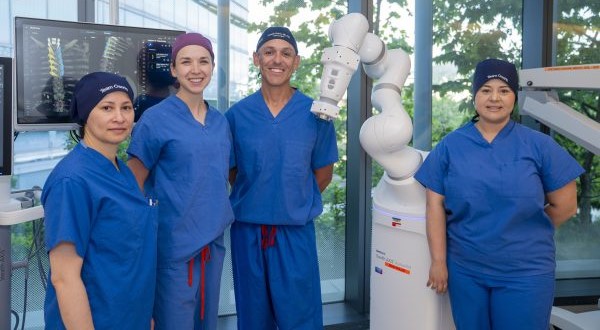
Artificial intelligence recently entered the medical arena in a new way, with UC San Diego Health integrating AI guidance into a first-of-its-kind robotic spinal surgery.
This new platform aims to offer more precise medicine with higher initial success rates by combining computer technology, customized implants, imaging and robotic assistance to help surgeons operate with greater accuracy. The robot also provides a detailed 3D view of the patient’s spine, adding extra safety measures when placing implants.
The technology is being credited with streamlining operating room workflow, reducing procedure time and supporting recovery.
UCSD is the first health system on the West Coast to perform spinal surgery with it.
“This platform fundamentally changes how we think about spine surgery,” said Dr. Joseph Osorio, an associate professor of neurological surgery at the UC San Diego School of Medicine in La Jolla. “For the first time, we are bringing together artificial intelligence, data-driven alignment planning, patient-specific implants, navigation and robotic screw delivery within a single system. That level of precision and coordination allows us to operate more efficiently while significantly enhancing safety for our patients.”
Osorio said the platform is unique in that it brings together different technologies currently in use and makes them all available in one place, with AI assistance.
For example, he said, the platform provides ways for surgeons to see in real time whether a patient’s spine is in alignment and that rods and screws are placed as needed for the surgery to be successful and in accord with the operation plan.
“Many times I would have to stop [surgery] and get an X-ray and measure the X-ray myself to make sure I’m reaching the goal,” Osorio said. “Now I can get that X-ray during surgery and a robot arm shows me how to measure where things are compared to where they need to be and whether I am on target or not.”
Additionally, when performing spinal fusions (procedures that stabilize the spine), “I am putting rods and screws into the spine … and with the AI, it uses the image of the spine and automatically puts in a suggestion of what size screw and where it should go, and the robot arm can take me to that spot,” Osorio said. “It cuts down on time and improves accuracy.”
Another element of the platform is new technology that can perform a CT scan while the patient is on the table, which Osorio said provides “lower radiation for the patient and a better image to plan off of.”
Another key feature is that the AI can integrate data from past surgeries to see what might have gone wrong or not been addressed so the issue can be resolved with fewer procedures.
But for those who might be concerned about the prospect of AI leading surgery, Osorio said that is not the case and that the human touch is still very much involved.
“There are stop points and checkpoints all along the way,” he said. “Just like [when] we use ChatGPT for suggestions on how to draft something, we don’t have to take it word for word. It’s not that the [technology] is doing the surgery for me; it adds these extra measures to make it safer. I have to look at and check it all, and once I have approved it, we can use it. … But the robot has 12 eyes, whereas I have two.”
UCSD Health has been using robotics in surgery for years, he said, but this new platform is “the next generation” in that “different AI components are finally coming together.”
Though there are plans for other facilities across the country to integrate the platform, Osorio said it is cost-prohibitive for many. So in the meantime, surgeons from around the world have been flying to San Diego to observe surgery that uses the technology.
“This platform represents a step closer to precision medicine, whereas spinal medicine has been riddled with variability,” Osorio said. “No one — not the patient, not the surgeon, not the hospital — wants repeat surgeries. This helps us continue to make strides in that direction.
“Sometimes you do surgery and they fail. This gives us that prediction upfront and now we leave the OR having achieved the goal we set out to achieve.” ♦