
OAKLAND — The city’s leaders may ask voters this November to scale back the wide-ranging powers of the Oakland Police Commission, throwing one of the country’s strongest law-enforcement oversight bodies back into the political fray.
Under a new proposal, the commission would no longer have the ability to help hire the police chief or appoint the city’s inspector general, while its own members would get more direct supervision from the Oakland City Council.
Supporters of the proposed measure say it will provide more stability for Oakland’s police chief position by having the role be accountable directly to the mayor alone. The city is once again grappling with an extended vacancy in the chief job, following the departure last fall of Floyd Mitchell, who openly bristled about needing to answer to the citizen volunteers who are appointed to the police commission.
Councilmember Ken Houston, a police-union ally who authored the new initiative, said the process of replacing Mitchell with a permanent hire has taken too long.
“They have gotten too comfortable with those seats,” Houston said of the commission. “They should be more of an advisory board.”
The city council next month will consider placing the proposal on the November ballot. Houston said he expects the measure to win popular support.
“It’ll be easy — I’ll talk to the voters,” he said.
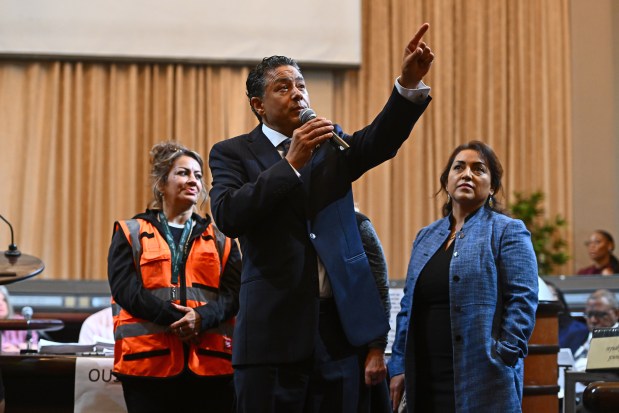 Oakland city council member district seven Ken Houston speaks during the 2025 Inauguration Ceremony held at Oakland City Hall in Oakland, Calif., on Monday, Jan. 6, 2025. (Jose Carlos Fajardo/Bay Area News Group)
But voters overwhelmingly approved establishing the commission in 2016 under the promise that a local oversight body would keep a close eye on the scandal-ridden Oakland Police Department, which is separately under the oversight of a federal judge.
The commission and mayor are the only two local entities that can fire the chief, though the mayor can do so without cause. That power would remain in the commission’s purview if voters approve the new initiative, but the volunteer body would be stripped of its ability to lead the recruitment of a new police chief.
Currently, the commission narrows the field of candidates to a shortlist it presents to the mayor, who decides the final hire. Under the new rules, the mayor would be solely in charge of those duties — aligning the process with that of hiring other department heads.
“There certainly are structural issues that need to be addressed in the city charter section about the police commission,” said Councilmember Kevin Jenkins, the council’s president, who along with Houston has led a tidal shift in Oakland’s policy direction.
“There is definitely a role for civil oversight,” Jenkins added. “If you look at the last police chief hires, I don’t want to critique the police commission but we need a little more expedience in doing our due diligence in the hiring process.”
In the years since its formation, the commission has found itself rife with infighting and embroiled in conflicts with elected leaders, including ex-Mayor Sheng Thao, who briefly sought to pursue a similar ballot measure in 2024 to challenge the commission’s powers.
Thao’s efforts never got off the ground, and the conventional wisdom in Oakland’s political circles is that taking on the commission is a tall task, given that a 2020 measure to strengthen the commission’s authority received 81% voter approval.
The commission’s members are currently appointed by an independent selection panel, which itself is staffed by a combination of the mayor and council.
 Oakland interim police Chief James Beere at police headquarters in downtown Oakland, Calif., on Tuesday, March 24, 2026. Beere has applied for the permanent chief’s position. (Jane Tyska/Bay Area News Group)
It is a delicate power structure, the foundation of which began to wobble when Jenkins and Houston orchestrated the ouster earlier this year of two commissioners, Ricardo Garcia-Acosta and Omar Farmer, after the commission’s critics accused Farmer of overstepping his authority. The two commissioners continue to fill their seats, though in a holdover capacity.
The chair of the selection panel, Rickisha Herron, compared the council’s actions to “bullying” before Jenkins dismissed her in February.
Now, under Houston’s proposed initiative, the selection panel would go away altogether, allowing the council to appoint and supervise commissioners directly.
“The reason why the voters made the panel an independent body is because they did not want politics involved in the selection of an oversight body,” Herron said in an interview. “Having the city council make the decisions around oversight in the past (before the commission formed) was ineffective.”
Among the commission’s most prominent opponents is the Oakland police officers’ union. Its president, Sgt. Huy Nguyen, acknowledged in an interview during the commission’s staffing standoff that he had conferred with council members about his criticisms.
OPD is arguably as close as ever to exiting the oversight of a federal judge, where the department has remained for over two decades following the infamous Riders brutality scandal. A monitor appointed by the judge oversees OPD’s affairs, submitting reports on the departments progress.
Earlier this year, Judge William Orrick praised Mayor Barbara Lee and Interim Police Chief James Beere — who has submitted his name for consideration in the permanent chief search — for department reforms, hinting that Oakland may be nearing the finish line.
In light of that possibility, police accountability advocates are confident voters will again support the commission, which intends to take the reins from the federal monitor as OPD’s primary watchdog.
“Otherwise,” said one of those advocates, Rashidah Grinage, “we run the risk of backsliding into the behaviors that got us into (federal oversight) to begin with.”
Shomik Mukherjee is a reporter covering Oakland. Call or text him at 510-905-5495 or email him at shomik@bayareanewsgroup.com.