


Second in a series of introductions of candidates for California governor running in the 2026 Primary. The top two vote-getters in the primary election – regardless of party preference – move on to the general election in November, according to the California Secretary of State.
California gubernatorial candidate and billionaire Tom Steyer has used his wealth and resources coming from both his business and non-profit experience to support families, students and middle to lower class Californians.
That includes Beneficial State Bank, TomKat Ranch, NextGen America, NextGen Policy, and The Giving Pledge, all of which Steyer believes have set him up to run the fourth-largest economy in the world.
Steyer is running for governor to help Californians achieve stability through affordable homes, an improved cost of living, and more access to education and healthcare.
Steyer sees this potential in the income the state accumulates each year, as well as all the taxable billionaires and mega corporations that reside in the state , all of which his regular reach and funds can’t cover for the state by itself.
Steyer was born and raised in New York, but has been based in San Francisco since 1986, after completing degrees from Yale University in 1979 and the Stanford University Graduate School of Business in 1983.
Steyer founded an investment management firm in 1986, which was renamed in 1990 to Farallon Capital Management.
He was a senior managing member for the hedge fund company until he stepped down, and had his shares bought out from the billion-dollar company in 2012 to focus on public service.
Steyer then founded NextGen America, a political organization focused on voter education registration and mobilization for young activists of all backgrounds in 2013.
Steyer served as president of the organization for six years before leaving, but has been involved with politics ever since.
In 2019, Steyer launched a campaign for the 2020 Democratic Presidential nominee.
He focused heavily for the party’s nomination in the South Carolina primary, but dropped out in February of 2020 after former Vice President Joe Biden won South Carolina’s Democratic nomination.
“There’s no question today, this campaign, we were disappointed where we came out,” Steyer said in an interview with CNN following the 2020 race. “But I said that if I didn’t see a path to winning, that I’d suspend my campaign. And honestly, I can’t see a path where I can win the presidency.”
Though Steyer had suspended his campaign for that job, he continued his work in addressing quality of life issues and is why he wants to run for governor.
As we near the 2026 California Primary, Steyer has self-funded almost $147,067,000 million out of $147,258,000 million for his campaign as of Monday, April 27, which is the second most for campaign funding in California’s history.
The highest was Meg Whitman’s 2010 California gubernatorial race campaign, with over $176 million and included a little over $144 million from the candidate herself, according to the California Secretary of State website.
Whitman would go on to win the Republican candidacy but ultimately lose to the eventual California governor, Democratic nominee Jerry Brown.
Steyer has spent millions on his campaign with numerous ads that focus on his top issue, the cost of living, by addressing unaffordable and lack of available homes, greatly funded and accessible education, universal public healthcare, taxing billionaires and closing tax loopholes, climate change, and the high cost of electric, oil and gas prices.
According to the website, 270 to Win, the five most recent polls as of Tuesday, April 28 for the Primary Election were taken by surveying a minimum of 800 voters and were averaged to find that Steyer is in third in voting with 15.4%.
Republican candidate and political commentator Steve Hilton sits at the top with 18.8%.
He is followed by Democratic candidate and the former attorney general of California and United States Secretary of Health and Human Services Xavier Becerra, who is polling near 16.4%.
In April, City Times published the 2026 edition of the City College Community Agenda, a survey that identified issues that students, faculty, staff and community members cared about.
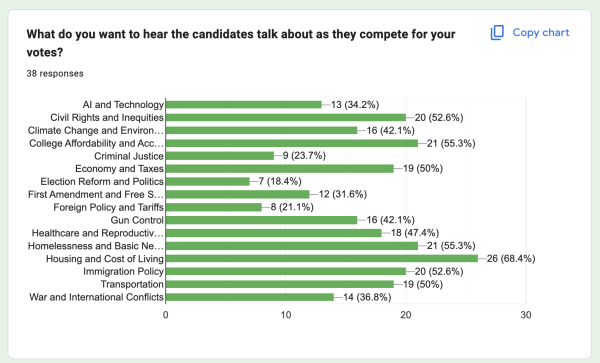 Results of the City College Community Agenda survey, as of Wednesday, April 29, 2026. Source: Google Forms
City Times Media is using the results to focus its election reporting, breaking down gubernatorial candidates’ statements shared through official sources and made during debates and forums.
Early survey results identified eight issues that matter most to the City College community.
Here is how Steyer stands on each issue.