
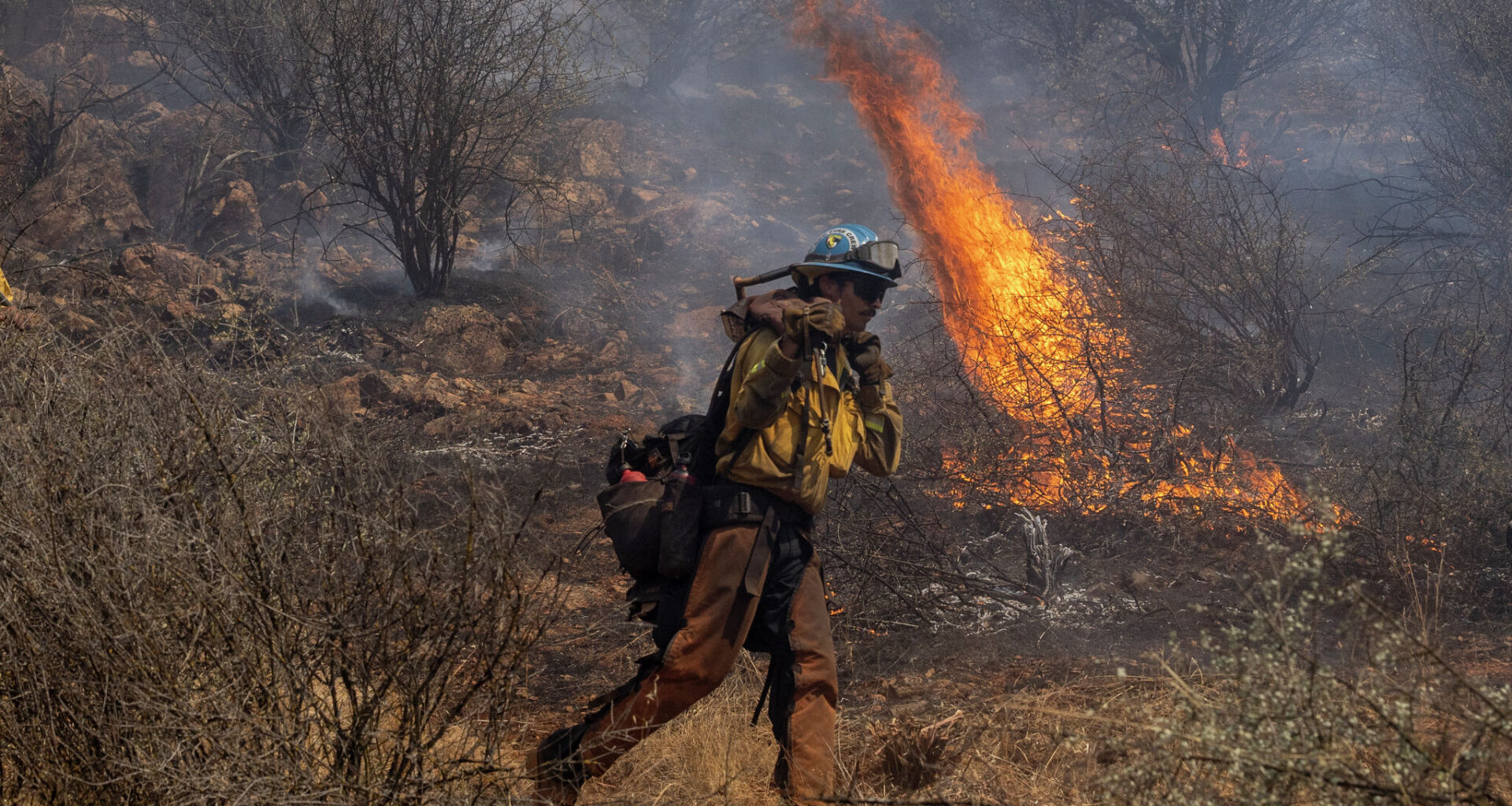
A firefighter walks by a burning bush near Chinese Camp (Tuolumne County) in September 2025. Officials predict above-normal wildfire activity in much of Northern California in June, July and August due in part to a low spring snowpack and what is expected to be a hot summer.
Stephen Lam/S.F. Chronicle
A thin snowpack is making Northern California and the West vulnerable to major summer fires as forests dry quickly.
Fire activity is expected to be above normal in June for the Bay Area, Sacramento Valley, northern Sierra foothills, parts of the North Coast and much of northeast California, according to a forecast released Friday by the National Interagency Fire Center.
By July and August, the fire danger will expand to mountainous regions, including Tahoe, the Trinity Alps and southern Cascades. Summer fog is expected to take an edge off fire danger along the coast.
Article continues below this ad
California got plenty of rain this winter. But the weather was warm, and not enough snow fell. California’s snowpack stood at just 21% of normal Friday, with less in the north and more to the south. That means drier vegetation at high elevations as summer kicks in.
The burst of spring rain last month, while helpful in the short-term after the very warm and dry March, will increase fire danger by midsummer, according to Cal Fire battalion chief David Acuña. That’s because renewed grass growth will provide more fuel for blazes when heat waves dry the landscape out.
San Francisco Chronicle Logo
Make us a Preferred Source to get more of our news when you search.
Add Preferred Source
“April showers bring May flowers, but what nobody talks about is that by the end of May, the flowers have died and now they are light fuel ready to burn,” Acuña said, adding that dense grass “can be very dangerous,” once it dies.
Article continues below this ad
Brent Wachter, a meteorologist with the Northern Operations Predictive Services unit, said large May fires are possible, but he doesn’t expect “an unusual amount unless we get into a higher frequency of dry-gusty wind events.”
Meteorological conditions during the summer could have a significant impact on the fire outlook, said John Abatzoglou, a climatologist at UC Merced.
Warm seas in the northeast Pacific coast, combined with a surging El Niño, are predicted to help make summer hotter than normal in California. However, short-term heat waves are a bigger influence on fire activity because of “flash drought” that rapidly dries the landscape, Abatzoglou said. Such events are impossible to predict more than a few weeks in advance.
Intermittent tropical moisture could also bring bursts of rain that temper fire danger.
The North American monsoon, which largely affects the Southwest, and the northeast Pacific hurricane season are forecast to be unusually active. While the winds of tropical cyclones rarely hold together upon reaching Southern California, remnant moisture can, like Tropical Storm Hilary in 2023.
Article continues below this ad
Partly for these reasons, Southern California is expected to have near-normal fire activity from May through August.
The National Interagency Fire Center predicts above-normal wildfire potential across much of Northern California, the Northwest and Rocky Mountains in July. Below-normal snowpack throughout nearly all of the West has preconditioned the landscape for fire, experts say.
National Interagency Fire Center
It’s unlikely the Bay Area sees significant summer rain from the monsoon or a remnant tropical storm, but Wachter said the Sierra Nevada is a wild card.
Dry lightning — thunderstorms accompanied by little to no rain — can spark wildfires. Active monsoon and tropical storm seasons typically yield more thunderstorms in the Sierra — and though they are often accompanied by rain to the south, that’s less the case in the north, where the lightning would typically be dry. Last summer, a lightning-sparked fire devastated the historic Gold Country town of Chinese Camp (Tuolumne County).
“I suspect this year will be the year of changes with more focus on the short-term happenings,” Wachter said. “I will be very curious how this season shakes out month by month.”
Article continues below this ad
California isn’t only the part of the West expecting an active fire season.
The warmest and fifth-driest 12-month stretch on record in Oregon has pushed more than two-thirds of the state into drought, according to Thursday’s U.S. Drought Monitor update. Drought covers just 5% of California, by contrast.
More than two-thirds of Oregon and three quarters of Nevada are in drought, compared to less than 5% of California, according to Thursday’s U.S. Drought Monitor update. California’s drought areas are in the northeast, represented by the light brown patch on this map.
Baron/Lynx
Oregon state climatologist Larry O’Neill said officials are “holding our breath” while waiting for fire season. “Most indications currently point to an early and active wildfire season for much of Oregon this year,” he said.
In 2023, smoke from fires in southern Oregon drifted into the Bay Area, degrading air quality for significant stretches of the summer. That could happen again this summer if blazes erupt.
Article continues below this ad
“Wildfire smoke knows no boundaries,” O’Neill said. “Washington, Oregon and California have traded smoke a lot over the last 10 years.”
NIFC predicts above-normal fire danger in at least parts of every Western state at some point from May through August. That includes Nevada, where deputy state climatologist Thomas Albright says he is “pretty concerned,” since everything from snowmelt, peak streamflow to vegetation growth is happening early this year.
Low snowpack and early snowmelt make fires more likely and severe. A recent study projects snowmelt in California will occur more than a week earlier for every degree Celsius of global warming.
Experts expressed concerns that firefighting resources could get stretched thin if much of the West is ablaze simultaneously, but Cal Fire’s Acuña says the agency is staffed adequately and prepared to keep 95% of fires less than 10 acres, consistent with the agency’s long-term goal. He also said Cal Fire is available to assist with federal incidents in California and in neighboring states.