
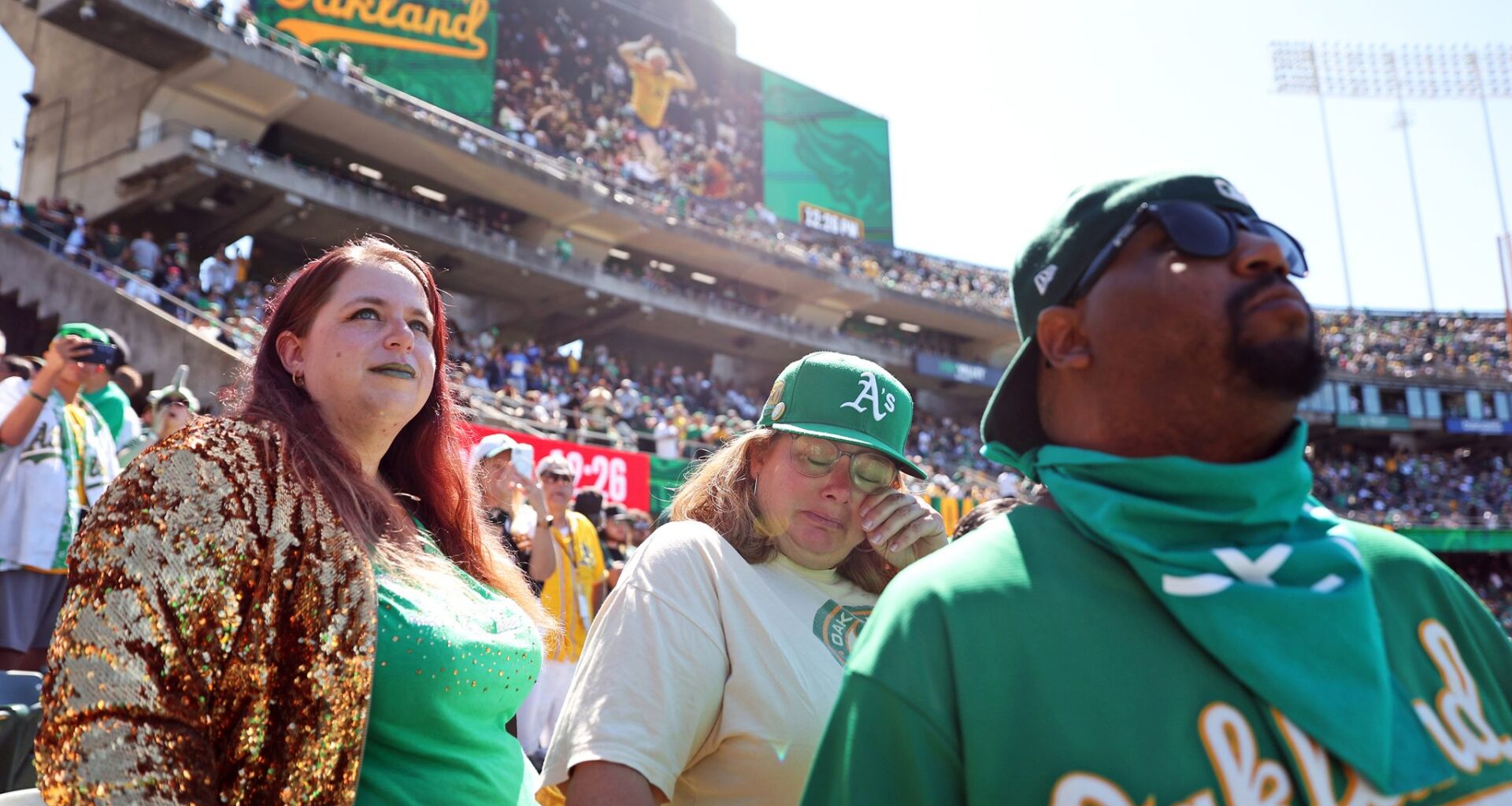
Oakland Athletics fans April Kenton of Tracy, center. and Sara Dunaway of San Leandro get emotional as a tribute to the Oakland Coliseum is played before the A’s final game in Oakland on Sept. 26, 2024.
Scott Strazzante/S.F. Chronicle
In Oakland, professional sports weren’t just entertainment. It was a shared language. It didn’t matter what neighborhood you lived in or what job, race, age or gender defined you. You could always talk about our local sports teams.
My three brothers and I were kids when the Athletics arrived in 1968. Brought in by owner Charlie Finley, with his flair and sense of spectacle, the team felt larger than life — and somehow, still completely ours.
I remember piling into my dad’s flashy yellow Thunderbird in the early 1970s and driving to King Junior High School (which became King Estates Middle School before closing in 2005) for a fan event featuring A’s outfielder Joe Rudi and third baseman Sal Bando. That afternoon, we shared a few laughs with Rudi, making the line separating fans from players feel paper-thin.
Article continues below this ad
A few years later, my brother was friends with one of the A’s ball girls, and Reggie Jackson drove them home after a game and stayed to field questions from the neighborhood kids buzzing around our block on their dirt bikes.
It wasn’t just baseball. My parents used to get dressed up to attend Raiders’ games — a cocktail dress and a tie — like it was a night out. Or we’d go to brunch at Rickey’s Sports Lounge in San Leandro, where every TV was tuned to the game, and families, after coming from church, gathered in semi-circular leather booths. Oakland sports teams were woven into the fabric of everyday life.
Raiders fans react to a great stand by Oakland’s defensive unit on Sept. 3, 1995.
BRANT WARD
I remember hearing stories about Golden State Warriors forward Purvis Short showing up at Mosswood Park to play pick-up games and how the energy of televised Warriors games carried into neighborhood streets with portable hoops.
San Francisco Chronicle Logo
Make us a Preferred Source to get more of our news when you search.
Add Preferred Source
Our love for our teams created a shorthand between strangers — an easy, unspoken way to connect in a city where people often lived very different lives. On a BART platform, in a Kaiser waiting room or standing in line at the Safeway on Fruitvale, you could always start a conversation with: “Did you see that game?”
Article continues below this ad
And just like that, barriers dropped.
Thaddeus Gil and his wife, Angie, pose for a portrait before Game 2 of the Western Conference playoffs between the Golden State Warriors and the Los Angeles Clippers in Oakland’s Oracle Arena on April 15, 2019.
Gabrielle Lurie/The Chronicle
As a former Alameda County public defender, I witnessed the bond of being an Oakland sports fan on display in the courtroom. Judges, prosecutors, public defenders — we often stood on opposite sides of deep and consequential disagreements. But mention the A’s, the Raiders or the Warriors, and suddenly there was common ground. A conversation would start and shared recognition would emerge. And for a fleeting moment, the distance between courtroom combatants narrowed. That connection mattered.
In a city as diverse as Oakland, this shared language was priceless. And now it’s gone. The Raiders left. The Warriors crossed the bridge. And the A’s — the last thread holding it together — are gone, too. Maybe the hardest part is that we didn’t fully understand what we had until it was gone. We didn’t just lose teams. We lost a way of talking to each other.
These weren’t just teams. They were part of the connective tissue of Oakland — something that gave people a shared point of reference in a place defined by its differences. Oakland still has pride. It still has community. But the kind of common language our teams created is not easily replaced. Recreating that kind of unifying experience is difficult, and far more necessary than we understood.
Article continues below this ad
I don’t know exactly what Oakland should do next, but I do know this: Having a presence in the national sports spotlight did more than draw attention; it created a shared experience and a shared language in Oakland. Without that, it’s hard to imagine being able to rebuild anything that comes close to what was lost.
Slugger Reggie Jackson of the Oakland Athletics mingles with fans in front of the A’s dugout in September 1969.
AP
For a long time, we had something rare in Oakland, and in its absence, we see just how special it was. I think about the decades of A’s games I attended, first as a kid and later with my son. I can still hear “Let’s go, Oakland!” echo through the Coliseum, and I can see the Oakland hills and Leona Quarry rising beyond the field.
Guest opinions in Open Forum and Insight are produced by writers with expertise, personal experience or original insights on a subject of interest to our readers. Their views do not necessarily reflect the opinion of The Chronicle editorial board, which is committed to providing a diversity of ideas to our readership.
Read more about our transparency and ethics policies
My hope for Oakland is to once again have a team on the national stage that brings the city together in a single proud chant of “Let’s go, Oakland.”
Article continues below this ad
Adrienne Elenteny is a retired Alameda County public defender who grew up in Oakland.