
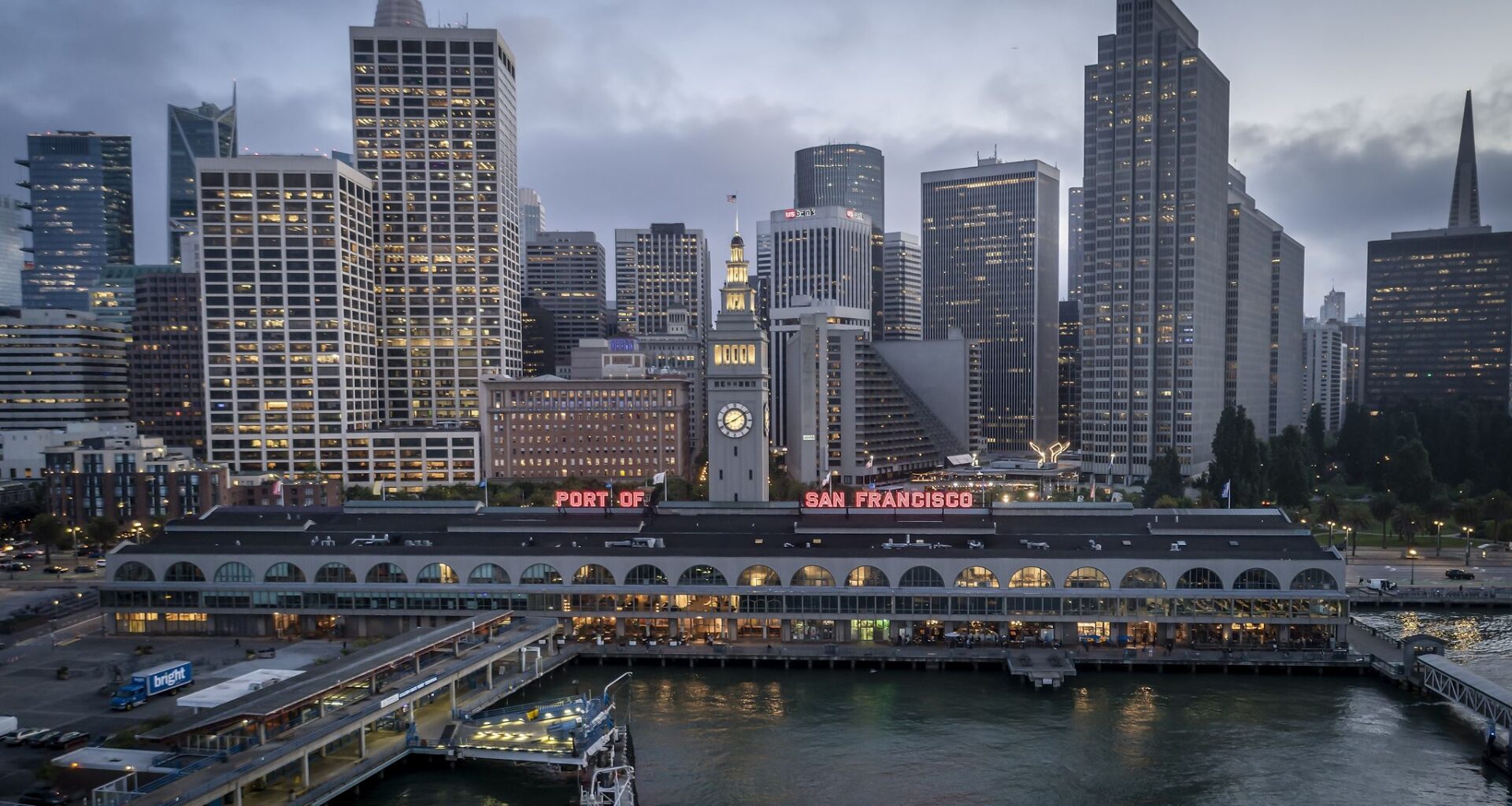
The Ferry Building, seen here this year, survived the 1906 earthquake. But prior shaking could have weakened the timber piles that were driven into the mud below the building long ago.
Carlos Avila Gonzalez/S.F. Chronicle
Parts of the San Francisco Ferry Building could collapse in an extreme earthquake, as foundation supports fail beneath sections of the building, its south promenade and back waterfront plaza, according to a previously unreported engineering analysis.
The 2024 seismic resilience report also found key structural weaknesses in the building’s 245-foot clock tower that could leave it unstable even in a less extreme quake, posing a risk to the thousands of people who pass through the transit and tourism hub each day.
Commissioned by the Port of San Francisco, which owns the building, the report outlines various possible earthquake scenarios, including a worst-case event statistically expected to occur every 975 years. Such an extreme earthquake, according to a port engineer, would be comparable to a magnitude 8 earthquake on the San Andreas Fault that funnels its energy towards the city, and there’s a 5% chance one could hit the Ferry Building in the next 50 years. But in more common, 100-year events — similar to the magnitude 6.9 Loma Prieta earthquake in 1989 — the structures are not expected to pose any safety risks.
Article continues below this ad
While the port has broadly spoken about the Ferry Building’s earthquake risks, the 845-page report, prepared by the engineering firms CH2M and Arcadis, wasn’t publicized when it was completed, and was only recently provided to the Chronicle upon request. Its conclusions raise difficult questions about how to safeguard one of the city’s major landmarks, though engineers say the Ferry Building’s worst-case risks are broadly similar to many older buildings in San Francisco.
“I don’t think there’s any more danger than there are in a lot of the buildings people are living in, working in, occupying every day,” said David Ojala, the president of the Structural Engineers Association of Northern California, who was not involved in the report. “It’s not where we’d like them to be, but unfortunately, a lot of the buildings in our city aren’t quite meeting that (collapse prevention) threshold (for 975-year events) as much as we’d like.”
The Ferry Building, shown here in 2025, has seen increasing number of visitors in recent years. The thousands of people who walk or work in the Ferry Building each day would be exposed to collapse hazards from structural and decorative components in an extreme earthquake.
Gabrielle Lurie/S.F. Chronicle
Still, engineers noted that people within or adjacent to the Ferry Building, home to offices as well as popular restaurants and ferry services, are exposed to collapse hazards from both structural and nonstructural components, such as decorative features. (Hudson Pacific Properties leases and manages the Ferry Building along with PIMCO Prime Real Estate. Hudson Pacific referred questions to the Port but noted the building falls under a companywide earthquake insurance policy. PIMCO did not respond to a request for comment.)
San Francisco Chronicle Logo
Make us a Preferred Source to get more of our news when you search.
Add Preferred Source
The Beaux-Arts style building, constructed on a foundation of timber piles driven into mud, was eight years old when the 1906 quake struck. That quake is considered comparable to a major, 225-year event in the report’s terminology. Despite the devastation it caused, 1906 was not as catastrophic as it could have been as the rupture directed much of its energy away from the city.
Article continues below this ad
The disaster damaged the clock tower, but the building survived. Yet strong shaking in 1906 and again in 1989 may have also weakened the timber piles, engineers said — though to what extent is unknown because they are underground.
In an extreme, 975-year scenario, the Ferry Building’s outer, sea-facing wall could fall. The support piles beneath the building closest to the waterfront could reach their breaking point, potentially causing parts of that wall and the floor at the first level to collapse, which in turn could create collapse risk for the upper levels and roof of the building. However, loads can sometimes be redistributed to still-standing portions of a building, said Steven Reel, the Port’s deputy program manager for its waterfront resilience programs, who oversaw the report. A port official also noted the report was focused on the building’s substructure, rather than potential knock-on effects higher in the building.
The Ferry Building, seen here in 2025, hosts restaurants and offices as well as being the terminal building for ferries.
Gabrielle Lurie/S.F. Chronicle
While Reel said a full collapse is unlikely in a 975-year scenario, he noted it is difficult to predict how structural failures would unfold.
In a major, 225-year event, pressure would build in parts of the foundation, causing cracking and localized weakening.
Article continues below this ad
The clock tower is particularly vulnerable. Weaknesses in its bracing and support columns create a “considerable risk” it could topple in an extreme earthquake, likely after leaning to one side, Reel said. In a major quake, it would have a lesser but still meaningful risk of falling.
This could complicate the city’s disaster response, since the area is designated as a major escape route from the city, and a fallen tower would limit its use.
The analysis, however, relied on worst-case estimates for several unknowns, including wall thickness, which could affect how resilient the clock tower is to shaking. The report, which is considered preliminary, recommends a second, more rigorous engineering analysis for the clock tower and the building’s substructure. Reel said the Port is considering commissioning the studies within the next two years.
Both the Ferry Plaza behind the building and the walkway south of it face collapse risks. In an extreme — 975-year — earthquake, many support piles would be pushed close to collapsing. In a major — 225-year — earthquake, the support piles would likely be damaged, leaving both areas in need of repair, though still standing.
Parts of the Ferry Building, including the iconic clock tower, as well as the Ferry Plaza and the south promenade, all face collapse risks in a extreme earthquake.
Port of San Francisco
The analysis recommends retrofitting or replacing foundation supports under the plaza and promenade. It also recommends soil improvements to reduce the effects of ground spreading in an earthquake — the sideways movement and cracking of earth that can cause further structural damage.
Article continues below this ad
A lead author of the report, from the engineering consultancy CH2M, redirected questions to port officials.
The findings come to light as the Port pursues a $13.5 billion effort to strengthen flood and earthquake defenses, including potentially replacing bulkhead wharves, along 7.5 miles of San Francisco’s shoreline. Engineers intend to replace the seawall and elevate the Ferry Building to protect it from sea level rise and simultaneously address its seismic issues over the coming decades. Reel said the port is planning to retrofit the Ferry Building substructure, clock tower, plaza and southern walkway as a part of that plan, which will cost up to $1 billion.
Despite the risks posed by extreme earthquakes, Reel noted the Ferry Building’s sturdiness makes it a relative success given its age and how its substructure was originally constructed with unreinforced concrete — a material that was later discovered to perform poorly in earthquakes.
The Ferry Building’s 245-foot clock tower, seen here in 2025, is at risk in both a major or extreme earthquake. Such a failure would complicate the city’s disaster response since the area around the building is designated as an emergency hub.
Gabrielle Lurie/S.F. Chronicle
“There’s a lot of structures in San Francisco that would collapse in this kind of (975-year) earthquake,” Reel said. “If we look at our risk assessment on the waterfront, there’s a lot of damage along the waterfront to structures, and the Ferry Building actually performs better than most.”
Article continues below this ad
“I’m more worried about my house,” he added. “(I’m) not overly worried about being in the Ferry Building.”
Sarah Atkinson, a hazard resilience policy manager at the urban policy nonprofit SPUR, said that while seismic retrofits are critical, San Francisco’s budget deficit, competing priorities and the challenges of securing federal funding — particularly under the Trump administration — could complicate efforts to move projects forward.
“This is not a unique case in terms of identifying seismic risk and not being able to act on it right away,” she said.
The building has a history of resilience. When the 1906 earthquake struck at 5:12 a.m. on April 18, the clock tower swayed back and forth so violently that its diagonal steel braces were pulled apart as rivets snapped, Ferry Building historian and former Chronicle journalist John King wrote in his book on the landmark. But after a long minute of shaking, the building emerged upright, albeit with the tower leaning slightly. A few days later, port engineers wrapped the tower in cable car wire while the structure waited for the reconstruction process to begin.
People dine outside the Ferry Building in July 2025. A new report recommends retrofitting or replacing foundation supports beneath the Ferry Plaza to reduce seismic risks.
Gabrielle Lurie/S.F. Chronicle
Since then, more than a century of ground movement and stress on the supporting timber piles have potentially made the structures more vulnerable to seismic events, Reel said. Still, the building emerged relatively unscathed from the 1989 Loma Prieta earthquake, though the shaking caused the clock tower to get stuck at 5:04 p.m. (The nearby Embarcadero freeway, however, partially collapsed, leading to its eventual removal, which helped the Ferry Building come into its own.)
From 1999 to 2003, the Ferry Building underwent a seismic retrofit as it was converted into a food hall. Reel said engineers at the time determined the foundation supports beneath the building did not require upgrades, given the lower seismic standards for a historic building compared with new construction. But those retrofits did not account for how the seawall or soil movement during an earthquake would affect the foundation, factors that are driving the collapse risk estimates in the new report.