
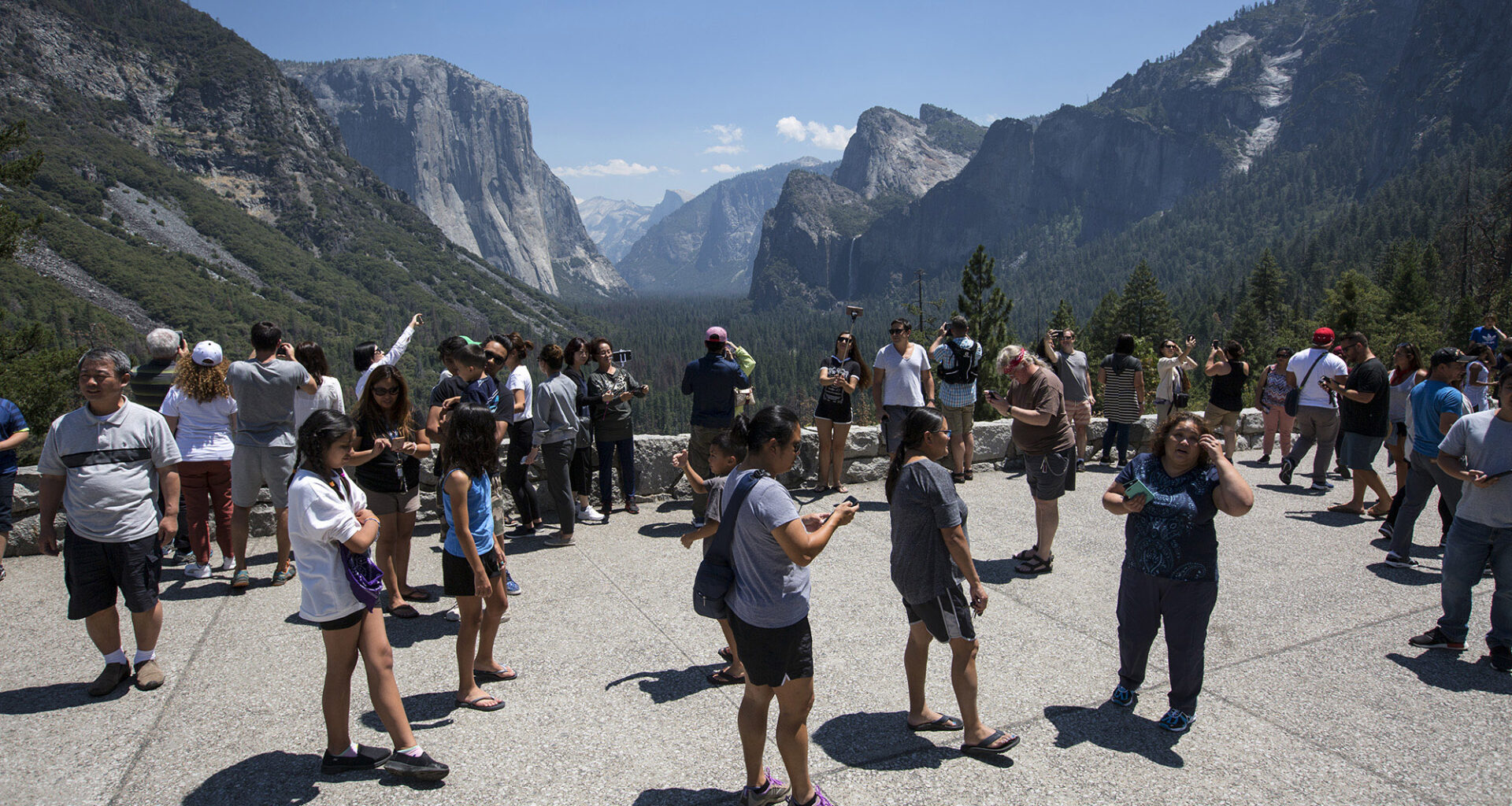
Crowds gather in Yosemite National Park. Yosemite Valley ran out of parking before 11 a.m. Saturday, May 2, 2026, weeks before the summer rush typically brings the park’s heaviest crowds.
Brian van der Brug/TNS
Yosemite Valley ran out of parking before 11 a.m. Saturday, forcing Yosemite National Park to warn visitors to stay away from its busiest area, weeks before the summer rush typically brings the park’s heaviest crowds.
“All parking in Yosemite Valley is full,” the park said in a Nixle alert at 10:59 a.m. “Avoid entering Yosemite Valley.”
About 90 minutes later, the park announced that Hetch Hetchy parking was full and that traffic was delayed about 1½ hours at the south entrance on Highway 41.
Article continues below this ad
The alerts offered an early look at what could become one of Yosemite’s defining challenges this year: how to handle crowding and traffic after the park dropped its peak-season reservation system.
Yosemite is entering its first summer since 2020 without a broad vehicle reservation requirement, a program that had been used in recent years to control traffic during the busiest months and weekends.
Crowds gather at the Glacier Point trailhead at Yosemite National Park. Yosemite Valley ran out of parking before 11 a.m. Saturday, May 2, 2026, weeks before the summer rush typically brings the park’s heaviest crowds.
Jacquelyn Martin/Associated Press
Park officials have said they will instead rely on hands-on traffic management, real-time monitoring, added staffing during peak periods and efforts to steer visitors beyond Yosemite Valley.
San Francisco Chronicle Logo
Make us a Preferred Source to get more of our news when you search.
Add Preferred Source
Saturday’s parking crunch came well before the park’s usual summer peak, when monthly visitation routinely exceeds a half-million in June, July, August and September.
Article continues below this ad
It also came during a spring season when Yosemite’s waterfalls have been a major draw, even though low snowpack and a fast melt-off are expected to shorten the peak waterfall window this year.
The timing is likely to add urgency to a debate that has been building since February, when the Trump administration announced that visitors would not need reservations this year to enter Yosemite, Arches National Park in Utah or Glacier National Park in Montana. Interior Department officials said the move was intended to improve public access.
A full parking lot at the welcome center in Yosemite National Park. Yosemite Valley ran out of parking before 11 a.m. Saturday, May 2, 2026, weeks before the summer rush typically brings the park’s heaviest crowds.
Brontë Wittpenn/S.F. Chronicle
Yosemite Superintendent Ray McPadden has defended the decision, saying earlier this year that the reservation system had become too sweeping a response to a problem that was mostly concentrated in Yosemite Valley on a limited number of peak days.
“A park-wide, seasonal reservation system to address a parking problem on Saturdays, sometimes, during the summer is complete overkill,” McPadden told the Chronicle in February.
Article continues below this ad
McPadden said the park’s review found that reservation slots often went unused in 2025 and that the system created frustration for visitors and extra work for park employees. He argued that Yosemite could manage congestion with a more targeted approach.
“Having the park being full is not a bad thing, it’s not a crisis,” he said. “There’s always been high demand for Yosemite. It’s a wonderful place.”
Crowds at the welcome center in Yosemite National Park. Yosemite Valley ran out of parking before 11 a.m. Saturday, May 2, 2026, weeks before the summer rush typically brings the park’s heaviest crowds.
Brontë Wittpenn/S.F. Chronicle
But former park officials and conservation advocates have warned that Yosemite Valley has hard limits, particularly for cars.
Cicely Muldoon, the former Yosemite superintendent who helped advance the reservation policy before retiring, said earlier this year that reservations were intended to protect the park and improve the visitor experience.
Article continues below this ad
“There’s not limitless capacity in Yosemite Valley for vehicles,” Muldoon said. “You get to a point where it’s just full.”
That point appeared to arrive quickly Saturday.
The park’s alert did not say when parking might reopen or whether visitors were being turned around or redirected elsewhere. Yosemite officials did not immediately provide additional details about traffic conditions.
Delilah Martinez, 8, sits on the back of a truck with her brother Nathan, 10, while eating lunch with their family near little known Ribbon Fall in Yosemite National Park on Thursday, April 2, 2026. The park’s waterfall season is coming earlier than usual this year due to low snowpack and rapid melt-off.
Brontë Wittpenn/S.F. Chronicle
The scene echoed congestion seen during Yosemite’s Firefall season in February, when the park also went without reservations for the popular sunset spectacle at Horsetail Fall. During that period, cars backed up at entrance stations, parking lots filled and visitors reported long delays in Yosemite Valley.
Article continues below this ad
McPadden said then that Firefall created unusual pressure because visitors were concentrated in one place at one time. Summer visitation, he said, tends to be more spread out and easier to manage.
“We’re going to have busy days. We’re going to have busy weekends,” he said. But “we are going to be successful this summer.”
The park is urging visitors to plan ahead, arrive early, use public transportation when possible and avoid driving from place to place once inside Yosemite Valley.