
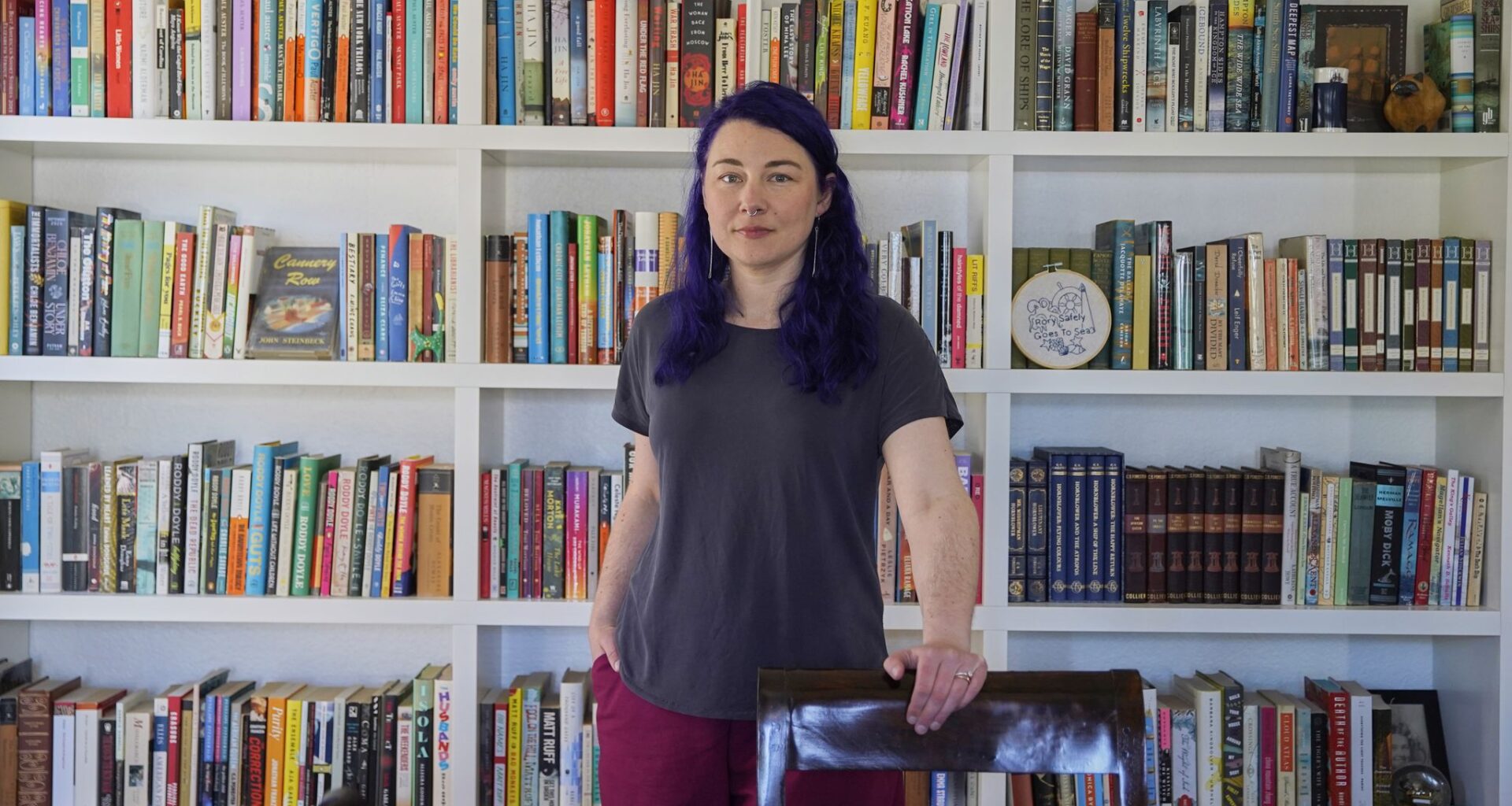
Portia Elan’s debut novel “Homebound” spans centuries, blending grief, technology and the search for human connection in a sci-fi story.
Giselle Garza Lerma/S.F. Chronicle
Before she became a novelist, Portia Elan worked for six years as a teen librarian at San Leandro Public Library.
Human connection, she recalled, was everything in that job.
Homebound
By Portia Elan
(Scribner; 304 pages; $28)
Portia Elan in conversation with Zoe Young: 7 p.m. Wednesday, May 6. Free. Jewish Community Center of San Francisco, 3200 California St., S.F. www.jccsf.org
Portia Elan in conversation with Michael David Lukas: 6:30 p.m. May 13. Free. Mill Valley Public Library, 375 Throckmorton Ave., Mill Valley. www.millvalleylibrary.libcal.com
Debut Night: First Editions with Kate Crane, Portia Elan, and Eric Scot Tryon: 6 p.m. May 27. $45 general admission; $30 for members. Book Society, 2945 College Ave., Berkeley. www.booksociety.social
“A lot of being a librarian is holding nonjudgmental space for people and their needs,” Elan told the Chronicle in a recent video interview from her home in Oakland. For her teen patrons, what they needed was a space to hang out — to film TikTok videos, sure, but also to simply chat or laugh together, in person.
Article continues below this ad
“Many young people are hungry for that bit of connection,” she continued, noting its a breath of hope in an era where screen time seems alarmingly alluring not only for teens but also for people of all ages. “Going out and doing that work of practicing empathy, day after day, made me so much more attentive to other people, and to my characters.”
That same sense of hope and empathy, rooted in finding comfort in companionship, remains a strong thread through the multiple timelines that make up Elan’s first book, “Homebound,” which is for adult readers.
San Francisco Chronicle Logo
Make us a Preferred Source to get more of our news when you search.
Add Preferred Source
An intriguing puzzle box of a novel, the story unfolds around three strong women, each coping with her own sense of grief. At the outset, in 1983, there’s Becks, a prickly 19-year-old student mourning the death of her uncle, Benjamin, who instilled in her a love of coding and games in the early days of computer programming.
U.S. cover of “Homebound” by Portia Elan.
Scribner
Portia Elan’s novel, “Homebound,” with its U.K. cover, on her writing desk in her Oakland home.
Giselle Garza Lerma/S.F. Chronicle
From there, Elan jumps forward six centuries to Yesiko, a fiercely independent sea captain who’s reckoning with the declining health of her only human companion for decades, her crewman Root.
Article continues below this ad
Bridging the two timelines is Tamar, an experimental biologist at UC Berkeley in the year 2078. While grieving the loss of a beloved mentor, she begins work on a project that would use robots to help stave off ecological destruction. One of her research subjects, an android called Chaya becomes central to connecting the plot points as their sentience grows. (Chaya refers to themself by the plural pronoun “we” and sounds “like a chorus of voices speaking all together,” Elan writes.)
“A lot of writing the book was about that question of loneliness, and how do we become less lonely?” Elan said. “For me, that question is never going to be solved in one individual lifetime. The answer to the loneliness of the human condition requires reaching backward and forward, so the book had to include that.”
It’s an ambitious undertaking, especially for writer who considers the English author David Mitchell’s Booker Prize-shortlisted third novel, “Cloud Atlas,” to be her urtext.
But Elan uses her characters’ emotional struggles as the solid, recognizable foundation on which to build up their imagined worlds, a decision that impressed her former writing teacher, Rachael Herron, who in 2023 began seeing early pages of the manuscript that would become “Homebound.”
“For me, (this story) is about fragmentation versus family,” said Herron, a USA Today-bestselling author of more than 30 books, referencing the deep social and online divides that plague modern society. “Everyone nowadays can often despair around this fragmentation, but Portia wrote this book about building deep, true found family and how (these bonds) leave echoes that affect the direct future and then the far-off future.”
Article continues below this ad
Portia Elan, author of “Homebound,” in her home office in Oakland, on April 17.
Giselle Garza Lerma/S.F. Chronicle
Critically, throughout their poignant narratives, each of Elan’s characters engages with the advancements and limitations of the technologies available at the time, influenced by her upbringing in Palo Alto with mechanical engineering professors for parents.
It’s a mix of subject matters that Elan’s publishing team hopes will have wide appeal, as “Homebound” releases in the same week in both the U.S., Canada and the U.K.
“Readers and publishers are more open than ever to genre and world-building and sci-fi,” Elan’s agent, Julie Barer, told the Chronicle via email. “I knew I could send ‘Homebound’ to someone who had never played a video game or watched ‘Star Trek,’ and they would still find something to connect to and love.”
By taking a long view of history in her novel, one that telescopes forward and back in time, Elan remains hopeful about how humanity might make use of the technologies at hand.
Article continues below this ad
“It feels a little scary to me to think about how change is happening fast right now, but then I remember that there has always been what felt like unprecedented, disruptive change — not always for the good, not always without cost,” she said. “But as living organisms, we have always survived it. And I wrote this book because I needed to figure out what would happen to these characters and how they were going to be OK.”
Hannah Bae is a freelance writer.