
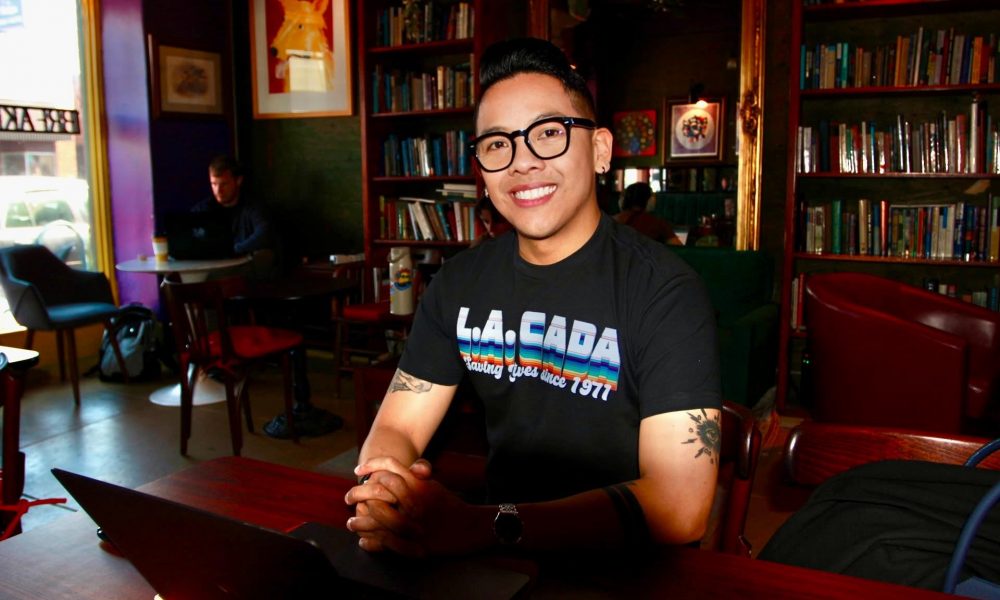
It is with great pleasure that I’d introduce The Los Angeles Blade’s newest addition, Christian Cintron. Cintron is here, queer, and ready to share his voice with our readers, a voice as multifaceted as the communities he represents. Cintron brings a dynamic blend of insight and irreverence to his work as a writer, comedian, and actor. With a résumé spanning roles from marketing executive to drag performer to energy healer, his forthcoming contributions to the Los Angeles Blade promise a perspective shaped by lived experience and deep personal evolution.
While his writing has appeared in Backstage, Hollywood.com, and Queerty, it is his experience in comedy that has most powerfully shaped his writing. The discipline of stand-up, where every word must earn its place, informs his journalistic style, resulting in work that is as sharp as it is authentic. At a time when audiences are often reluctant to engage with more difficult conversations, Cintron bridges the gap with humor and honesty, delivering commentary that invites reflection without losing its sense of wit or humanity.
Welcome to the team, Christian Cintron…
You have been referred to as “a jack-of-all-trades and master of fun.” As a writer, comedian, actor, and spiritualist, you are a true Renaissance man. With such a glistening resume, what can our readers expect in your forthcoming publications for the Los Angeles Blade?
I bring a unique perspective. I’ve been everything from a marketing executive to a drag queen to an energy healer. I remember the times when if you weren’t a straight white man, you had to be exceptional. Those expectations left a lot of us searching for who we are, and I just did a lot of the things I wanted to do and have continued to work on myself.
On the other side of all of these experiences, I’ve found some growth and space for a lot of nuance. This facilitates a lot of the tough conversations we have to have as a society. But we also don’t have the attention spans or want to have them, so I bring a little humor, sass, and pop culture references to help the medicine go down, so to speak.
Your work has graced the pages (or screens) of Backstage, Hollywood.com, and Queerty. How did writing an outlet mold or impact your comedic voice onstage?
Ironically, I think it’s more the opposite that my experience onstage helped me hone my voice, write more clearly and efficiently to handle the workload of a working writer. I think there are a lot of internal blocks and unresolved issues that gum up the works when we’re writing. My time in comedy has helped me work through a lot of that to get my point across. I will say that journalistic writing has taught me word economy, so that’s helped me write tighter jokes.
Now, I wouldn’t find this interview complete without inquiring into your spiritual side. Can you shed some light on your spiritual philosophies and how they influence your written and comedic endeavors?
I think spirituality is 50% what we know in our core and 50% making peace with the unknown. I had a bit of a spiritual awakening. It started when I did drag. Something about healing my own issues with gender really helped me integrate two parts of myself: the part of me that learned strength from women and the man who was able to be myself without feeling emasculated.
Ironically, putting on the mask of drag helped me find my inner masculinity. Then strange things started happening. I was drawn to developing my spiritual side, healing myself, and doing a lot of inner work.
A lot of queer folks have religious trauma. I went to Catholic school for 14 years, from pre-kindergarten to high school. After getting more spiritual, I understood the qualities everyone’s preaching about in Christianity: charity, love, joy, and grace. Growing up around showed me some great tools to live by, but also a lot of fundamental BS, lying, and manipulation. I took a class in college on Satan that literally charted how everything attributed to Satan in the Bible is based on who the authors were beefing with at the time.
This strange cognitive dissonance of people claiming Christianity “above all else” but not being remotely Christ-like really highlights the spiritual sickness of American culture. I try to bring healing to people by saying the quiet part out loud. Deputizing people to speak their truth and share their stories. I tell my students you don’t know whose medicine you’re carrying. I think we all have spiritual healing to do.
Appearing in the Laugh Proud comedy special on Tubi is pretty major (we heart Tubi). What did this experience open your eyes to in regard to performing for a broader audience?
Yay, Tubi! Laugh Proud was an amazing experience. It was nice to work with comics at all levels of their career and perform at the LGBT Center’s Renberg Theater. Seeing comics I looked up to, like Alec Mapa and Lily Tomlin, had performed there was a dream.
As a comic, you’re always working for a broader audience, and every past set is just a version of who you were in that moment. I think the biggest lesson from the whole experience is that dreams do come true. I always wanted a special on TV, and that dream did happen. On the other side of the experience, some of the grandiosity that scared me about the whole industry really fell away. We’re all just artists arting about and working together, we can make amazing things happen.
Stand-up comedy: entertainment, social commentary, personal therapy. What is the ratio of each that works for you?
36-26-36, which are also my measurements, j/k. Honestly, I think it’s less a ratio and more finding out all of the parts that make up who you are and getting all the horses going in the same direction.
Those sum up core aspects of my personality, people I have been, and my values. Finding a way to put all those together and the agility to cycle through those parts of myself all day, every day, is part of the magic of going with the flow.
That’s why I created Stand Up 4 Your Power. It sums up the things I love: comedy, personal empowerment, social justice, joy. I put them all into a way to help people heal and rewrite their stories.
You also birthed Stand Up 4 Your Power. What was the impetus to merge stand-up comedy and self-empowerment?
Trigger warning, but I lost a few friends from comedy to suicide. Part of why I’m not a household name is that stand-up comedy can take a toll on your mental health. I had to take breaks to really focus on myself and heal. A lot of stand-up comedy is about the sharp edges and making light of the darkness. Each time I left and did improv, or drag, or therapy, or spiritual work,, it changed who I was but the skills of joke writing and expression always kept me sane.
I wanted to help give that to other people. I was sick of seeing angry and depressive comedians kill the vibe, and so I created the sum of everything I learned from stand-up comedy and outside the art form that helped make me a better version of myself. I put that in a program that helps me help people rewrite their stories, process old emotions, and shift the vibe.
Comedy helps you speak confidently, express emotions, and change the narrative. Why not do that for your mental health and personal goals?
Who were the comedians or performers that made you laugh the hardest growing up?
I can’t miss the opportunity to drop a little education on my baby gays out there. The first comedy specials by out comedians were Bob Smith and Suzanne Westenhoefer. I remember watching them alone in my room and feeling something. I also remember Alec Mapa’s LogoTV special filmed at The Abbey really inspiring me to believe I could be queer and POC and just tell my story.
Growing up, I always loved female comics like Elaine Boozler, Rita Rudner, Paula Poundstone, and even Ellen, may she rest in peace, out of the limelight. I was also a huge fan of John Leguizamo and Tracey Ullman. They were the blueprint and my dream. Creating characters and telling stories.
You also teach at the Rodney Dangerfield Institute. I am curious, what have your students taught you about comedy (I hope at least one is reading this)?
This is another weird dream moment. Rodney Dangerfield did Ladybugs and Rover Dangerfield. Kinda shocking that a bawdy self-deprecating comedian would make children’s programming. His widow put money aside to help Los Angeles City College make comedy education more financially accessible, and I love that. That means that our students come from all walks of life.
I’ve had veterans, artists, people who are just curious, and even a few dancers from Jumbo’s Clown Room. I’ve learned a lot. I’ve learned to be a more patient individual, and I feel I’ve grown with my students. I’ve learned from each class, whether it’s at LACC, the West Hollywood Library or the LGBT Center. I even have a class coming up with Outfitters Wigs in Hollywood.
Do you feel comedians have a duty to challenge political and/or cultural norms?
Yes! Throughout history, comedians have had a fundamental duty to challenge political and cultural norms to rub up against authority. The most powerful jokes are the ones that punch up at what’s wrong with society.
What’s gotten lost is that comedians at some levels stopped caring about having the whole audience enjoy the joke. They are content with having their petty tyrannies or podcasts. You can say whatever you want and care less about being funny and more about being famous.
How can you be in an art form of the people if you have a falsely inflated ego? I teach my students that stand-up comedy is about balance and imbalance. You play with self-awareness and social awareness. I think what’s missing from both comedy and the world is the balance of those two things.
Part of cancel culture is that if someone doesn’t like you, they don’t want you to succeed, and they don’t want to be around you or support you. Rather than step their pussies up and write better jokes or learn about other points of view, they bitch that no one wants a tepid take on transgender people by a millionaire while the world’s on fire.
How has our current cultural climate impacted what your audiences respond to with laughter? Are there topics that you find folks are more hesitant to respond to?
I firmly believe nothing is off limits in comedy. But the more offensive the material, the margin of error becomes razor-thin. I think it’s a lot easier to split the room these days if you talk about anything political.
In the end, it really all boils down to the intent, the vibe, and the performer. The political state of affairs has made it a bit hard to laugh at some things, so it’s more – does bringing up what we need to talk about kill the vibe or not?
Since we’re on the topic of audience responses, can you recall and recount any heckler horror story that haunts your memories?
I am lucky to say, knock on wood, I’ve never had any crazy hecklers; it’s mostly just drunk girls woo-hooing. My biggest horror story was one time I was really excited about filming a tape. So I invited my mom, my aunt, and this guy I was seeing. There were a lot of random corporate groups that were there. I cracked a joke about being gay and Latino, and I saw this tall Black guy in the front row just cross his arms and give me this look. It was a look like no matter what I said, he wasn’t going to listen.
After that, I realized you have to find a way to bridge the gap to the people who just won’t like you. I wrote a joke about straight Black men and gay men. We have so much in common. Who else can pull off bright colors and walk down the street and spontaneously burst into song?
And now a palette cleanser: what’s one of the more unexpectedly wholesome or rewarding post-show moments you’ve experienced?
Part of comedy is performing at nontraditional venues. I’ve performed everywhere from a laundromat to a Thai restaurant to a synagogue to a benefit for a girl’s soccer team. What is always unexpectedly rewarding is when I’m the most nervous about a show, having someone walk up to me and tell me they enjoyed it.
With such a fine-tuned, established voice on the comedy scene, I am curious to know what theme or topic you are most looking forward to exploring for the Los Angeles Blade. Let’s put the “Op” in Op-ed,” shall we?
The comedian in me has a lot of opinions on how I wish things would be better. I think what I’d love to explore for the Blade is a lot of the conversations I have with friends, or to offer a unique take on some of the shit we all bitch about or have beef with, with the intention of bringing some sort of resolution.
I’m Puerto Rican, queer, I’ve done drag. I’ve really toed the lines of never really being a part of one single community, but also seeing it from multiple perspectives. I think this helps me ask provocative questions and share hot takes that encourage people to look at all sides of things. While our society may have abandoned journalistic ethics, I still try to bring that sense of balance and truth, even if I’m sharing an opinion.
Looking ahead, what project would make you feel like you’ve unmistakably leveled up as an artist? Aside from writing for the Blade, of course.
Right now, I’m working on turning the workbooks I created for Stand Up 4 Your Power into a book I can put out into the universe. I’d be lying if I said there isn’t still a part of me that would love to star in a television show or movie. My dream has always been to be part of a cult movie or pop culture reference, like a Greg Araki movie or getting some great line that becomes a meme.