
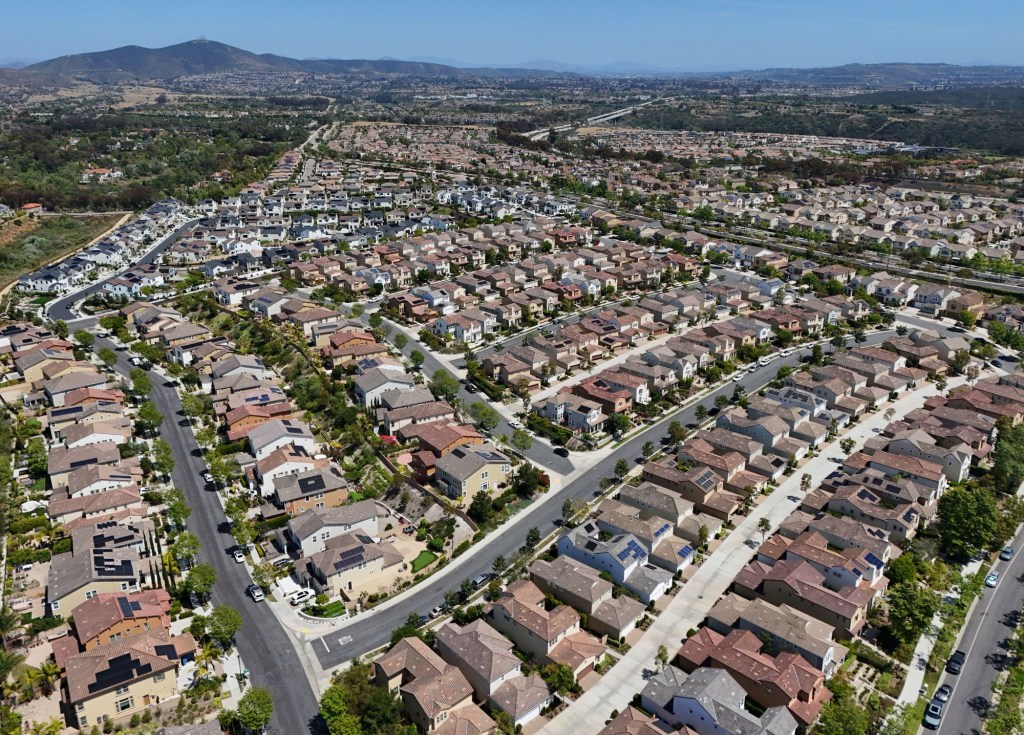
The push to limit companies from owning numerous single-family homes seemingly moved quickly at all levels of government, fueled by bipartisan support.
Proponents of the limits say companies scoop up single-family homes for rentals that would otherwise be on the for-sale market, in theory at more affordable prices.
But the trend aimed at reducing that practice seems destined for a slowdown.
Despite the populist appeal of the concept, powerful opposition has grown. Meanwhile, research is questioning whether such policies would deliver the benefits for would-be homeowners as promised.
In Sacramento last week, a bill aimed at taking away a tax break from corporations that own more than 50 single-family homes in California was shelved by the Assembly Revenue and Taxation Committee and may be dead for the year.
Assembly Bill 1611 by Assemblymember Matt Haney, D-San Francisco, was opposed by the California Apartment Association, the California Chamber of Commerce and the California Building Industry Association.
In San Diego, City Councilmember Kent Lee has deliberately taken a go-slow approach for his proposal to place a new tax on companies that own or rent more than 10 single-family homes or homes in small buildings such as duplexes.
Lee said he wanted not only a collaborative and transparent process in developing the measure, but to make sure it wouldn’t result in unintended consequences, especially discouraging homebuilding or having investors pass the cost of the tax on to tenants, according to David Garrick of The San Diego Union-Tribune.
High-level opposition has not yet emerged, though the San Diego Building Industry Association expressed caution in moving ahead.
The 21st Century Road to Housing Act pending in Congress would prevent any investor that owns at least 350 homes from buying more, with some exceptions. The Senate passed its version and the House, which was cool to corporate limits, is working on a compromise version.
Politicians as disparate as President Donald Trump and Gov. Gavin Newsom have advocated support for some form of restrictions on corporate homeownership.
The cost of housing and availability aren’t just huge issues in California, but nationwide. Much of the problem has been blamed on what many housing advocates, elected officials and builders say is an inadequate supply, despite efforts in recent years to produce more homes in the state and across the country.
The frustration is compounded when investors jump into the competitive market and buy homes, often for cash — something many prospective individual and family buyers cannot do.
In some quarters, that has led to heated words. Haney has castigated “Wall Street landlords” and “corporate abuse in our housing market,” suggesting that artificially inflates home prices.
According to Haney’s office, his bill would no longer have allowed owners of more than 50 homes to defer California taxes on profits by selling a single-family home through a like-kind exchange, commonly known as a 1031 exchange.
How much companies are responsible for the overpriced housing market has long been debated. Large-scale investor ownership is relatively small in San Diego, the state and throughout the country.
Understandably, knowing that might not take the sting out of being outbid for a home by a corporation.
An initial review by Lee’s staff found that about 6,000 of the city’s 500,000 homes are corporately owned — amounting to just 1.2 percent.
The state government’s California Research Bureau said that under 3 percent of single-family homes are owned by holders of at least 10 properties in the state, according to the San Luis Obispo Tribune.
Nationwide, The New York Times reported that only 140 corporations meet the criteria for the 350-home ban and they account for 0.59 percent of single-family homes in the country. Further, corporate ownership is more concentrated in certain regions, such as parts of the Sunbelt, particularly in and around Atlanta.
The West Coast and Northeast are much less affected. Parcl Labs, whose housing data is cited by the Times, listed the 30 metro areas with the greatest concentration of this level of corporate ownership and San Diego was not on the list. Los Angeles and Riverside were, but their concentrations were below 1 percent.
The Parcl Labs findings also challenged the extent to which reducing corporate ownership to 350 single-family homes would directly benefit individual buyers, the Times said. Between March 2024 and January 2026, portfolios for landlords with fewer than 100 units grew, while portfolios shrank for landlords with 1,000 or more properties — which real estate analysts typically define as large institutional landlords.
The analysis shows that when large investors sold those homes, instead of being released to individual buyers, they were often bought by other investors, albeit smaller ones. Of course, it’s uncertain whether that dynamic would apply to the lower thresholds in the state and San Diego proposals.
The Urban Institute further threw cold water on the idea of a federal limit on corporate ownership after Trump issued an executive order in January calling for one.
“The administration’s emphasis on lowering housing costs is welcome amid rising concerns about affordability,” institute fellow Laurie Gordon wrote. “But data suggest this approach may not actually add to the housing supply for first-time homebuyers or increase paths to homeownership.
“Indeed, institutional investors may have more of a role in increasing housing affordability, not less of one. Evidence suggests that institutional investors are in a strong position to increase housing supply through their build-to-rent activities, thereby easing strains on both homeowner and renter budgets.”
Gordon suggested that for investors, there should be requirements to ensure “greater size comes with greater responsibilities.” That would include mandating rent vouchers be accepted, greater flexibility in security deposit payments, allowing renters to use rent payments to build credit scores and providing a longer grace period when eviction notices are issued.
None of this is to say that limiting corporate ownership in some fashion couldn’t be one tool to free up more houses for individuals to purchase, but it likely would be in the margins.
As with so many initiatives aimed at increasing housing and lowering purchase prices, there is no silver bullet.
What they said
Jonah Goldberg (@JonahDispatch), editor of The Dispatch, Los Angeles Times columnist.
“Just FYI: Maxwell Smart wasn’t dubbed Agent 86 because he was a legendary assassin.”