
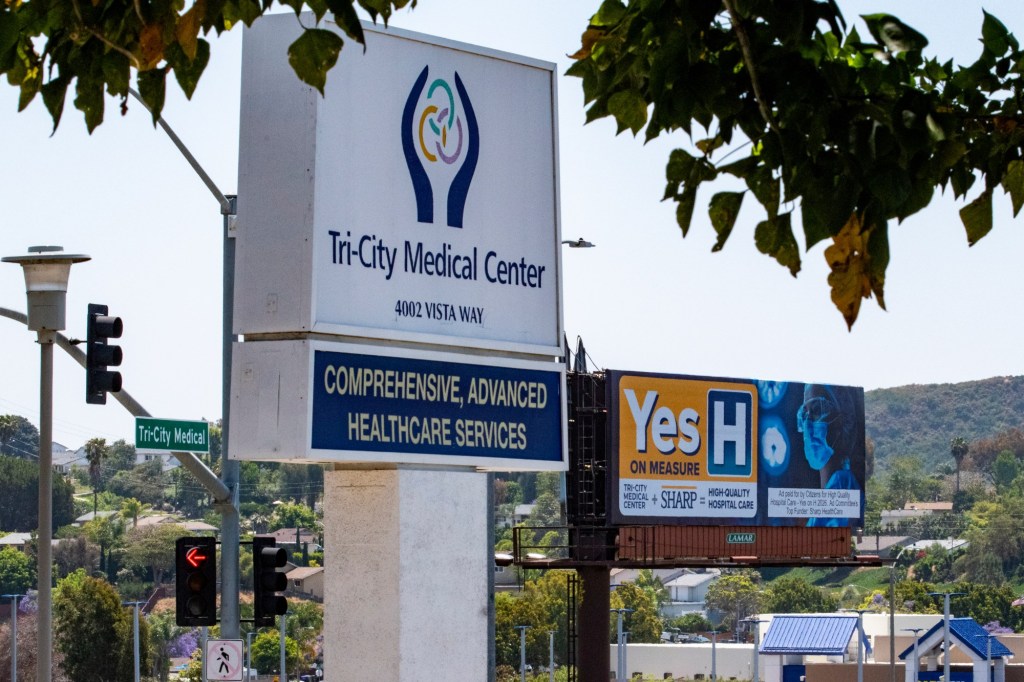
Nearly three decades ago, a consultant advised Tri-City Medical Center directors that the Oceanside hospital should partner with a large health system or face financial ruin.
Tri-City directors did explore mergers or partnerships with larger organizations in the late 1990s and early 2000s, but concerns over lost independence scuppered promising alliances with Scripps Health and Palomar Pomerado, the sister public health care district serving inland North County.
For the first time since Tri-City opened in 1961, voters in Oceanside, Carlsbad and Vista will get a chance to make such a deal happen on June 2, marking yes or no on Measure H, which would lease Tri-City’s assets to Sharp HealthCare for 30 years, triggering the region’s largest medical provider to invest $100 million in the facility.
Supporters hope for a much different result than was the case the last three times Tri-City put a referendum on the ballot.
Faced with statewide seismic upgrade requirements, Tri-City attempted to secure its future in 2006 with Proposition F, a $596 million construction bond proposal that fell just 404 votes shy of passage. A second try in 2006, and another in 2008, fared slightly worse.
Those setbacks were followed by severe shifts in the local health care market that have seen Tri-City’s patient volume fall significantly. Total discharges have fallen from 15,383 in 2015 to 8,901 in 2025, according to state financial reports.
Stiff competition for labor and expensive upgrade requirements forced the Tri-City board to close the hospital’s behavioral health department in 2018 and its labor and delivery department and neonatal intensive care unit in 2023. Opening of a county-sponsored behavioral health unit and better financial results over the past year have provided some breathing room. But it was not long ago that the organization’s finances were so poor that some vendors sued for payment.
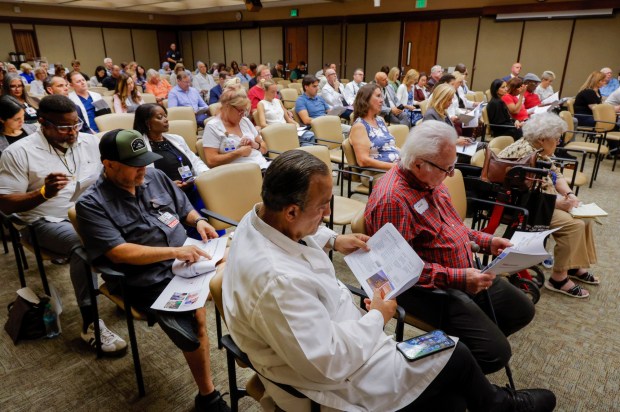 Residents attend the first Measure H forum at Tri-City Medical Center in Oceanside on Oct. 30, 2025. Charlie Neuman / U-T file
The current board has made it clear they believe that long-term security can only come through partnership with a larger regional provider, especially since big cuts to federal Medi-Cal reimbursements loom.
Measure H is modeled on a similar arrangement with Grossmont Healthcare District in La Mesa, first approved by voters in 1991 and extended in 2014. Sharp Grossmont Hospital has grown significantly under this arrangement.
The lease, at a price of $1 per month, would create a new 15-member board to run Tri-City, 10 appointed by Sharp and five appointed by Tri-City’s elected directors.
While the monthly payments are as cheap as possible, Sharp would assume $80 million in existing Tri-City debt and would also invest at least $100 million in the facility. That cash would be used to improve buildings and to add services. Reinstatement of the hospital’s labor and delivery department is high on the list.
Given Tri-City’s experiences the last three times it asked voters for approval, many might wonder what is different this time?
Pretty much everything.
The key difference is that Measure H asks the voters for zero additional dollars. It would simply approve a long-term lease, but existing property tax levies would not change. And, this referendum has a much lower threshold for passage. While hospital bonds require approval by two-thirds of voters to pass, leasing a public health care district’s assets to a private nonprofit such as Sharp requires a simple majority — 50% of votes cast, plus one.
Another key factor, says Jeff Segall, a Carlsbad resident who ran Tri-City’s public relations department when the 2006 and 2008 bond campaigns failed, is that Measure H has no organized opposition. By comparison, the three bond measures each had official “against” statements listed in voter guides.
“For the bonds in ’06 and ’08, we had hospital directors out in front of the hospital campaigning against it, and it’s great that that is no longer the case,” Segall said.
Indeed, Tri-City’s board has been unanimous in its support of Measure H and has garnered a wide range of organizations to endorse the referendum, including the California Nurses Association, the Service Employees International Union, the San Diego County Medical Society and the San Diego Taxpayers Association.
Hospital officials have said previously that the measure has polled with an approval rating of about 70%.
Segall said that the one possible weakness that he sees is that voters may mistakenly associate Measure H with its predecessors.
“My biggest concern is people looking at the ballot and saying, ‘oh, they’re at it again, I’m going to vote against it,’” Segall said. “That would be a shame, because that’s not the case.”
Sharp has been working hard to prevent that kind of conclusion.
The region’s largest medical provider has made $150,000 in monetary contributions and $177,645 in non-monetary contributions to the Measure H campaign, spending that cash on promotional billboards, targeted Facebook advertisements and direct mailers to likely voters. Before putting Measure H on the ballot, Tri-City held a series of public meetings to answer the public’s questions. The three main documents that control the deal — affiliation, lease and transfer agreements — are available for anyone to download at Tri-Citymed.org.
Significant labor opposition would be able to spend the kind of cash necessary to push back against Measure H.
But that is not happening.
Registered nurse Astrid Warner, who works at Tri-City’s infusion center and serves on the hospital’s professional practice council, said Friday that worker support is strong because many have been worried that recent financial trends threaten Tri-City’s long-term survival.
Plans to not just invest in the facility, but also increase the number of programs, have earned internal support, as have promises to gradually increase wages and keep existing staff.
“Bringing labor and delivery back, having more comprehensive oncology care, we hope to keep them accountable for these promises,” Warner said.
It is clear, though, that there is a long way to go.
That warning of financial doom the consultant made back in 1997 cited a coming move toward managed care. This prediction has largely come true. More patients than ever before are enrolled in health insurance, generally health management organization plans, that control which doctors they can see and which hospitals they can use. Insurance companies tend to go with large health systems that can provide care both in and out of hospitals, negotiating rates with those that can cover the whole continuum of care.
Here, the numbers show that Tri-City, an entity designed to serve a distinct geographic area at a time when large systems were still rare, has struggled to make this transition.
Data published by the state Department of Health Care Access and Information show that managed care accounted for about 41% of San Diego County hospitals’ net revenue in 2000 compared to about 72% in 2025.
Tri-City captured just 2% of the region’s total in 2025. That’s less than half of the 5.3% captured in 2000.
Ron Mitchell served as a Tri-City board member in the late 1990s, continuing through the failed bond attempts. A certified public accountant, now retired, he said the majority of board members at the time simply did not believe that voters would approve a merger with a bigger system. Labor, fearing major management changes, he said, also likely would not have been in support.
The bigger lesson in Tri-City’s saga, Mitchell said, is the true danger of short-term thinking.
“The sad thing is, if we had made a good decision at that point in the 1990s, the whole landscape of the hospitals and health care in North County would be totally different,” he said.
Both Segall and Mitchell said they have had friends and acquaintances ask them why they should bother voting for Measure H if they do not personally use the hospital. Both said they point out the advantage of having a hospital with a full-service emergency department nearby. After all, they argue, ambulances take a resident suffering a stroke or heart attack to the closest hospital and, while modern freeways do make travel quicker, traffic is a never-ending wild card.
“Either you want a hospital with an emergency room close to your home, or you want to drive to Palomar or Kaiser or Scripps,” Mitchell said. “That’s the decision as I see it.”