
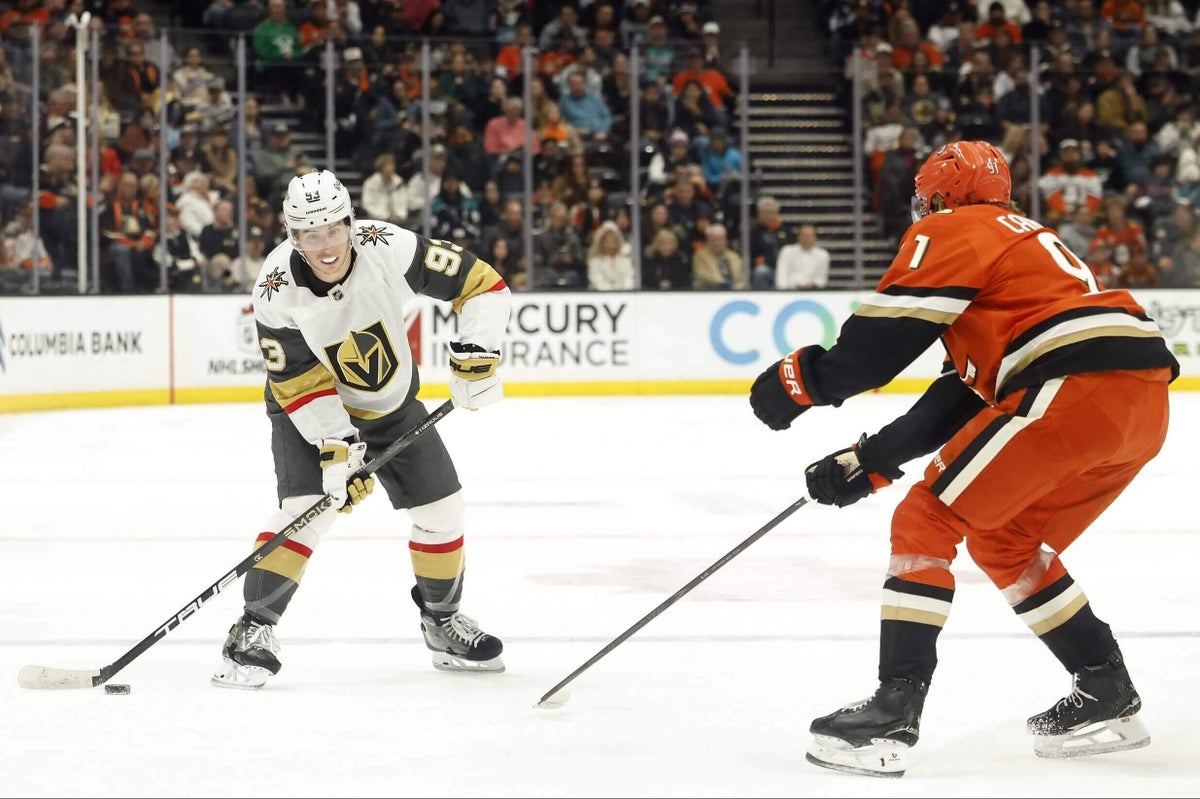
LAS VEGAS – The Vegas Golden Knights and Anaheim Ducks will meet in the playoffs for the first time, with Game 1 of the second-round series set for Monday night at T-Mobile Arena.
It’s a bit odd that the sides have never clashed in the postseason, but it’s a product of the Golden Knights’ championship window opening just as the Ducks’ swung shut. Vegas’ Pacific Division dominance began right as Anaheim’s stranglehold on the division — led by a core headlined by Ryan Getzlaf and Corey Perry — ended.
Anaheim was in the postseason in 11 of 13 seasons from 2006-18, but then missed out for seven straight years until this season. Meanwhile, Vegas is in its eighth postseason run in nine years since joining the league in 2017. There was only one season of overlap, when Anaheim bowed out of the opening round to San Jose in 2017-18.
Now, after a lengthy rebuild, the Ducks are stacked with young talent and ready to challenge the division champs. The teams met three times during the regular season, and Anaheim won all three. They were closely contested, with the Ducks winning in overtime twice in November, followed by a 4-3 regulation win in February.
Here are three key areas that could end up deciding the series:
1. A clash of styles
The Ducks play a high-event, run-and-gun style of hockey. They’re happy to trade chances with their opposition. The Golden Knights have the ability to score in transition, but prefer a heavier, more methodical style of game. It’s a similar dynamic to what took place in Vegas’ first-round series against Utah.
There were moments when the Mammoth found room for their speedy forwards to operate, but for the most part, they were held in check by Vegas. As the series wore on, the style of hockey swung further and further in the Golden Knights’ favor, and they believe that experience could help them against Anaheim.
“(Utah) was a team that came at you with a lot of speed and skill,” Vegas forward Mitch Marner said after eliminating the Mammoth in Game 6. “They made us work throughout the neutral zone to really try to slow them down and shut down some of their offense. I thought we did a really good job the last couple of games of slowing that down, so yeah, I think it helped a little bit for sure.”
Early in the first round, it appeared Utah’s young stars, Logan Cooley and Dylan Guenther, were ready for postseason breakout performances. By the end of the series, they struggled to generate much of anything against Vegas’ staunch defense.
On paper, Anaheim has more firepower up front, led by Cutter Gauthier, Leo Carlsson and Beckett Sennecke. Carlsson and Gauthier were particularly impressive in their first-round win over Edmonton, but it will be fascinating to see how they match up against a veteran Golden Knights team that will do what it can to turn the games into physical, defensive slugfests.
“Good team speed,” Vegas captain Mark Stone said of the Ducks. “They’re a fast team with a lot of good, young skill. They have a good veteran presence as well.”
In the regular season, the Golden Knights allowed the second-fewest shots in the NHL (23.91 per game), and that shot suppression continued against Utah in the first round. Meanwhile, Anaheim averaged the third-most shots in the regular season (30.2), and led all teams with 32.11 per game in the first round against Edmonton.
Anaheim won that battle in the three meetings with Vegas this year, averaging 28.33 shots and four goals per game. It will be fascinating to see which team can force the other to play its style of hockey in this series.
2. Strength vs. strength on special teams
The Ducks’ power play was nothing special during the regular season, ranking 23rd in the league with an 18.6 percent conversion rate, but in the first round, the unit caught fire. Anaheim converted 16 opportunities with a man advantage into eight goals for a ridiculous 50 percent.
Gauthier scored three times on the power play. Alex Killorn and Mikael Granlund each pitched in two more. Defenseman Jackson LaCombe quarterbacks the unit from the point, and had three assists himself in the first round.
Vegas’ penalty kill also enters this series red hot. Not only did it kill 15 of Utah’s 16 power plays in round one, but it outscored the Mammoth power play by scoring two short-handed goals (including a double-overtime winner in Game 5).
“I thought (assistant coach) John Stevens, who runs (the penalty kill), had a really good game plan for them,” Vegas coach John Tortorella said after the series. “The penalty kill was key. Not only killing some off, but two really important short-handed goals.”
In the regular season, Anaheim had five power-play chances against Vegas and scored only once – a snipe from the right circle by Gauthier. Both sides enter this series feeling great. The winner of this battle will go a long way toward determining the series.
3. Goaltending
Statistically, it was a rough opening round for both starting goalies. Lukáš Dostál and Carter Hart ranked 19th and 20th in goals saved above expected among 21 goaltenders who played in the playoffs, ahead of only Edmonton’s Connor Ingram, according to HockeyStats.
That said, they each made big saves in key moments. Dostál faced the more dangerous chances of the two, and got the better of Connor McDavid and Leon Draisaitl on more than one occasion. Hart struggled through the middle of the series against Utah, but had his best game in the close-out Game 6, stopping 22 of 23 shots.
Both netminders also have a strong history against the opposition. Dostál was in the net for two of Anaheim’s wins over Vegas this season, and had a solid .905 save percentage in those games. Over his career, he’s been even better against the Golden Knights, with a .917 save percentage and 2.75 goals against average in five starts.
Dostál’s patience and hockey IQ are a good match against a Vegas attack that prefers to pass the puck into the net rather than relying on a high volume of shots.
On the other end, Hart has yet to face the Ducks as a member of the Golden Knights. He did have success against Anaheim as a member of the Philadelphia Flyers, going 2-1-0 with a .941 save percentage and 2.03 goals-against average. Hart’s athleticism and skating should help him keep up with the Ducks’ high-paced attack, which loves to score with lateral passes. He struggled on clean shots from mid-range against Utah, and Anaheim’s sharpshooters will test him there in this series.
4. Blue-line dynamism
Vegas’ defensemen focuses more on two-way play with the ability to mix in offensive skill. Shea Theodore, who won Game 4 against Utah with an overtime goal, has that capability. Theodore and Brayden McNabb are long-time partners with complementary strengths. Noah Hanifin and Rasmus Andersson are all-around types who also handle a lot of minutes. Hanifin leads Golden Knights defensemen with five points, all assists.
Anaheim’s blue line might provide more upside in the offensive end. The series win over Edmonton was a breakout turn for LaCombe, whose nine points lead all defenders in the playoffs. He wasn’t just a force in creating offense. Even though Connor McDavid was later revealed to be playing with a foot fracture, LaCombe was instrumental in limiting the Oilers superstar to just two assists in five-on-five play over the six games.
On top of that, LaCombe controlled the tempo in the series. He steadied the Ducks when it was necessary and triggered their fast-break style at opportune moments.
“I think he’s got a good feel for it,” coach Joel Quenneville said. “Very quiet about how he goes about his business and plays that type of game. Very patient, very relaxed. Next thing you know he’s skating up ice, like he’s not even moving and effortlessly goes by people. Next thing I know it’s an odd-man break. He delivers a puck out of our end very well, whether it’s passing or making some moves or just skating with his speed.
“There’s a lot of possession time when he’s out there. Defensively, I think, he had a good series as well. I think him and his partner lugged a lot of minutes against a lot of the best players in the game.”
The Ducks aren’t leaning solely on their top pair of LaCombe and Jacob Trouba. John Carlson has given them another proven puck-mover who can eat a lot of minutes. Carlson has five assists while averaging nearly 24 1/2 minutes on the second pair with Pavel Mintyukov.