
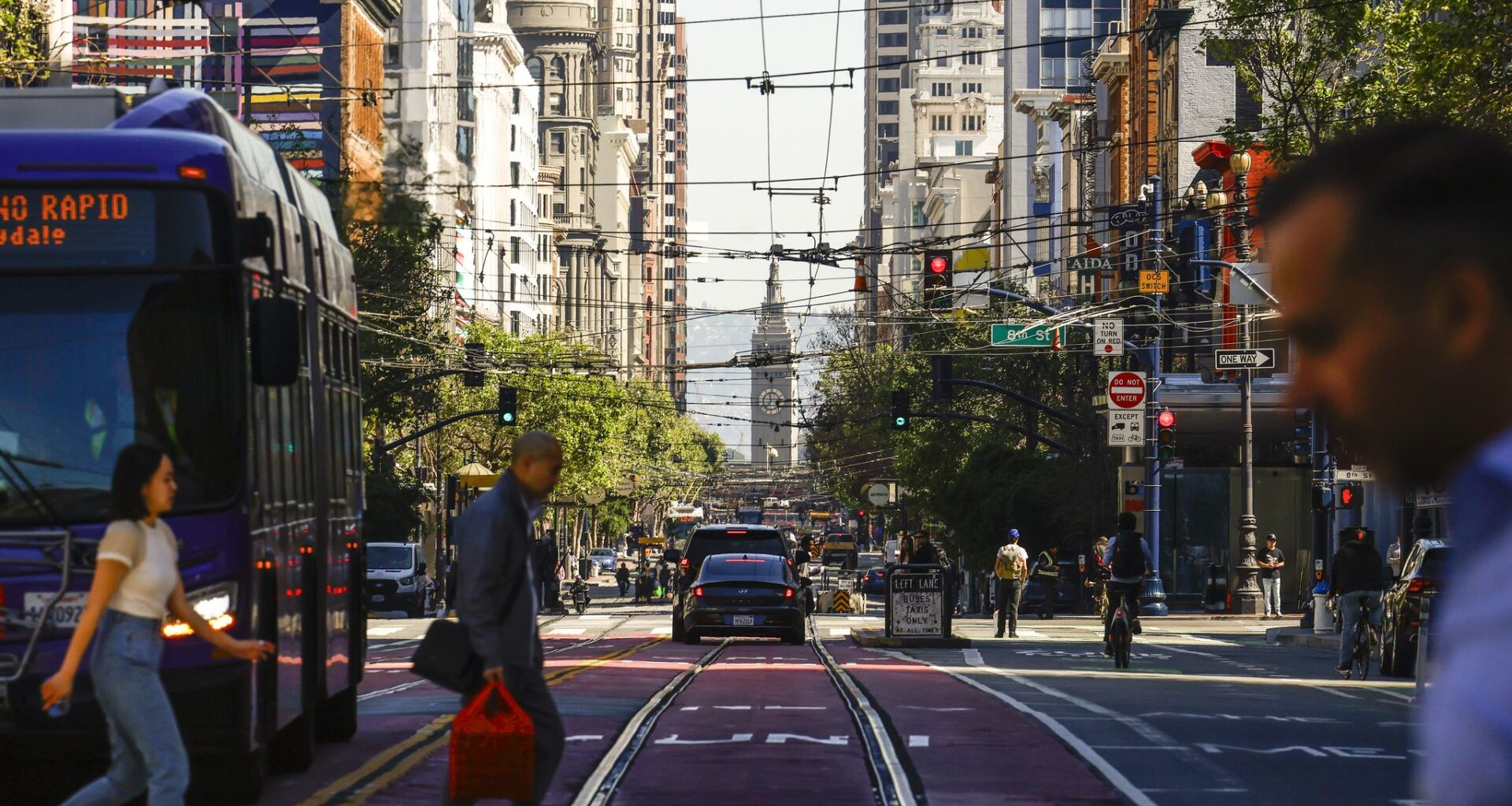
A San Francisco supervisor wants to revitalize the city’s Mid-Market corridor by moving the Hall of Justice into the embattled neighborhood still struggling with post-pandemic vacancies.
Jessica Christian/S.F. Chronicle
San Francisco’s Mid-Market corridor has plenty of space to spare. The city has needs. One city official says it’s time to connect the two and is making a rather bold pitch: Move San Francisco’s main criminal justice facility into the neighborhood’s surplus of empty buildings.
While the concept is in its infancy, it raises some intriguing possibilities. Could San Francisco’s famous decommissioned downtown mall become the next Hall of Justice? What about the former Twitter headquarters abandoned by Elon Musk after the pandemic? Or the utilitarian structure at Market and South Van Ness where disgruntled San Franciscans now line up to contest parking tickets?
In recent months, Supervisor Matt Dorsey, who represents the beleaguered neighborhood that connects City Hall to the Financial District and Embarcadero, has made it his mission to help repopulate the failed tech hub with city workers. He argues that a major public agency could serve as a stabilizing force for Mid-Market, a district that has struggled to recover from the pandemic.
Article continues below this ad
He pointed to the Hall of Justice — the longtime headquarters for the Police Department and Superior Court system — as both a prime opportunity and logical candidate for relocation, given its longstanding need for major upgrades. The facility has been located at 850 Bryant St. on the edge of the SoMa neighborhood since the Eisenhower Administration. It’s been listed as seismically unsafe since 1992 and building a replacement has been the topic of four major city feasibility studies going back to 2008. A 2013 $1.6 billion capital plan to build a new Hall of Justice adjacent to the current building has been stalled.
Supervisor Matt Dorsey, speaking at the Frontier Tower 1 year anniversary celebration in San Francisco, lives in the Mid-Market area and believes the city should revitalize the troubled corridor.
Giselle Garza Lerma/S.F. Chronicle
Dorsey, who plans to call a hearing to test the idea, envisions a “vertically integrated justice center” that could consolidate the courts, the district attorney and city attorney offices, and potentially the police academy — currently housed in a former elementary school in Diamond Heights — under one roof.
San Francisco Chronicle Logo
Make us a Preferred Source to get more of our news when you search.
Add Preferred Source
There is no shortage of buildings to choose from.
Article continues below this ad
Mid-Market’s commercial landscape, riddled with vacancies that trace back to the city’s tech-fueled real estate boom and its pandemic-era collapse, offers a range of large, underused properties that could potentially accommodate such a complex, according to Dorsey.
Among the list of sites he has floated: Uber’s former headquarters at 1455 Market St., a 22-story tower that the city has the option to purchase; the federally owned office building at 50 U.N. Plaza that the Trump Administration briefly listed for sale in 2024; the Twitter building and the closed San Francisco Centre mall at Fifth and Mission streets.
“One South Van Ness — that could be the Hall of Justice,” Dorsey said, referring to the eight-story office building that houses the Municipal Transportation Agency at South Van Ness Avenue and Market Street.
While the cost of converting any of these buildings into a vertical justice center is not known, repurposing existing buildings is often less expensive than ground-up construction, particularly when acquisition costs are low. Few such projects have advanced in San Francisco in recent years due to high financing and construction costs. Still, with downtown office building values sharply discounted, the economics could shift.
“An acquisition or adaptive reuse project would get us going on the cheap,” Dorsey said.
Article continues below this ad
Supervisor Matt Dorsey’s pitch to move the Hall of Justice targets this former Uber headquarters, at 1455 Market St. in San Francisco, as a potential new location.
Carlos Avila Gonzalez/S.F. Chronicle
Dorsey’s proposal comes as San Francisco grapples with historically high commercial vacancies — roughly one-third of its downtown office space remains unused — and questions about how to reshape its response to homelessness.
Dorsey, who lives in Mid-Market and is the former head of communications for the police department, argued that the neighborhood has borne the brunt of the city’s homelessness initiatives — from shelter-in-place hotels during the pandemic to the controversial Linkage Center — and that city officials now have the “opportunity” and the obligation to course-correct. But critics say his proposal to relocate the Hall of Justice to Mid-Market would not help the neighborhood recover.
For decades, the hulking Hall of Justice has maintained a fortress-like presence on Bryant Street, rising seven stories and occupying an entire block between 7th and 8th streets, hemmed in by the concrete overpasses of U.S. Highway 101. Inside, dim corridors connect courtrooms, offices and jail facilities in a layout widely viewed as outdated and inefficient. Since the 1990s it has been a source of complaints from employees and the public alike. From plumbing failures and broken elevators to pest infestations and persistent maintenance issues, city officials and engineers have warned for decades that the building is unsafe, yet no comprehensive retrofit has been completed.
“It’s not serving us well in the 21st Century,” Dorsey said.
Article continues below this ad
A flag rests at the Hall of Justice in San Francisco at Eighth and Bryant streets in the city’s South of Market neighborhood.
Benjamin Fanjoy/For the S.F. Chronicle
Much of the building’s core functions have already moved elsewhere due to longstanding concerns: seismic vulnerability, aging infrastructure and the high costs of modernizing the 65-year-old building. Its location was driven by proximity to a freeway exit, not public transit or housing or jobs.
“It has been widely understood for years that the Hall of Justice is a safety hazard and a move out of this building is long overdue,” said Rob Borders, courtroom clerk at the Hall of Justice and SEIU 1021 bargaining team member. “As a union, we strongly support moving all court and city employees out of this death trap and into a safer facility as soon as possible.”
Several departments have already relocated, including police headquarters, now based in Mission Bay. The district attorney’s office operates out of a temporary site in Potrero Hill. The only major SFPD division still housed at 850 Bryant is the department’s investigations bureau. The courts occupy just 23% of the building and many suites are partially or completely vacant.
“We would welcome any resources the city would be willing to invest in new infrastructure for the SFPD, period,” said SFPD Spokesman Evan Sernoffsky.
Article continues below this ad
And Mid-Market could use the foot traffic from attorneys, police officers and other justice system-adjacent workers descending on the neighborhood’s cafes and restaurants, according to Dorsey.
One potential location for the Hall of Justice is the closed and vacated San Francisco Centre shopping mall, though its new owners haven’t signaled an intent for government use.
Santiago Mejia/S.F. Chronicle
Dorsey tapped Lisa Follman of the architecture firm Skidmore Owings & Merrill to study options for a Mid-Market criminal justice center. She said the current Bryant Street location is unusual compared with other cities like New York, Chicago and San Diego, where courts are typically clustered near civic centers and transit. In San Francisco, by contrast, key departments remain scattered across multiple neighborhoods.
“It’s pretty disconnected — down there south of the freeway,” she said.
Follman said the state’s Judicial Council of California, which oversees courthouses, has strict standards governing how the buildings are designed and constructed. They require 16-foot ceilings to accommodate the jury boxes and the judge’s dais. They need three separate paths to access the courtroom, so that defendants, the judge and jury, and the public can safely enter without bumping into one another. There has to be ample parking and a jail either onsite, nearby or a combination of the two.
While about 45% of Mid-Market’s offices sit vacant, the vast majority of buildings don’t meet the requirements for the type of conversion that Dorsey is pitching, she said.
“That is one of the things that becomes really difficult in an existing building,” Follman said. “You can’t have a column in the middle of a courtroom.”
Follman analyzed five Mid-Market buildings with potential to be converted into a new justice hub. In addition to the empty mall and former Twitter headquarters, she looked at the boarded up Hotel Whitcomb, the federal office building at 50 U.N. Plaza and 1455 Market St., a 22-story tower the city has an option to purchase.
A rendering of what 1455 Market St., formerly the Uber headquarters, could look like if the city moved the Hall of Justice to the location and it was refurbished. It’s a pitch being mulled by Supervisor Matt Dorsey.
SOM
Of the contenders, 1455 Market came out on top. It has the required ceiling height, large floorplates, parking and sits in a prime location. It’s also adjacent to 49 South Van Ness, where the city’s planning, public works and building departments are located.
“It starts to create a little neighborhood with all of these civic services,” she said.
In recent years, 1455 Market’s owner, Hudson Pacific Properties, leased roughly 400,000 square feet inside to various city departments, and has offered to sell the tower to the city next year. But whether the city, which faces a two-year budget deficit of over $643 million, will execute on this 2027 purchase option is unclear.
“We are assessing department needs in the future, keeping in mind our role as a major real estate player in the Mid-Market neighborhood,” said Angela Yip, a spokesperson for the city’s Real Estate Division. She added that funding for real estate acquisitions can come from a “variety of sources, including general fund and non-general fund monies.”
A rendering of what the boarded-up Whitcomb Hotel could look like if the Hall of Justice were moved to that location in Mid-Market and the building refurbished.
SOM
Any move will have to be approved by the Judicial Council of California. Karen Datangel, senior analyst for public affairs for the council, said a new courthouse in San Francisco is slated to be funded in fiscal year 2028-29. Once the funding is in place — it would be a combination of state money and local bonds — an advisory group would review all the available project sites and then make a recommendation.
While most agree that Mid-Market needs an economic lifeline, not everyone is convinced that planting a criminal justice center within the neighborhood is the right approach.
Rudy Corpuz, executive director of United Playaz, a SoMa nonprofit that runs programs for low-income kids and has a staff largely made up of formerly incarcerated adults, said any new criminal justice center in Mid-Market “has to be more about rehabilitation for people who need it — not just jail cells.”
Randy Shaw, executive director of the Tenderloin Housing Clinic, a nonprofit that provides supportive housing to formerly homeless residents in the neighborhood, also opposes the idea.
Shaw, who has been vocal about Mid-Market’s drug crisis, said the neighborhood “does not need more criminal justice activities.”
“It needs more positive foot traffic, which it has seriously lacked” since the San Francisco Centre mall at Fifth and Mission streets closed.
Meanwhile, there is a growing push to formally transform Mid-Market, which is home to five major theaters, into an arts and culture-heavy district.
“We’re talking about a Mid-Market theater district and a new use for the S.F. Centre. Both are inconsistent with the Hall of Justice,” Shaw said. “The Hall of Justice never spurred economic activity near its current home — there’s no reason to believe it would do so for Mid-Market.”