
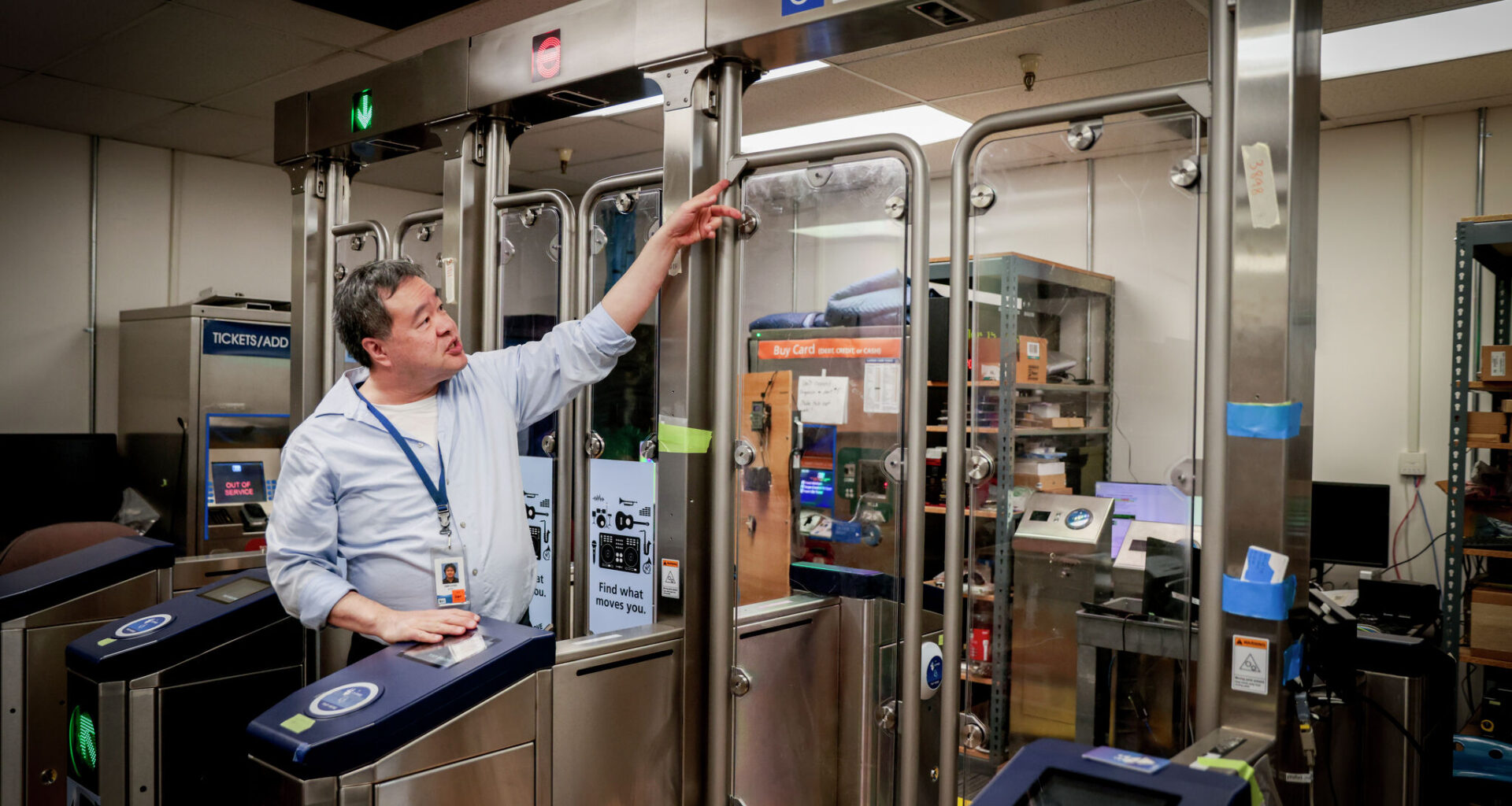
Senior computer systems engineer Weldon Chen points to the AI sensor in the upgraded fare gate at the Lake Merritt BART lab in Oakland. The upgrades come in an effort to curb piggybacking and fare avoidance.
Brontë Wittpenn/S.F. Chronicle
New fare gate detection zone graphics can be seen at the Lake Merritt BART lab in Oakland.
Brontë Wittpenn/S.F. Chronicle
Joy Sharma, interim assistant general manager of infrastructure delivery, looks through data sheets for the upgrades to the new fare gates at the Lake Merritt BART lab in Oakland, on Wednesday. The upgrades come in an effort to curb piggybacking and fare avoidance.
Brontë Wittpenn/S.F. Chronicle
Inside a small laboratory, deep in the bowels of BART’s Lake Merritt Station, a team of engineers is toiling away at the transit agency’s latest invention: a fare gate that shuts fast enough to prevent cheating.
“So if you proceed quickly, it’s harder for someone to go behind you,” said Joy Sharma, BART’s assistant general manager of infrastructure delivery.
Sharma stood in the laboratory on Wednesday, gesturing toward a fare gate mock-up arranged on a plywood podium. It looked exactly like a gate in the wild, with tall Plexiglass panels and sensors to track body movement. But this version had hardware and software upgrades, all serving to close the panels in 500 milliseconds, instead of the former 800.
Article continues below this ad
The idea, Sharma said, is to block people from slipping behind paying passengers, a tactic known as “piggybacking.”
“Basically, we’re taking a really great product, and making it better,” said BART spokesperson Alicia Trost, who joined Sharma to demonstrate the technology. Sharma tapped a payment card and proceeded through the mock gate in three steps, with Trost trailing by about two paces. The panels closed before Trost could get through.
San Francisco Chronicle Logo
Make us a Preferred Source to get more of our news when you search.
Add Preferred Source
Last month, BART began testing this innovation at Antioch Station, as well as the middle row of stiles at Concord. Riders who board or exit at either stop can try a hack, of pausing a beat just after they pass the black sensor strips. The panels will shut with a satisfying swish, blocking any would-be freeloaders.
The Lake Merritt BART lab tests new fare gate infrastructure in Oakland, to help curb piggybacking and fare avoidance.
Brontë Wittpenn/S.F. Chronicle
Officials expect to roll out the design systemwide on May 18.
Article continues below this ad
It’s a new chapter in BART’s ongoing quest to find the perfect fare gate, a Platonic ideal that dogged the agency for years. Pressure began mounting nearly a decade ago, when officials announced that fare evasion was costing the agency up to $25 million a year. At that time, BART had low pie-wedge gates at all 50 stations, infrastructure that dated to the 1970s. An unathletic person could hop over or squeeze through the triangular consoles. Some riders evidently got the impression that payment was optional.
Desperate to solve the problem and calm an angry public, engineers holed up in their laboratory and began experimenting. They tried double-decker gates that were too high to vault, as well as plates resembling shark fins that would stick up as the stiles closed. Board directors at BART even considered the “Iron Maiden,” a revolving, prison-style door with bars that come together like interlocking teeth.
After careful deliberation, the board settled on Plexiglass panels rigged with cameras and sensors, which have the institutional look and feel of an airport security checkpoint. Their purpose is practical as well as aesthetic, “hardening” stations by warding off scofflaws and stemming other types of antisocial behavior. Incidents of graffiti, vandalism, garbage can emptying, and fire extinguisher spraying have plummeted since the “Next Generation” gates were installed last year, according to reports presented to the board of directors in February. Budget analysts estimate that BART will generate $10 million annually, and that its staff has already been spared nearly 1,000 hours of maintenance work, thanks to these modern entrances.
An AI sensor is pointed out on a fare gate at the Lake Merritt BART lab in Oakland.
Brontë Wittpenn/S.F. Chronicle
But despite those gains, piggybacking has continued to bedevil the agency. Paying customers complained about how creepy it was to tap in and feel a tailgater pressing into them. Although the cameras tripped a buzzer alarm whenever they spotted more than two bodies, station agents usually didn’t respond to the sound. BART police didn’t have enough officers to constantly monitor every entrance.
Article continues below this ad
Clearly, BART’s brain trust had to come up with something better. The lab engineers had a new assignment.
They came up with three fixes, Sharma said. First, they shortened the sensor area along the stiles, which detects movement and prevents the gates from closing. Then they turned off part of an artificial intelligence camera at the top of the panels, also aimed to track movement and keep the gates open. Arguably the most important change was also the most obvious. Crews timed the panels to open and close more quickly.
“Unless you’re really pushing your way in, like a really big invader, it’s not easy to piggyback anymore,” Sharma said. Making that adjustment wasn’t easy. Workers had to Macgyver the machines so that all the cameras and software worked impeccably, allowing one person through before the panels swing closed. Notably, they had to avoid striking and potentially injuring anyone who got caught in between.
Tweaking the technology took months. Workers spent long hours in the Lake Merritt lab, which is tucked away behind linoleum corridors with fluorescent lighting and doors that can only be opened with key cards. The laboratory itself has all the furnishings of a station concourse — not only mock gates, but ticket vending machines with their cables exposed, and destination signs that blink to show that a train is coming.
Article continues below this ad
Senior computer systems engineer Weldon Chen holds a new motor that will be installed in the upgraded BART fare gates.
Brontë Wittpenn/S.F. Chronicle
With field testing underway in Concord and Antioch, officials are anxious to see whether the gates will succeed. Although the gate sensors can theoretically record and log “piggyback” incidents, BART hasn’t collected or shared that data, said John Yen, manager of computer systems engineering.
At least one rider at Concord Station said he’s observed a drop in cheating, even if he wasn’t cognizant of the fare gate modifications.
“I haven’t seen piggybacking in a long time,” said Chris White, hastily tapping his Clipper card as he rushed through a fare gate on Tuesday, anxious to catch a San Francisco-bound train. White didn’t bother to look back and watch the panel jerk shut.
Another rider, Axel Flores, strode through the fare gate with an electric scooter in tow. The panels closed with a small gasp, a sort of in-drawn breath that flashed by in a microsecond. Flores shrugged.
Article continues below this ad
“Seems normal to me,” he said, clutching the neck of the scooter, which mercifully had not been hit by a panel.
One woman flinched as the gate snapped open, whipping shut before she had fully stepped into the concourse. A locking mechanism clicked in place. The woman blinked, clutched her purse and kept walking, seemingly unaware of what she’d witnessed. For riders, the difference is subtle. For BART, the impact could be huge.