
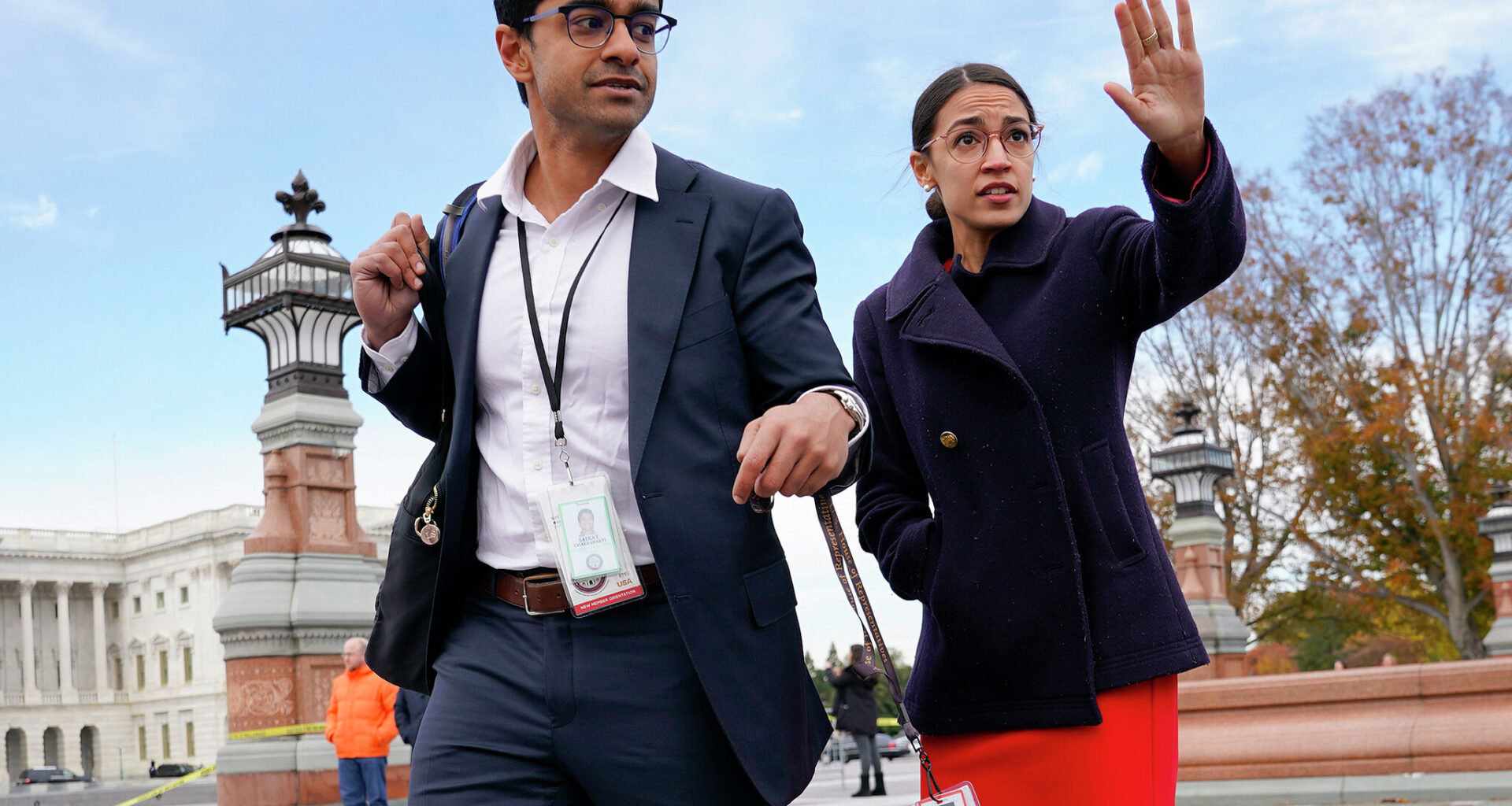
Rep.-elect Alexandria Ocasio-Cortez, D-NY., right, and chief of staff Saikat Chakrabarti, left, walk together after joining the freshman class of Congress for a group photo on Capitol Hill in Washington on Nov. 14, 2018.
Pablo Martinez Monsivais/Associated Press
WASHINGTON — Congressional staffing changes are not ordinarily treated as national news.
But when Saikat Chakrabarti stepped down as Rep. Alexandria Ocasio-Cortez’s chief of staff in August 2019, a mere seven months after the New York Democrat arrived in Washington to shake up the establishment, more people knew his name than many of the sitting House members whose feathers he had so thoroughly ruffled with his critical tweets.
His sudden departure sparked intense speculation. Did Ocasio-Cortez fire the outspoken Chakrabarti to placate furious Democratic leaders? They denied any connection to the backlash, characterizing the exit as long planned by Chakrabarti, who was ready to move on to other opportunities.
Article continues below this ad
Nearly seven years later, Chakrabarti is seeking to return to the House as the next representative for San Francisco, campaigning heavily on his relationship to Ocasio-Cortez, who has publicly refused to endorse him.
The discrepancy is so conspicuous that it’s become political fodder all over again, including a pointed attack by one of Chakrabarti’s biggest rivals in the June primary, who called him “shady and disrespectful” for touting his ties to Ocasio-Cortez.
San Francisco Chronicle Logo
Make us a Preferred Source to get more of our news when you search.
Add Preferred Source
As ballots arrive to voters this week, Chakrabarti faces questions about why his former boss won’t support his candidacy and why he’s so eager to get back to a place where, seven years ago, he either no longer wanted to be or was no longer welcome.
Ocasio-Cortez has taken pains to avoid speaking about Chakrabarti. Asked by a reporter last month about the lack of endorsement for her former chief staff, she gave a winding 90-second answer in which she said she was “trying to think about the role I’m trying to play more broadly in these things” without ever mentioning his name.
Article continues below this ad
“I have pretty much stated I’m kind of refraining from commenting on the race at this point. Thank you,” she told the Chronicle days later, laughing at a question about whether something had happened between them.
“I appreciate the, you know, the questioning. But again, I’m just refraining from commenting at this moment. Thank you,” she said. “I’m so sorry. I’m so sorry.”
His connection to Ocasio-Cortez has nevertheless been among the foremost messages of Chakrabarti’s campaign. When a Chronicle reporter canvassed voters with him in March, he introduced himself to voters: “Hey, I’m Saikat and I used to work with AOC.”
Saikat Chakrabarti speaks to a Bayview resident while canvassing in the neighborhood in San Francisco on April 23, 2026.
Lizzy Montana Myers/For the S.F. Chronicle
So her defensive posture undercuts Chakrabarti’s primary selling point — that he offers San Francisco a new type of progressive champion in the mold of Ocasio-Cortez — and casts doubt on whether he can be effective in the House.
Article continues below this ad
It’s nothing to worry about, according to Chakrabarti. He maintains he could still earn Ocasio-Cortez’s seal of approval, though he won’t discuss the endorsement process that he says he’s going through. They have a “good relationship,” he says, and have “been in touch over the years.”
Chakrabarti said his exit from Ocasio-Cortez’s staff was a “planned departure,” a few weeks after his wife had a baby. He wanted to spend more time raising his daughter and transition into strengthening progressive economic policy advocacy outside of Congress.
“I felt that the stuff I was good at doing — setting up her office, the Green New Deal stuff — was accomplished,” he said. “This was never about building a career.”
That changed when President Donald Trump won a second term. Chakrabarti said he now believes he has a real “chance to change the system.”
“I saw the Democratic Party establishment’s response to Trump was pathetic. They had no vision for what to do after Trump,” he said.
Article continues below this ad
It doesn’t matter if Democratic lawmakers don’t want to work with him — notably, no other sitting member of Congress has endorsed him either — because Chakrabarti believes he can capitalize on the furious public energy exemplified by mass protests like the No Kings rallies to pressure his colleagues into action. He pitches himself as a disruptor who will draw attention at the Capitol to get things done, just like Ocasio-Cortez.
A supporter holds an election poster at the opening party for Saikat’s second campaign office in the Castro in San Francisco on April 23, 2026.
Lizzy Montana Myers/For the S.F. Chronicle
“I plan to use this popular outrage that we’re seeing to make change on the inside,” he said. “My approach isn’t going to be to work the inside game and the backroom deals.”
But people who were around during Chakrabarti’s first stint in Washington say that’s exactly what got him into trouble before.
Drew Hammill, who was then-Speaker Nancy Pelosi’s deputy chief of staff, said he thought Chakrabarti was fired for repeatedly antagonizing the Democratic Caucus. In particular, criticisms of moderate Democrats that Chakrabarti posted to social media, comparing them to segregationists, inflamed tensions, crystallizing what Hammill said was already a growing frustration with Ocasio-Cortez’s style among many of her colleagues.
Article continues below this ad
“You are supposed to be seen and not heard” as a staffer, he said. “If other members don’t want to work with your chief of staff, that’s a problem.”
Hammill would not say whether Pelosi had explicitly asked Ocasio-Cortez to get rid of Chakrabarti, but he said “it was made very clear to AOC a number of different ways that there is behavior here that is not in your interest and not in your constituents’ interest.”
“In my view, he was fired,” Hammill said. “I think she very clearly understood that she had to turn the page.”
Several people who worked in Ocasio-Cortez’s orbit at the time declined to speak on the record because of political sensitivities, but denied that Chakrabarti had been fired under pressure.
One person familiar with what happened, who was granted anonymity to discuss sensitive personnel matters, said their relationship grew strained as Ocasio-Cortez dealt with conservative media coverage suggesting she was a puppet of her staff and criticism from more traditional colleagues who felt Chakrabarti was overstepping his role. Unhappy in D.C. and ready to do something else, Chakrabarti ultimately stepped aside to give Ocasio-Cortez space, they said.
“It wasn’t about egos clashing as much as trying to break the norms of Washington and the norms closing in on them,” the person said. “It’s very awkward when people are addressing the chief of staff as the person who’s in charge instead of the congressperson.”
Chakrabarti and Ocasio-Cortez arrived in Washington together in 2019 as a changing of the guard.
After working as an organizer on Vermont Sen. Bernie Sanders’ unsuccessful 2016 campaign for the Democratic presidential nomination, Chakrabarti cofounded the political action committee Brand New Congress to oppose incumbents across the country. The group recruited Ocasio-Cortez to run against veteran Rep. Joe Crowley in a district spanning the Bronx and Queens, and Chakrabarti managed her upset victory in the primary.
He subsequently served as Ocasio-Cortez’s first chief of staff, which included collaborating with activist groups to draft the Green New Deal resolution that became her early policy signature. The proposal — calling for a transformation of the American economy to eliminate poverty while becoming carbon-neutral over the course of a decade — caused a national stir before Ocasio-Cortez was even sworn in, because of a November 2018 sit-in at Pelosi’s office demanding action on climate change that Ocasio-Cortez attended.
“The thing we wanted to do was basically change what was politically possible in Washington around climate,” Chakrabarti told the Chronicle editorial board last week. “That got pretty much everybody running for president to respond with their own ambitious climate plans.”
But Chakrabarti quickly became a controversial figure on Capitol Hill, where he overshadowed fellow progressives and directly challenged Democratic leaders, frustrating members of the party.
He was also a target of scrutiny for Republicans, who portrayed Chakrabarti as the mastermind behind Ocasio-Cortez. In March 2019, only a few months into her first term, a conservative nonprofit accused Chakrabarti of hiding campaign spending by paying more than $1 million from two political action committees he helped found to a campaign vendor that he also ran. The Federal Election Commission faulted Chakrabarti for improper disclosures but ultimately rejected the complaint.
“The reason they do this is they get headlines from it,” he told the Chronicle editorial board. “The whole setup was completely above board.”
The strain burst into the open that summer when, in a matter of weeks, Chakrabarti slammed moderate Democrats for their approach to border policy (“They certainly seem hell bent to do to black and brown people today what the old Southern Democrats did in the 40s,” he tweeted) and Pelosi for resisting calls to impeach Trump because it was a distraction (“What is this legislative mastermind doing?” he wrote online).
Alexandria Ocasio-Cortez, left, the winner of the Democratic primary in New York’s 14th Congressional District, speaks on a phone as Saikat Chakrabarti, her senior campaign adviser, stands by on June 27, 2018, in New York.
Bebeto Matthews/Associated Press
As anger swept through the Democratic Caucus, and Pelosi publicly dismissed Ocasio-Cortez’s influence, the two sat down for a private meeting. A week later, Ocasio-Cortez announced that Chakrabarti was leaving her office for the think tank New Consensus to advocate for the Green New Deal.
Pelosi brushed past questions last week about whether she asked Ocasio-Cortez to fire Chakrabarti. “I don’t know anything about him,” she said.
Chakrabarti said he does not “know the conversations that they may or may not have had,” but no such request was ever communicated to him. He added that he had no regrets about his tenure and is “very proud of the work that we actually accomplished.”
Though Ocasio-Cortez would distance herself from Chakrabarti’s “divisive” comments, she continued to stand behind him publicly in the immediate aftermath.
But her silence now has allowed others to fill the void. State Sen. Scott Wiener, another Democrat running for the San Francisco House seat, posted a video last month criticizing Chakrabarti for emphasizing his ties to Ocasio-Cortez.
“Constantly invoking AOC in campaign ads and social media posts without even having her support is shady and disrespectful,” Wiener said.
Chakrabarti called it a distraction by a corporate candidate who is trying to make the race about everything except policy.
“What I do in my campaign messaging is talk about my own work history,” he said. “This is the kind of Capitol Hill scuttlebutt that makes so many people roll their eyes.”