
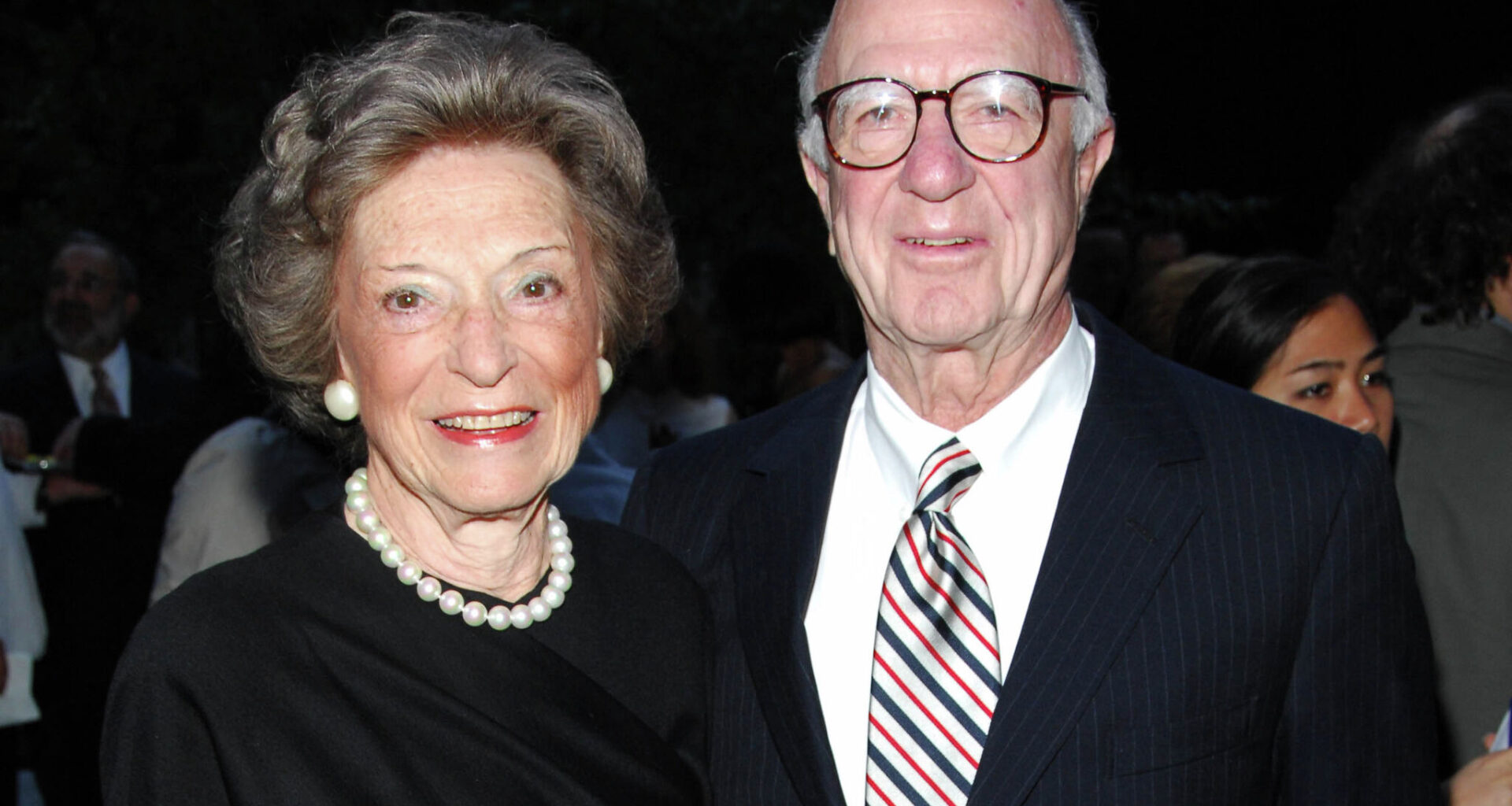
Doris Fisher (left), who co-founded Gap Inc. with her late husband, Donald Fisher (right), died in San Francisco at 94. She helped turn a single Ocean Avenue jeans shop into a global retail company and later became a major Bay Area art patron and education philanthropist.
Patrick McMullan/Patrick McMullan via Getty Image
Doris Fisher, who co-founded Gap Inc. with her late husband, Donald Fisher, and helped turn a San Francisco jeans shop into a global retail company that defined generations of casual American style, has died. She was 94.
Fisher died peacefully in San Francisco, Gap Inc. announced Monday. The company did not disclose a cause of death.
Fisher was among the most influential business figures to emerge from San Francisco in the second half of the 20th century. She helped build Gap from a single Ocean Avenue storefront into a household name, then used the fortune and influence that followed to become a major force in Bay Area philanthropy, education and modern art.
Article continues below this ad
Her legacy is visible in shopping malls and closets across the country, but also inside the San Francisco Museum of Modern Art, where works from the Doris and Donald Fisher Collection helped transform the museum’s permanent holdings.
Gap began with a mundane frustration. Donald Fisher could not find a pair of jeans that fit. In 1969, a turbulent year in San Francisco and across the country, the Fishers raised $63,000 and opened a store at 1850 Ocean Ave. The shop sold Levi’s jeans and music on records and tapes.
San Francisco Chronicle Logo
Make us a Preferred Source to get more of our news when you search.
Add Preferred Source
Neither Doris nor Donald Fisher had retail experience. But they had timing, taste and a simple idea: make it easier for customers to find the clothes they wanted.
Doris Fisher came up with the company’s name, a reference to the “generation gap” between young people and their parents. Donald Fisher had wanted to call the store Pants and Discs.
Article continues below this ad
The simpler name won. So did the concept.
Gap’s early appeal rested on ease: jeans, casual clothes, clear displays, accessible prices. The Fishers soon opened more stores, added more clothing and dropped the records. The business eventually expanded to include Old Navy, Banana Republic and Athleta.
Gap Inc. reported $15.4 billion in net sales for fiscal 2025 and ended that year with nearly 3,500 store locations in about 35 countries.
Fisher served as Gap’s merchandiser until 2003 and remained on the company’s board until 2009. In the company’s early years, she worked in the store and wore Gap clothes herself.
“And I could always sell what I was wearing,” she said in a video on Gap’s website.
Article continues below this ad
Bob Fisher, Doris Fisher and Bill Fisher attend the Met Gala on May 3, 2010 in New York City. Doris Fisher, who co-founded Gap Inc. with her late husband, Donald Fisher, died in San Francisco at 94.
Patrick McMullan/Patrick McMullan via Getty Image
Gap credited Fisher with helping shape the company’s merchandising, store design, advertising and product development. She pushed the company, it said, to stay focused on the customer.
“We must have complete knowledge of what we want to stand for in our business. That will make our store sing with excitement for the type of customer we want to appeal to — and have complete awareness as to our customers’ needs,” Fisher said.
Donald Fisher, who died in 2009, often credited his wife’s eye and instincts with helping the business survive its early years.
“In the beginning, her incredible sense of style and judgment saved our tails, as she drove the fashion side of the business,” he wrote in “Falling Into the Gap,” his self-published memoir. “If she loved a fashion or idea, whatever it was, she left no doubt. She’d gush with delight.”
Article continues below this ad
In 1970, when Gap needed to appeal to younger customers drawn to brighter, more expressive clothes, Doris Fisher pushed the company toward bolder styles.
Doris “went for the wildest stuff (Levi’s) had— and I’m talking crazy looking!” Don Fisher wrote. “There were stripes, checks, hounds tooth, and variety of plaids. They had red, white and blue fashions; bright colors in big bells. … The shelves emptied as fast as we could fill them.”
Robert Fisher, the couple’s oldest son and Gap’s board chair, said in an interview before her death that his mother understood the company first as a customer.
“Style was always important to her,” Robert Fisher said. “How she looked, what she wore. She was the ever-present voice of the customer, thinking about what the customer would want.
“Even in her late 70s and 80s, she’d complain to me that all the Gap pants were low rise. She’d say, ‘Look i wear my pants up to here.” I’d say, ‘Mom, you’re 80. Customers are not 80. ‘ She always looked at herself as the first customer of the Gap.”
Article continues below this ad
Doris Feigenbaum was born in San Francisco on Aug. 23, 1931. Her father, B. Joseph Feigenbaum, was a Harvard-educated lawyer and former state legislator. Her mother was Dorothy Feigenbaum.
“My father, born in 1900, was a lawyer and a good friend of Supreme Court Chief Justice Earl Warren. My mother, like most women in those days, did nothing,” Fisher told the Wall Street Journal in 2015.
“She grew up with very formal parents in a very formal house,” Robert Fisher said. “She had a traditional Jewish upbringing, not necessarily religious, but family-oriented. She had a pretty domineering father with high expectations (whom) she always strove to please.”
Fisher graduated from Stanford University in 1953, where she studied economics. That same year, she married Donald Fisher, a longtime family friend.
The couple had three sons: William, Robert and John. Robert and William Fisher have served on Gap’s board and held management positions with the company. John Fisher owns the Athletics baseball team, which left Oakland after the 2024 season and is planning to move to Las Vegas for the 2028 season.
Gap said Doris Fisher is survived by her three sons, 10 grandchildren and 13 great-grandchildren.
Fisher’s influence extended well beyond retail. She and Donald Fisher became one of the country’s most prominent collectors of modern and contemporary art, assembling works by Andy Warhol, Cy Twombly, Richard Serra, Roy Lichtenstein, Alexander Calder, Ellsworth Kelly, Willem de Kooning, Richard Diebenkorn, Chuck Close and other major artists.
The collection began modestly. In the mid-1970s, the Fishers started buying prints to brighten Gap’s corporate offices. Over time, collecting became a central part of their lives.
“We love picking the art ourselves, which is why we never wanted to have a curator,” Doris Fisher said in a 2007 interview with SFMOMA.
SFMOMA has said the Fishers developed their eye by visiting galleries, museums and artists’ studios around the world and by forming friendships with artists.
“Art challenges you,” she said, according to Gap.
Robert Fisher said his mother was drawn to art that was “beautiful, lyrical, stylistic” like the works of Agnes Martin and Ellsworth Kelly.
He added, “She became very good friends with Ellsworth. She had a deep personal relationship with him and his husband Jack Shear.”
The Fishers originally wanted to build a private museum in the Presidio but dropped the plan after critics argued it would harm the national park’s natural beauty and historic character.
Instead, the family reached a landmark agreement with SFMOMA. In 2009, the Fishers pledged more than 1,100 works to the museum, one of the largest gifts of its kind.
The arrangement was not without controversy. Some critics objected to conditions attached to the Fisher galleries, including requirements that a large share of the works displayed there come from the family’s collection. But the partnership also changed the scale and ambition of SFMOMA, giving the museum long-term access to one of the world’s major private collections of postwar and contemporary art.
Last month, “Reimagined: The Fisher Collection at 10,” a reinstallation that sought to give greater context to the art and how the Fishers assembled it, debuted at the museum.
Fisher’s philanthropy also centered on education. Gap said she served on the board of KIPP, the charter school network formally known as the Knowledge Is Power Program, and supported efforts to expand educational opportunity for underserved students.
“My parents would take a tour every year of all the schools they had helped to support and start through KIPP and Teach for America,” Robert Fisher said. “That was probably the highlight of her year, going around, talking to students and teachers and heads of school and really relating to people who were just trying to improve themselves. It was so emotionally empowering to her to see these kids in difficult situations and communities thrive.”
Along with her three sons, Doris Fisher donated almost $9 million to Americans for Job Security, a conservative advocacy group that supported Republican candidates and sought to defeat President Barack Obama in the 2012 election, according to prior reporting.
At Gap, in philanthropy and in art collecting, Doris and Donald Fisher operated as partners.
“My father was a million ideas a minute, and my mother kept him focused,” Robert Fisher said. “My dad was very competitive, and my mother helped to soften those edges.”
“It’s just a much stronger thing if you’re working together,” Doris Fisher said in a video about the couple’s philanthropy.
Gap said the family requested that donations in Fisher’s memory be made to SFMOMA or the KIPP Foundation Northern California.
“We do our best to lead by example,” Fisher once said, according to Gap, “Not because others are watching, but because it’s the right thing to do.”