
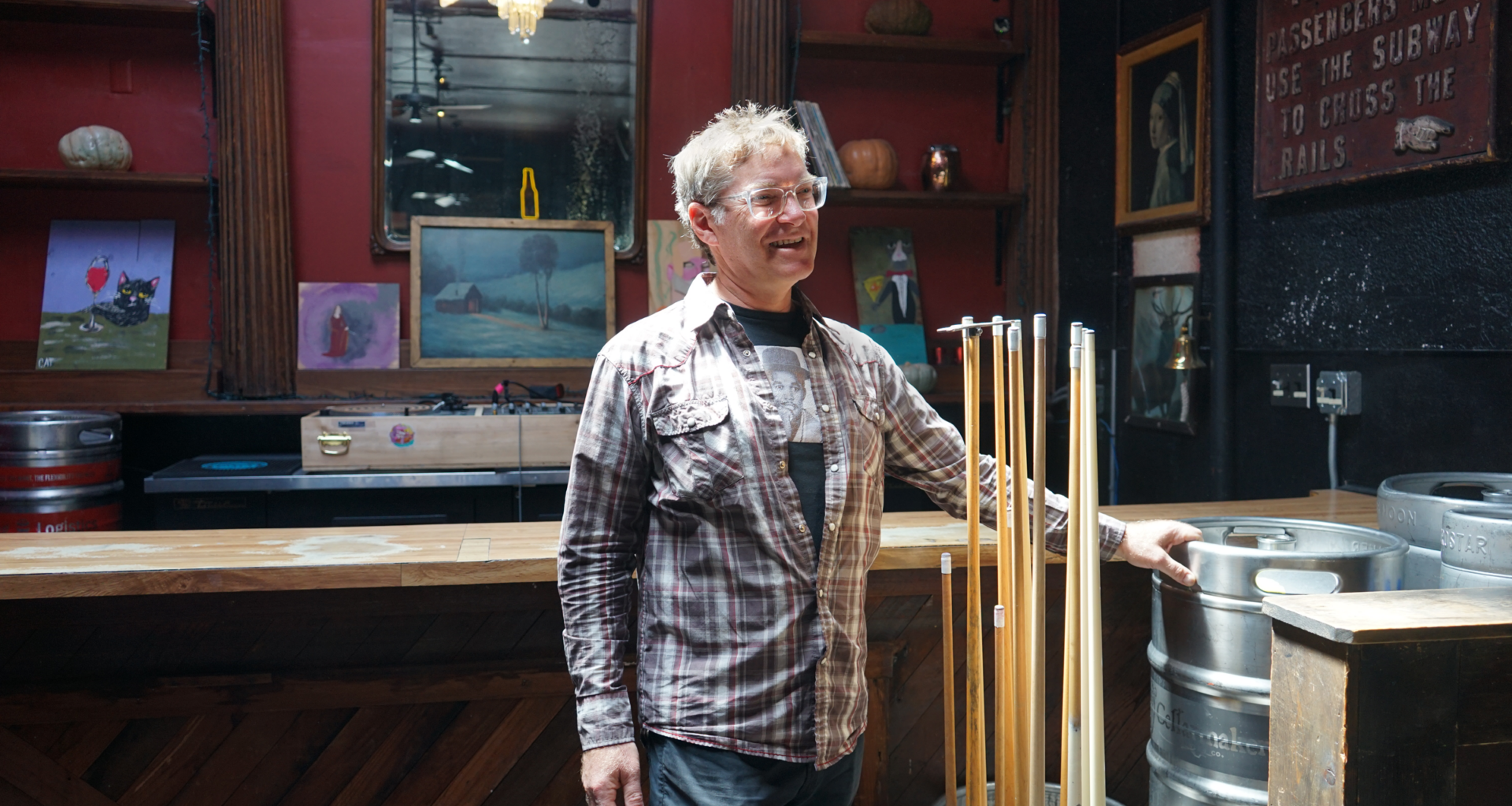
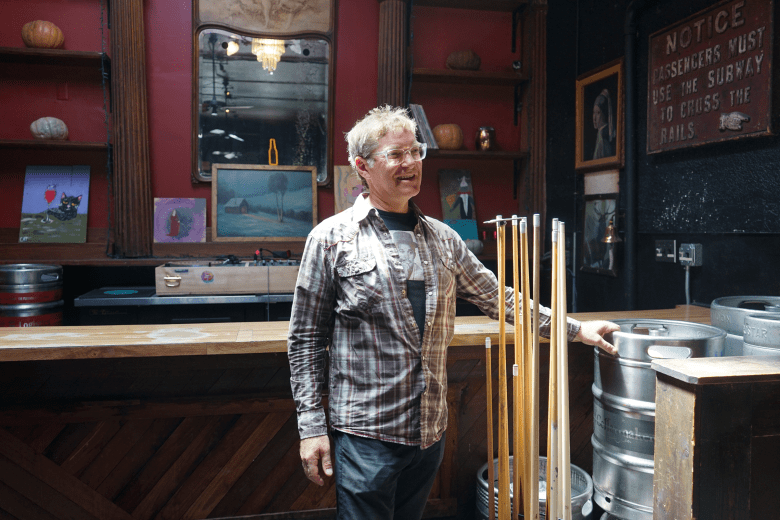
 Mike Linn at Spats before a show on Friday, April 24, featuring the bands Horrhaus, Cuva Bimo and Some Good Things. The semi-retired pediatrician volunteers his time booking bands for the downtown Berkeley bar. Credit: Eva Edgren
On a Thursday night in April, a modern rock band plays to a sparse crowd at Spats in downtown Berkeley. A handful of people gather near the stage while others drift between rooms, lingering at the bar, circling the pool table, or taking a spin on the $11 liquor wheel.
“Business really depends on the crowd the bands can bring in,” says bartender Desiree Jessa.
Across Berkeley and the Bay Area, bars and small venues are struggling for a range of reasons, including people drinking and going out less and rising food, fuel, rent and labor costs.
At Spats, a 56-year-old guy is sweating it out on nights and weekends, volunteering his time to keep the dream of live music alive. His name is Mike Linn, and he’s a semi-retired pediatrician.
Linn has spent years helping bands find places to play just for the fun of it. The Berkeley resident answers emails, builds lineups, connects touring acts with local bands and shows up to make sure the night runs smoothly.
Linn’s involvement with booking began in 2015 at the Octopus Literary Salon, a small Oakland venue, where he brought in touring bands like Lou Barlow and The Posies and local acts like The Disciples of Markos and Marbled Eye. He also DJs on KALX, UC Berkeley’s radio station, plays keyboards in a band, and each summer, volunteers in the first aid tent at the Mosswood Meltdown festival in Oakland, where he often runs into patients and their families.
Linn has been volunteering at Spats since the bar was renovated last year, with a new kitchen and a stage for live performances. Adachi Hiroyuki, the chef behind the pop-up Aburaya, had begun lunch service at Spats and introduced Linn to the space. Soon after, Linn was booking acts for Jason Beebout, the bar’s owner and vocalist for the Bay Area band Samiam.
“He popped in, and we talked,” Beebout said. “I’ll take all the help I can get.”
Linn’s taste runs wide, shaped more by curiosity than genre. At the Octopus and now at Spats, he books a mix of local and touring acts, from punk and garage to country and experimental, often giving space to bands before they’ve built much of a following.
As his wife, Karen Meckstroth, put it: “If a band gets big, he’s usually moved on.”
Days treating patients in Berkeley, nights setting up for shows and bartending
Music has always been essential for Linn.
“For me, music has been the most important hobby for sanity,” he said. “The more I read, especially medical literature, the more I believe music does things other hobbies don’t.”
Family vacations with Meckstroth, also a doctor, and their two daughters were planned around music, and the girls grew up singing, playing piano and going to shows. “His passion for music always exceeded his passion for pediatrics,” Meckstroth said.
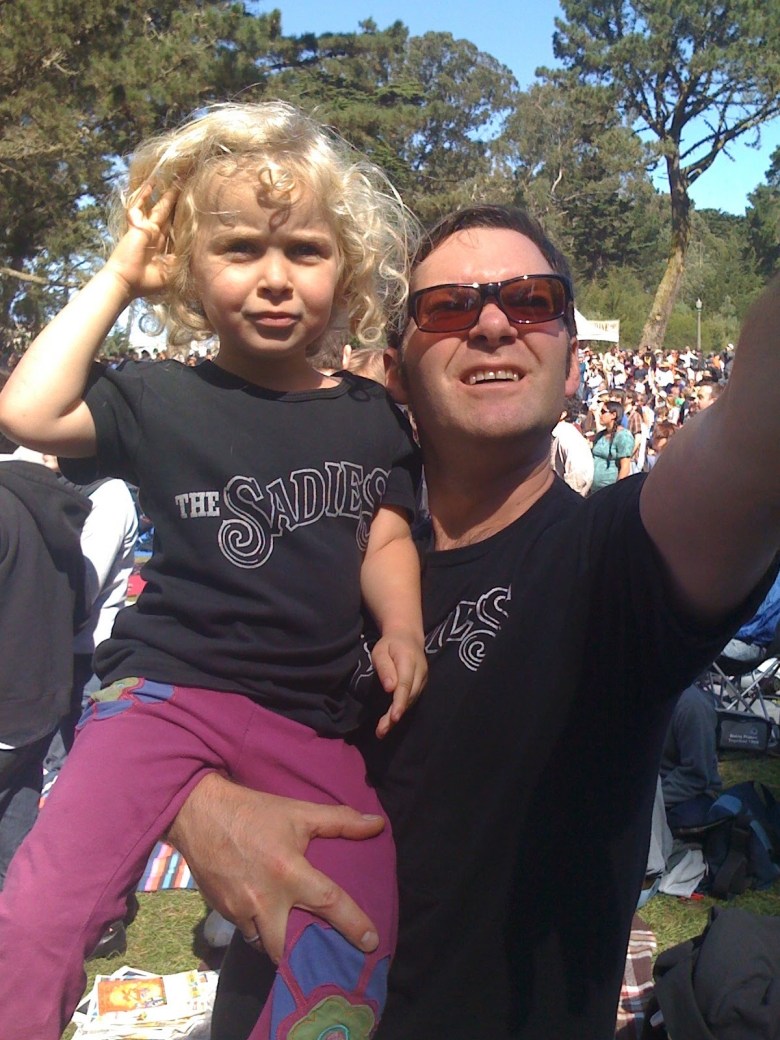 Mike Linn with his daughter Sada at the Hardly Strictly Bluegrass festival in San Francisco in 2009. Courtesy: Mike Linn
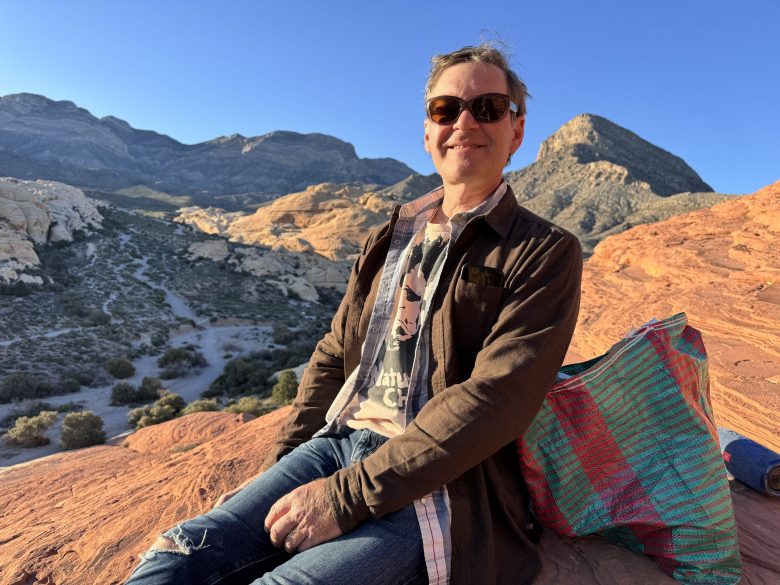 Mike Linn at Red Rock Canyon in 2024 with his ever-present Bluetooth speaker. Courtesy: Mike Linn
For three decades, Linn worked as a pediatrician with Stanford Children’s Health, including 10 years at its Berkeley office, before beginning his retirement in 2024 (he still sees the occasional patient). During many of those years, when his days ended around 5:30 or 6 p.m., his nights were just beginning.
“I would finish at the office, eat dinner, and head over” to the Octopus, he said. “I’d help with set up, sound, door, bartending and clean up. There were weeks where I was there four or five nights a week, sometimes two shows a night.”
Ian Patton, who was part of the small team running the Octopus and oversaw the kitchen, remembers a group of teenage punks who had driven down from Alaska.
“They were maybe 18 tops,” Patton said. “We asked them if we could make them anything, and they wanted PB&J.”
Linn treated them with the same attentiveness he would offer any established act.
“I remember Mike being so kind and caring to them, and treating them with the same respect he would if it was Tommy Stinson from the Replacements or another big-name touring band,” Patton said.
Even chaos was handled with a kind of calm improvisation, as at a Stork Club show during a power outage. “We put candles out. The bar went cash only,” Linn said. “It was a great show.”
‘My work in music is payback for what I’ve gotten from it’
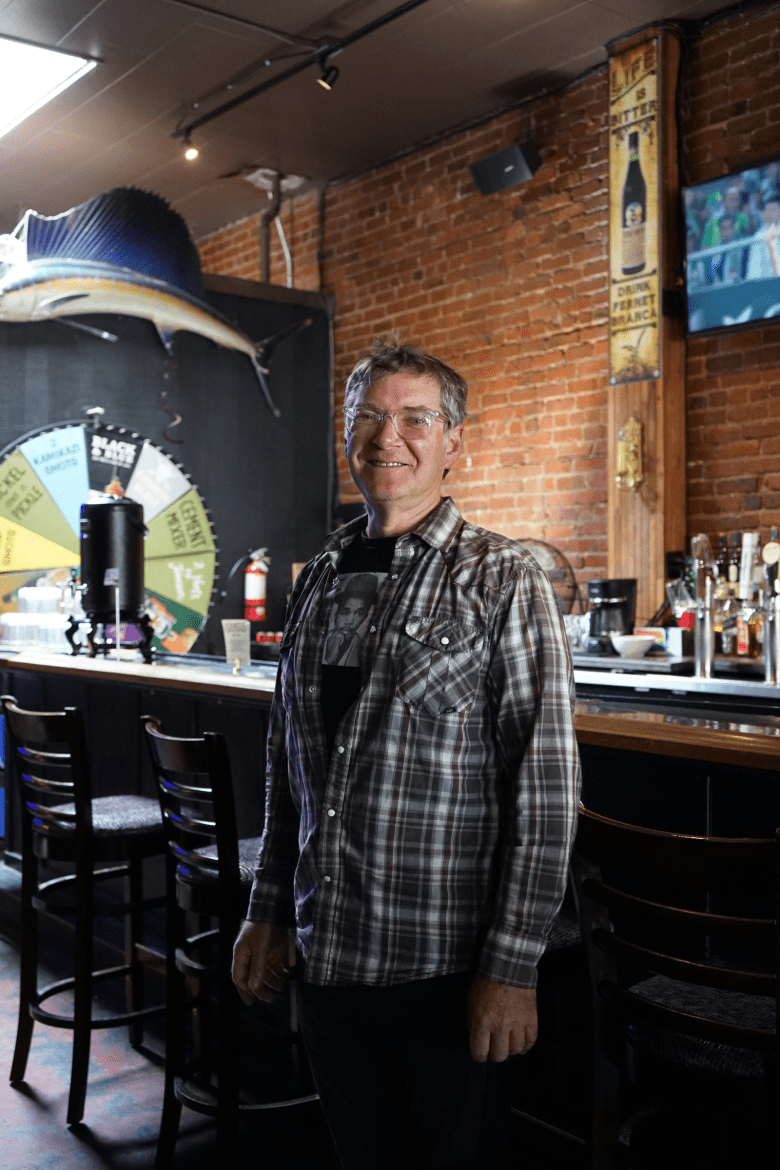 Mike Linn at Spats on April 24, 2026. Credit: Eva Edgren
Linn has treated the children of musicians he’s worked with and cared for patients who later show up at shows. Most musicians, though, have no idea what he does during the day.
“Those that know seem unaffected by it,” he said.
What they do notice is his responsiveness.
“My sense is that most bands don’t even get a response when reaching out to a venue,” Linn said. “So a quick, kind response seems like a bare minimum.”
Bands without a following often need help building a bill that will bring people in. Linn connects them with local acts, helps shape lineups and encourages promotion on all sides. He does not take a percentage. He does not sign contracts.
“If I can make it easier for bands to connect to local clubs and take some money home, that is reward enough for me,” he said.
For Linn, this work is his way of paying things forward.
“I always felt like my work in music is payback for what I’ve gotten from it,” he said. “I can’t say music saved my life, but it’s gotten me through a lot of rough times.”
As a kid, Linn lost his father before his first birthday and later moved from Chicago to the suburbs with his mother and stepfather.
“It was a lot,” he said. “I had a blue Panasonic tape deck that I carried everywhere, mostly listening to Abbey Road.”
He compared the way he connects with artists to the tact he deploys as a pediatrician when talking to parents.
“For most artists, their work is like their baby,” Linn said. “I try to be caring, appreciative and transparent. And oftentimes, I tell them how beautiful their baby is.”
Michael James Tapscott is a writer based in the East Bay. Originally from the Midwest, he has lived in the Bay Area for nearly two decades. He previously wrote for Nuvo Newsmagazine, and his fiction has appeared in numerous literary journals.
“*” indicates required fields