
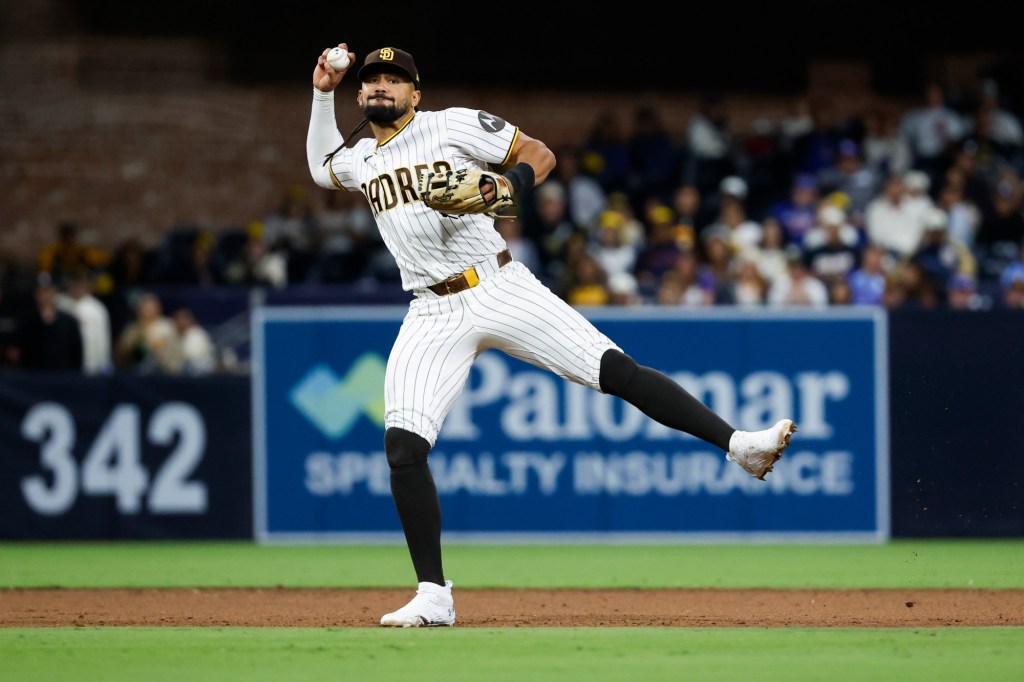
This will be a nerdy column about defense as played by the Padres and their opponents in the recent homestand.
Nerdy because I enjoy watching what happens when the ball is put into play and have been lucky to see many big-league games in person.
The view from the pressbox affords a look at all the defenders.
Decades ago my gig as a newspaper’s film runner put me closer to home plate than each team’s manager.
Garry Templeton was revealed as a shortstop god as I peered through a field-level portal some 60 feet behind home plate at The Murph. The limitations of Steve Garvey’s damaged throwing shoulder became more apparent.
Above all, as a wide spectrum of defensive actions unfolded with clarity, I saw that big league ball moved much faster than it seemed to move from the stands or via telecasts.
From the Padres’ six home games last week are several takeaways about the D:
The Cubs continue to defend at high level.
Xander Bogaerts has sustained his efficient form of 2025.
Manny Machado, whose baseball tempo seems unerring, remains the best baseball thrower I’ve seen.
In skill and importance, defensive honors Sunday went to Padres newcomer Griffin Canning for his agile pickoff of a White Sox baserunner at first base. The play, completed by Ty France’s positioning and tag, blunted a first-and-third threat.
Defensively, the Padres had a C-minus pair of series. That’s one reason they went 2-4.
Let’s ramp up the nerdiness.
Most big-league games serve up interconnected defensive consequences —through lines — that matter a lot but almost always get glossed over in video and all print game accounts for good reasons.
I’ll nerd out over a key defensive stretch in the 8-2 loss Friday to the White Sox.
Six runs in the second inning led to Chicago avoiding a bullpen game and the doomsday scenario of facing a well-rested Mason Miller.
Padres defenders did not have a great second inning.
They dared to be great. But they weren’t able to be great.
Here was a crucial first domino: Fernando Tatis Jr., playing second base, where he has scant game experience, tried to nab a runner at home plate instead of completing a double play after gloving Machado’s perfect throw to get the first out with Chicago ahead, 1-0.
Tatis’ throw was in time but sailed wide and high.
When a team fails to get a “sure” out, the ballpark atmosphere seems to thicken.
Padres pitcher Germán Márquez did not lighten the fallout. He walked the next hitter, then went 2-0 on No. 9 hitter Drew Romo.
Freddy Fermin dared to be great next.
The catcher challenged the ball call after lunging far to his right to spear the 2-0 pitch.
The Padres would have just one challenge left if he was wrong, meaning Fermin must’ve been near certain he was right.
Replay confirmed the ump’s call.
Márquez followed with a ball, loading the bases.
When a sacrifice fly made it 3-0, the Padres weren’t yet in an awful spot. Not with two outs and Sox pitcher Noah Schultz, a rookie, having logged a laborious first inning, overcoming three walks and a balk.
It came down to this: Márquez threw a nasty curve with the count 2-2 against slugger Munetaka Murakami, the majors’ home run leader yet also a strikeout-prone hitter.
Seemingly advantaged by the Padres’ being unlikely to challenge the call, Murakami took the two-out borderline pitch.
It was correctly ruled too low.
Márquez came back with another curve.
It didn’t curve. Murakami slammed it for a three-run home run. Shultz, staked to a 6-0 lead, settled.
The Padres? The gained valuable if expensive feedback.
Tatis learned more about the game speed and angles at second base. In right field he doesn’t have to step and reset in response to a sliding baserunner, as he did Friday before throwing.
Fermin learned more about how to react to the automated ball-strike system that MLB adopted this year. The catcher has fared well there, winning 13 of 19 challenges, beating the league average. Later in the series, Fermin won a key challenge and made another top-notch throwout.
The Padres will want to squeeze out another good season on defense, a year after finishing third of 30 teams at turning balls in play into outs.
OK, that’s enough nerding out. In baseball no one chants “deee-fence.”