
A proposed half-cent sales tax hike for all of San Diego County is one step closer to November’s ballot.
A coalition of labor unions and nonprofit leaders turned in about 151,000 signatures in support of the measure to county election officials, ending a months-long drive of volunteers collecting signatures.
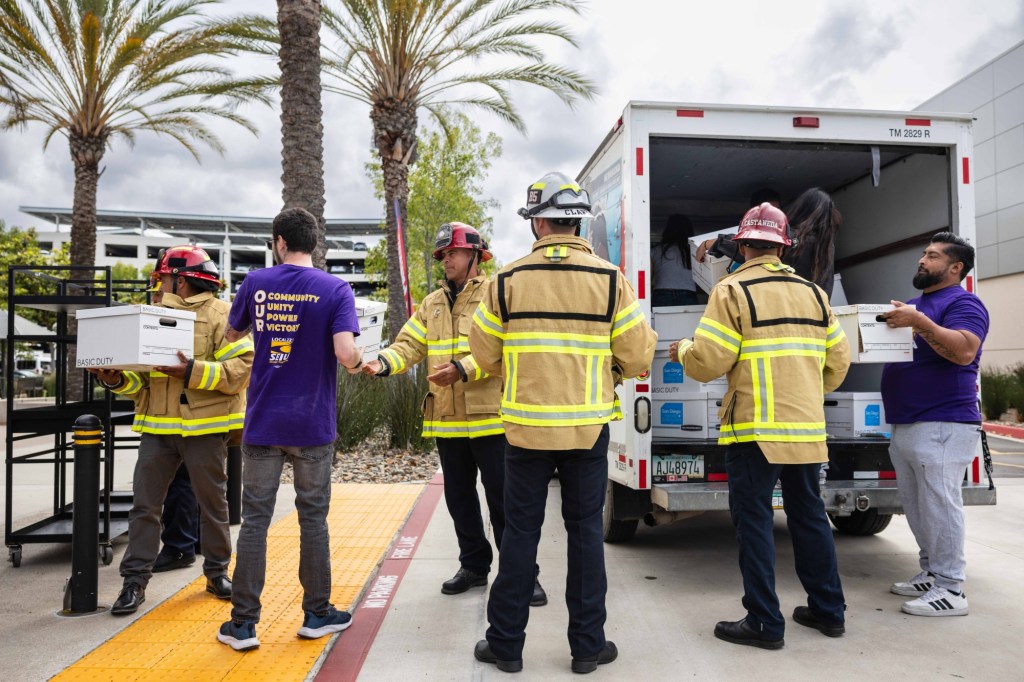
On Monday, organizers brought boxes of signatures to the registrar’s office on a U-Haul, wielding signs in support of the measure’s funding of county services.
“This effort is already a success story of community action,” said John Clark, vice president of the firefighters union Cal Fire Local 2881. “This measure is about what it delivers: real, tangible improvements to people’s lives.”
If successful, the measure would raise the countywide sales tax rate from 7.75% to 8.25%. Supporters estimate it would bring in $360 million in new revenue for the county in its first year.
Sixty percent of the revenue would fund county social services programs, some of it to maintain staffing for administration of food assistance and health care programs.
Another 22.5% would fund mitigation efforts for the Tijuana River Valley sewage crisis, and the remaining 17.5% would fund staffing, equipment and infrastructure for public safety agencies like the sheriff and fire protection.
“These aren’t abstract problems,” Clark said. “Firefighters, health care workers, community organizations, parents and working families have come together with one voice.”
The San Diego County Registrar of Voters now has 30 days to verify the signatures. The number organizers collected far exceeds the number needed to qualify for the ballot, which is about 103,000.
If ultimately placed on the ballot, the tax hike would need support from only a simple majority of voters to pass, since it’s sponsored by community groups.
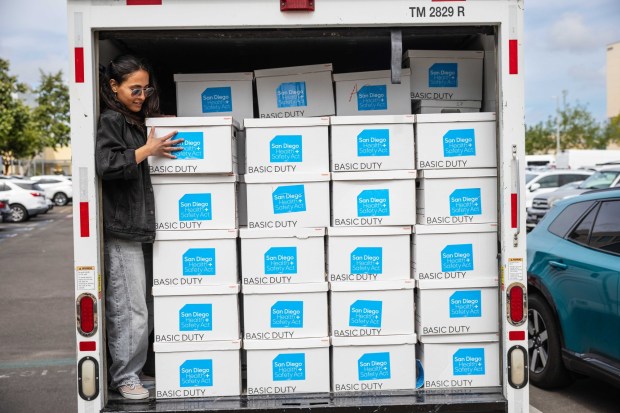 Natalia Rodriguez moves boxes with signatures for a ballot measure for a half-cent sales tax increase in San Diego County to fund health and safety initiatives on Monday, May 4, 2026, in San Diego. (Zoë Meyers / For The San Diego Union-Tribune)
Leading the coalition are the firefighters union, SEIU 221 and Children First San Diego, a political committee controlled by local nonprofit leaders. The coalition has raised nearly $2 million to fund its campaign, disclosures show.
Some of its biggest donors include local businessman Mel Katz, who loaned the campaign $500,000, and Qualcomm founder Irwin Jacobs, who donated $250,000, according to disclosures. Sharp Healthcare and Scripps Health each gave $100,000, and the San Diego Foundation gave $250,000.
Meanwhile, Democratic supervisors have been gauging public support for a possible sales tax hike with county-funded polling and outreach efforts. But any sales tax ballot measure placed on the ballot by supervisors, rather than by a citizens’ initiative, would need to meet a higher threshold to pass — a two-thirds majority.
But in a region already long pummeled by a high cost of living and at a time when consumer costs are sharply up, voters may be skeptical of a measure that would make things even more expensive. A countywide sales tax measure to fund transportation projects narrowly failed at the ballot box in 2024.
Asked about affordability concerns, SEIU President Crystal Irving called them a “valid question” but argued weakened county services are “even more harmful.”
“I think it also speaks to just how much of a need there is right now for these services, because the community stepped up and decided that they wanted to fund this in those numbers,” Irving said.
Other supporters point to elements of the package they say could bring down child care costs. Organizers have even made “affordable child care” a leading slogan of the campaign.
About a fifth of the expected new revenue would get distributed across various child care programs.
Eight percent would go to vouchers that low-income San Diego County families could spend on child care. The voucher program is administered by the state, and with the new sales tax revenue, the First 5 Commission of San Diego would give grants to existing state voucher programs.
Other new tax revenue would go toward stipends for licensed child care providers. The hope is that stipends would raise pay in a sector with historically low pay and thin margins, ultimately helping with staff retention and improving care for children.
“What this is going to fund basically falls into affordability for families,” said Courtney Baltiyskyy, vice president of policy and advocacy at the YMCA of San Diego County and president of Children First San Diego.