
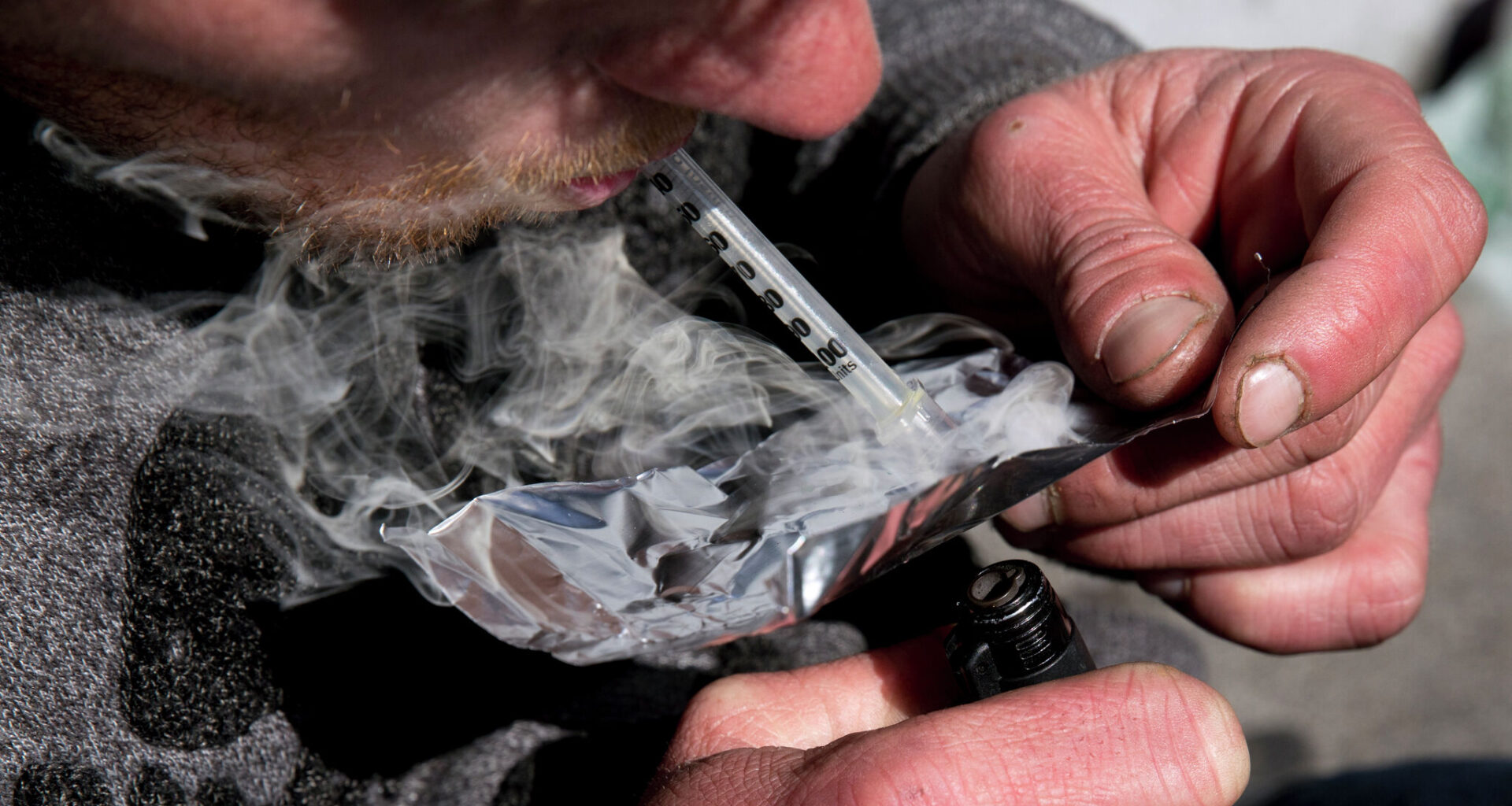
A man smokes fentanyl in San Francisco in 2020. Voters want Prop 36’s mandate for drug addiction treatment, but a poll shows 53% disapprove of its implementation.
Jessica Christian/S.F. Chronicle
In November 2024, California voters approved Proposition 36 by more than a 2-to-1 margin. The measure, which reclassified some misdemeanor theft and drug crimes as felonies, was largely viewed as a necessary corrective to earlier criminal justice reforms and as a way to address crime, homelessness and drug addiction all at once.
“Tonight, California voters have spoken with a clear voice on the triple epidemics of retail theft, homelessness and fatal drug overdoses plaguing our state,” San Jose Mayor Matt Mahan said of the results. “In supporting Proposition 36, they said yes to treatment. They said yes to accountability. And they said yes to putting common sense before partisanship, so we can stop the suffering in our communities.”
But the truth is, despite those good intentions, voters were misled. While Prop 36 mandated treatment for drug addiction, it provided no dedicated funding for it. As a result, just nine months after nearly 70% of voters passed Prop 36, a whopping 53% polled said they disapproved of its implementation. That displeasure holds across nearly every demographic: 60% of Democrats disapprove, but so do 38% of Republicans. Even among voters who approve of President Donald Trump’s job performance, 45% disapprove of what’s happening with Prop 36.
Article continues below this ad
When asked what should happen now, 47% said Prop 36 should be repealed entirely, and 22% said its treatment programs needed to be fully funded. Another 15% want to delay all implementation until funding is available.
It is tempting to treat Prop 36 as a badly drafted law that slipped past voters. It is not. It is the predictable product of structural flaws in California’s ballot initiative process.
San Francisco Chronicle Logo
Make us a Preferred Source to get more of our news when you search.
Add Preferred Source
Start with bundling. California’s Constitution requires ballot measures to address a single subject, but courts have interpreted this so permissively that initiatives can package incompatible goals together. Prop 36 combined treatment and enhanced penalties into one yes-or-no question.
Then there is funding. California’s Constitution has no mechanism to ensure ballot measures include money to implement what they promise.
Article continues below this ad
This pattern has played out before. The three strikes felony law of 1994 mandated services without appropriating resources, and it took propositions in 2012 and 2014 to roll it back. Now, Prop 36 swings the pendulum again. This isn’t just about evolving public opinion. It’s a broken mechanism converting nuanced preferences into blunt policy lurches.
The fix has to come from outside the initiative process.
Most importantly, the state Legislature needs to do its job. While the proposition process includes the wrong incentives — the pressure to bundle, to overpromise, to duck the funding question — proper evidence-based legislation that responds to voters’ demands can fix the unfortunate bait-and-switch.
Advocates across the state have been pushing for a proven evidence-based practice to achieve the Prop 36’s goals. But the funding math is not encouraging. For 2025-26, the funding allocation for Prop 36 is $88.5 million. For 2027-28, that amount will dwindle to $17.4 million. County behavioral health agencies alone estimate needing $95 million to $213 million annually.
Courts should recognize what I call a “substantive fidelity” requirement. When implementation creates a material divergence from an initiative’s core promises, courts should be able to intervene by declining to enforce the parts of the bargain that depend on the parts the state refuses to deliver. If the treatment pathway Prop 36 promised is functionally unavailable, the penalty enhancements that presuppose it should not be enforced.
Article continues below this ad
Prop 36 voters chose balance and got selective implementation. The advocates demanding voluntary, accessible treatment are aligned with those voters.
The Legislature is starting to respond. Senate Bill 926, titled “Public safety: Funding of Proposition 36 Act,” proposed spending $400 million to help cover the shortfall. As originally drafted, though, the bill reproduced the bait-and-switch. Of its six allocation categories, three — district attorneys, city police departments,and probation — were designed to go directly to law enforcement. But that version did not hold. On April 23, the bill was amended. The carve-outs for district attorneys and city police are now gone. What remains directs money to county behavioral health departments, community-based interventions, probation and counties for administration. The amendments also stripped the hard $400 million figure from the bill; it remains to be seen whether and how much funding would be provided.
Guest opinions in Open Forum and Insight are produced by writers with expertise, personal experience or original insights on a subject of interest to our readers. Their views do not necessarily reflect the opinion of The Chronicle editorial board, which is committed to providing a diversity of ideas to our readership.
Read more about our transparency and ethics policies
The amended SB926 is closer to what the polling shows voters want. It is not perfect. Probation and incarceration-cost offsets still tilt a share of the package toward the carceral side of voter priorities, and a fund with no guaranteed appropriation is not yet a funded program. But the trajectory matters. Public pressure moved the money away from law enforcement and toward the rehabilitation infrastructure that Prop 36 promised. That is what public opinion, applied steadily, looks like.
When voters passed Prop 36, they hoped it would deliver results on crime, homelessness and drug treatment. It’s past time to make good on those promises.
Article continues below this ad
Dvir Yogev is a postdoctoral researcher at UC Berkeley. Their research on public opinion and criminal justice reform has appeared in Criminology and in Public Opinion Quarterly.