
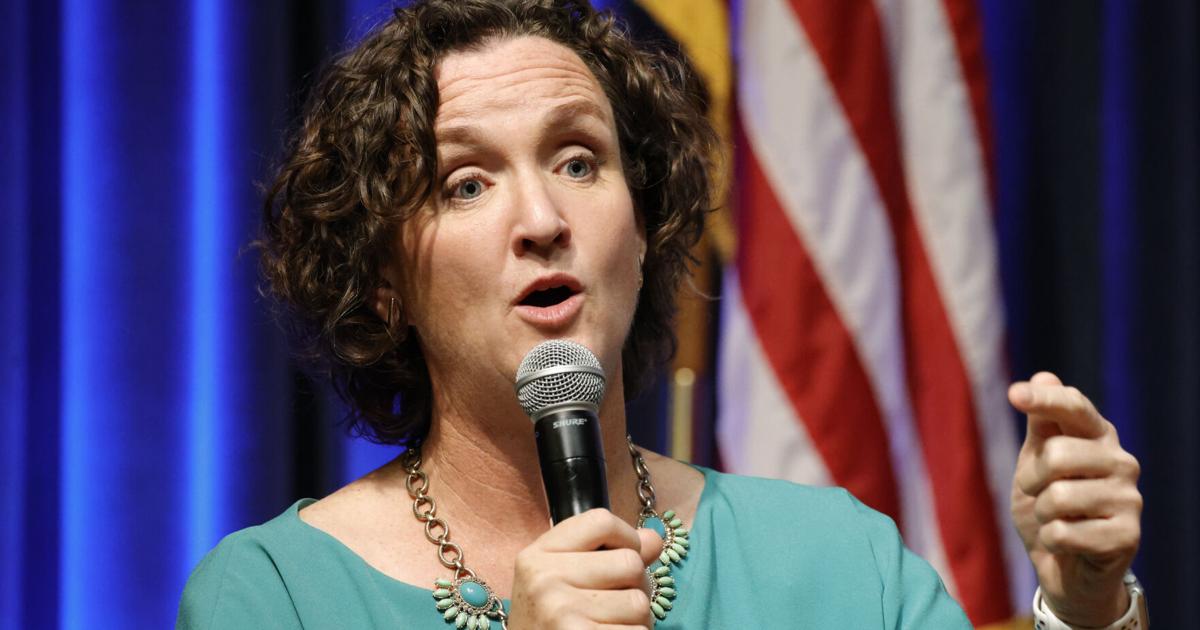
Every candidate for governor promises to tackle California’s affordability crisis. Katie Porter says she was doing that work long before she ever entered politics.
As a UC Irvine law professor, she testified before Congress about how mortgage servicers were helping fuel a foreclosure crisis. She later served as California’s independent monitor of a national mortgage settlement in the wake of the 2008 financial crisis.
The progressive Democrat ousted a two-term Republican congresswoman in 2018, flipping the Orange Country district from red to blue by promising to counter President Donald Trump and represent working families. She twice won reelection before announcing she would seek Sen. Dianne Feinstein’s seat in the U.S. Senate in 2024; she ultimately finished third in the primary and failed to advance to the general election.
Though the result was a clear blow to what once seemed an unstoppably rising political star, Porter pivoted and announced a run for governor the following year.
Porter has built a campaign platform that includes providing universal free child care, accelerating new housing construction, providing two years of free college tuition for Californians and eliminating state income taxes for households that earn less than $100,000 a year. And she’s highlighted her refusal to accept contributions from corporate-backed PACs.
The following conversation is part of a series in which The Examiner plans to speak with each of the major candidates in the California gubernatorial race. This interview has been edited for length and clarity.
Why do you think people remain so undecided and haven’t paid attention? We have, now, at least a generation of Californians who haven’t had a contested governor’s race.
The thing about this race that I think is fascinating is all these voters being, like, “Well, I know who I like. I know what policies I care about. But someone should just figure out who should be governor.” Democracy lets each of us answer that question.
So this election’s about what Californians want. It’s not about what Sacramento lobbyists want. It’s not about what a handful of wealthy people want. It’s about what Californians want. And so my job is to communicate that I am the candidate who will best address affordability because it’s not, like, a talking point for me. It has been what I’ve worked on my whole career.
Long before I was a politician, I studied families pushed into bankruptcy by medical debt or job loss, helped document how homeowners were getting cheated and preyed upon by predatory lenders, and then in Congress took on the very special interests that continue to make life harder for people.
Can you expand a little bit on how we make California more affordable? We can’t nibble around the edges on affordability. This latte costs a fairly outrageous amount. But I didn’t pay for this latte and think, “You know what? That’s it. I’m fed up.”
What is driving people to get to that breaking point is the cost of housing. It’s the biggest expense that most families face. And so if you’re serious about affordability, you’ve got to make housing your No. 1 issue, and it’s been my No. 1 issue the entire year I’ve been in this race. It was my No. 1 issue in the Senate race.
Why? Because it’s a family’s biggest expense. If you have young children, child care can be even bigger than your housing, right? College tuition is a big expense, right?
We all should want to bring down those everyday costs, but if you can take 10 or 20% off the cost of rent or the cost of someone’s mortgage, that is hundreds and hundreds of dollars to help deal with all the other things that cost a lot.
For housing, is it as simple as building more of it? And if so, how do we make that a faster, more straightforward process? It’s about building more, faster.
If we build more, but we take two and four and 10 years to do it, by then we’re right back in the same place we’ve been. So we have to build much faster, not just because we need the housing — we do, and more supply should help on the price point — but time is money. When you build slowly, it costs more.
Anyone who’s ever renovated a kitchen understands this. They tell you it’s going to be done in two weeks, and there you are five months later with no kitchen. And the price tag tripled.
So, all of the different tools to make housing get built faster. Some of that is about permitting pre-entitlement … some of it is about post entitlement — we get things built and then they sit for months waiting for inspections for certificates of occupancy. Some of it is about innovating and how we build. That can also help bring down the cost. The building code — having a more standardized modernized building code.
The fact that we’re so slow, that’s the easiest thing to fix that will help bring down housing costs and, like I said, 10 or 20% cheaper rent. That’s not like an extra latte. That’s several grocery carts full of food.
Talk to me about the other component of that affordability plan, which is child care. So, first, let’s be very clear. This is still about families, parents getting to choose the child-care provider that’s best for them. All of those providers who love and care for kids, they still do that work — but we’re going to help families pay for it, and we have to.
We don’t expect every family to find the money to pay for education. It wouldn’t be feasible. Same thing is true on child care. I served on the Joint Economic Committee in Congress. Those economists fought and yelled at each other about everything. The only thing they agreed on — even the far-right, trad-wife, everyone-should-stay-home economists — agreed that less-expensive child care grows the economy.


Under new proposal, SFPUC would be able to purchase infrastructure the utility would otherwise be required to install itself

Good times and to-go alcohol sales are set to pop up in the upper Fillmore and Glen Park, much to the delight of nearby bar and restaurant owners

“About Face: Disrupting Ballet,” follows two dancers as they raise awareness about stereotypes in ballet — and seek more authentic depictions of Asian people in dance …
Part of your platform is implementing a progressive corporate tax. How do you do that? And is that, in part, to offset some of the costs of programs such as free child care? Most Californians, including me, are pretty shocked when they find out that the most profitable corporation pays the same tax rate as that child-care provider who only earns a buck at the end of the year after paying all their expenses.
I think that’s outrageous. We’re a progressive state. We have a very progressive income tax, which I support. We should have a progressive corporate tax. This is not about targeting any particular industry. It’s not about picking on tech or ag or oil or manufacturing. It’s not about picking on big business or small business. It’s about saying when you have a banner year, you pay a little more, and that’s exactly what happens to any one of us when we get a bonus or a raise or anything like that.
So if you raise that top rate from 8.84% to 9.5% or 10%, you would generate enough revenue to pay for two free years of college tuition. You’d have enough revenue to eliminate California income taxes on everybody earning less than $100,000. That takes about $8 billion. And you have some left over — not enough to cover [free] child care, but look, we already took it down from 5 [years old], now we have 4 because we have pre-K, right? And so you’re, you’re eroding at it that way. And then, probably, you pay for some of this through some kind of small payroll tax on everybody over time.
To take a 90-degree turn here. How do you explain to a nature-loving, climate-change-concerned Californian that we need to keep oil refineries open? There’s a big difference between keeping what we’ve got open — which I think we have to do, at least with [President] Donald Trump in office — and drilling more, which I oppose. We should not be investing in the energy infrastructure of the past, not when every global competitor and other states are investing in the future energy.
Right now we have our own fuel standard — we have our own gas blend, and it’s refined here because we’re the only state that has it. That fuel standard, the low-carbon fuel standard, is why we’ve made a lot of progress on pollution. And so it’s going to be refined here because we’re the only ones who are buying it.
One of the things we could do is push to get that low-carbon fuel standard into other states. So that everybody is refining it, right? Our energy demand is going to go up a lot, right? So we don’t have an excess capacity right now because we’re seeing electrification, electric cars, data centers, all of them. Energy demand is going to go up, so we’re not in a position right now to take down anything.
But that is different than saying “Let’s go backwards.”
Not to get too philosophical, but with Donald Trump as president, how much of your work as governor would be reacting to what is coming out of Washington versus building affirmatively a future and your own set of policies for California? A lot of those things end up overlapping. So even on things like housing … Donald Trump’s tariffs, ICE raids, deporting workers, like the war in Iran, all of these things are making housing more expensive.
Health care was already really expensive. California needed to contain our costs per patient in Medi-Cal. But then he goes and guts a bunch of the funding for that. So he’s making every one of our affordability challenges worse. That’s true.
But it is also true that you cannot blame Donald Trump for problems like expensive housing. That was true long before he ever reared his orange head. Anybody who says it’s all about Trump, what they’re telling you is they have no plan to tackle California’s own longstanding, homegrown challenges. And for me that is not enough.
I know you support abolishing ICE. As governor, you can’t just do that overnight. How do you protect immigrants in the meantime? Calling for ICE to be abolished is a moral issue. It is moral leadership. You have to say that. Nobody can say “stop racism” and make it stop, but you should stand on your own feet — “Protect trans kids.” That’s a hard thing to do because there’s a lot of attacks on them coming, but you have to show that moral leadership. And by the way, the governor has a role to play in abolishing ICE because the governor should be communicating with our congressional delegation, the largest in the United States — “This is a top priority.”
In the meantime, what do you do? We have a lot of undocumented people living in red counties and in purple counties in rural California, and so one of the things the state can do is really hold jurisdictions to account for following the sanctuary city policy.
I want to ask about what has been made of your behavior — your temper, or whatever it is — in this race. I want to allow you to address that issue on its surface, but also [ask] why you think so much has been made out of it. My team and what we did together means everything to me. Free COVID testing wasn’t something I did. It was something I did with my staff.
All of those whiteboard moments weren’t — I might have held the marker, but we rehearsed, we practiced, people came up with ideas, like — I dedicated my book to my staff, not to my kids, not to my parents, to my staff.
It means a lot to me that my staff stepped up on their own, and when I read that letter in the paper after it was published that they’re speaking up and saying what I think everybody knows, which is that we all have bad moments and we’re also all better and can be better than our bad moments. I have really worked hard to demonstrate that to voters and, you know, and importantly to me in that moment with that staffer years ago. I’ve apologized thousands of times at this point on the campaign trail, and that’s important.
But what really matters — and what I think should matter to Californians, which I don’t get asked — is “Did you apologize to the staffer then?” And the answer is yes, and we kept working together for four years after that video. That was early in us working together and we were having a bad day like she was walking in my shot. I was getting frustrated.
I do think women are — questions about temperament, that word in particular, I just don’t hear that coming up for other candidates.
Do I think there’s something like people are quick to globalize about women? Yes, and we saw it with Kamala, we saw it with Hillary — s—, we saw it with Dianne Feinstein, right? We saw it with Barbara Boxer. That’s a thing. And I think in this race, it is hard for people sometimes to imagine something they haven’t seen in California, home to 39 million people, the largest democracy in the United States, one of the largest democracies in the world. We’ve never seen a woman governor.
Is there anything that we didn’t address or touch on? There is so much fear about Donald Trump. And I get it. Like, he is hurting Californians. We also have to do two things. One is not let our fear of Trump scare us out of electing a governor who will live our values. Donald Trump is attacking our energy — our clean, green energy, — our climate protections, our public lands. But that means you need a governor who’s going to be fierce on those issues, not one who’s profited off fossil fuel or [is] taking donations from fossil fuel.
It’s the right problem. Donald Trump, he’s the problem. But the solution is to go with somebody who’s shown again and again and again who she’s going to be, against that.