
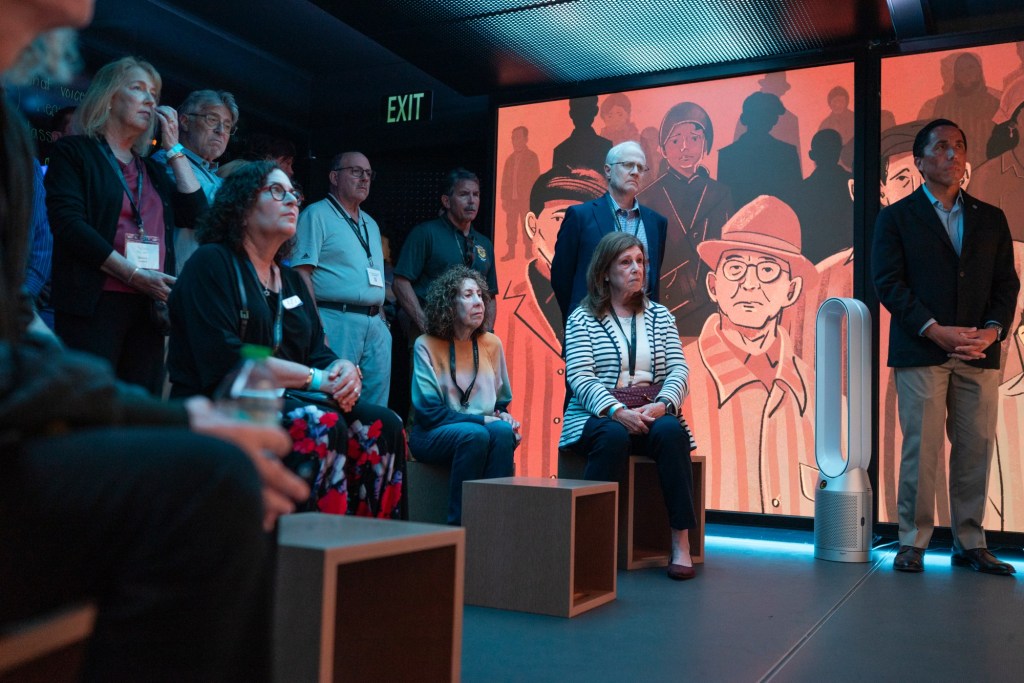
A new mobile museum is set to bring Holocaust education to San Diego County schools in an effort to expand understanding of the genocide of Jews in Europe during World War II, and how its lessons can apply today.
Spark Interactive, an initiative from the Goldberg Institute for Holocaust Education and the Jewish Federation of San Diego, is a fully digital, interactive classroom on wheels that will travel to school districts around the county, including San Diego Unified, Poway Unified and Carlsbad Unified and the San Dieguito Union and Sweetwater Union high school districts.
The museum educates visitors about the conditions that led to the rise of Adolf Hitler and Nazi Germany and to the Holocaust and World War II, including the use of propaganda and disinformation and economic and social factors in Europe at the time.
“It’s when hate, indifference and silence led to absolute, catastrophic ends,” Gillian Belk, field educator with Spark Interactive, told a group of La Jolla Country Day School students during a preview of the museum last month.
“What we’re here to do is to learn from those mistakes and how to create a better future,” she added.
The museum officially opened on Sunday and will begin traveling to schools during the upcoming school year. Organizers hope to reach more than 2,000 students across eight schools in the first year.
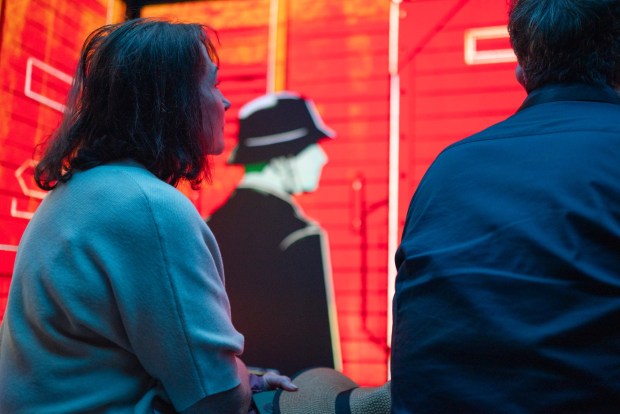 Attendees watch “Holocaust 101,” an interactive video shown inside the Spark Interactive bus during its launch event at Crownair Aviation in San Diego on May 3, 2026. (McKenzie Patterson / For The San Diego Union-Tribune)
A December 2024 survey found only about a quarter of California schools had a Holocaust and genocide teaching system in place at the time, citing challenges like a lack of resources and too little time for curriculum development.
That education that is now mandated for public schools, under a state law that took effect last year. And a state law enacted last fall established a grant program to help schools access resources for Holocaust education, such as instructional materials and transportation to related events.
Spark Interactive is intended to meet students and schools where they are, says Darren Schwartz, founding director of the Legacy of Light Goldberg Institute for Holocaust Education.
“We’re going to come to you and do a reverse field trip,” he said.
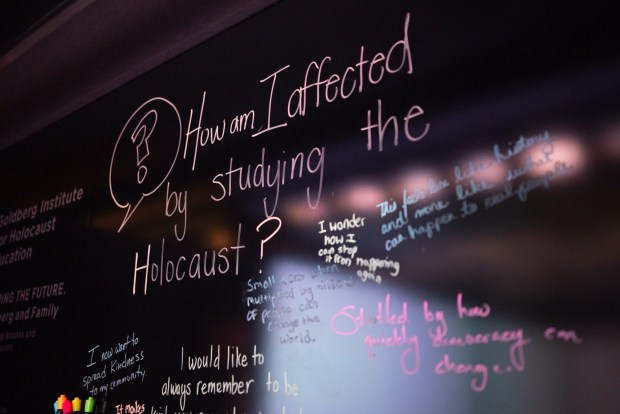 Reflections written by prior attendees of Spark Interactive on May 3, 2026. (McKenzie Patterson / For The San Diego Union-Tribune)
The Spark Interactive mobile museum currently covers the Holocaust and the events leading up to it, with Nazi state-sponsored propaganda and discriminatory laws against Jewish people. But since it’s digital, curators could eventually adjust the focus of the teachings.
The programming can also be tailored to different classes, Schwartz said. The Goldberg Institute helps prepares pre- and post-visit lessons for teachers, as well as questions to send home to parents so families can continue to engage with the material.
Students say that the mobile museum has been a helpful addition to their understanding of the Holocaust.
Eighth-graders Oliver Burgett and Patricio Gasiola have been learning about the World War I and II at La Jolla Country Day School. They liked that the mobile museum was interactive, letting them touch screens to better view the exhibits.
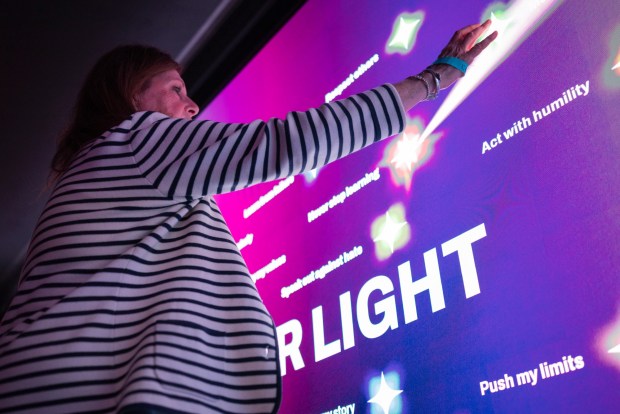 Attendees tap a spark reflecting what they learned after watching “Holocaust 101,” an interactive video shown inside the Spark Interactive bus during its launch event at Crownair Aviation in San Diego on May 3, 2026. (McKenzie Patterson / For The San Diego Union-Tribune)
Lillia Howe, a junior at La Jolla Country Day, said the museum helped show her the Holocaust’s true impact on human lives. “It wasn’t just statistics, but people who were actually experiencing it,” she said.
The mobile museum is one of several ongoing efforts to expand Holocaust education in San Diego.
For years, founders of a local Holocaust exhibit — called Remember Us the Holocaust, or RUTH — have pushed to find a permanent museum space. A current fundraising campaign seeks to raise $40 million to $60 million to buy land, pay for construction and fund programming.
Spark Interactive has come to life through a multimillion-dollar effort from local donors, including a lead gift of $10 million from San Diego philanthropist Lee Goldberg.
The Legacy of Light Goldberg Institute for Holocaust Education launched in January and includes a training program to equip teachers with the tools needed to teach about the Holocaust.
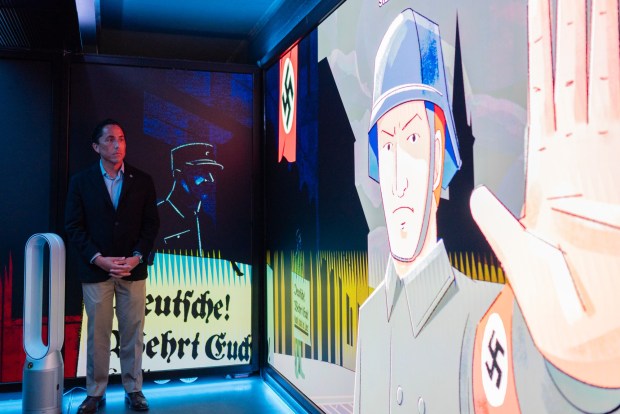 San Diego Mayor Todd Gloria watches “Holocaust 101,” an interactive video shown inside the Spark Interactive bus before speaking at its launch event at Crownair Aviation on May 3, 2026. (McKenzie Patterson / For The San Diego Union-Tribune)
Jack Packer, who teaches English at Carlsbad High, was part of the program’s first cohort so he could bring guidance back to other teachers at his school.
He said it’s important to teach about the Holocaust, but doing so can be challenging.
“Some of the impediments to teaching it are student interest (and) the amount of time that has passed,” he said. “Now, it’s harder to get those who were there or have personal knowledge to share their experience.”
Packer already incorporates some related themes — including fascism and the effects of bystander behavior — in his class lessons about dystopias found in literature.
And as his ninth-graders learn how to write research papers, they explore how to find credible sources and determine bias. He says this can help them better understand current events, including antisemitism, anti-immigrant rhetoric and rollbacks of minority groups’ rights.
“Even if we don’t speak about the current events that are going on in our class, we do talk about how to differentiate what is real or what is not real, and how to take that information and move forward with it,” he said.