
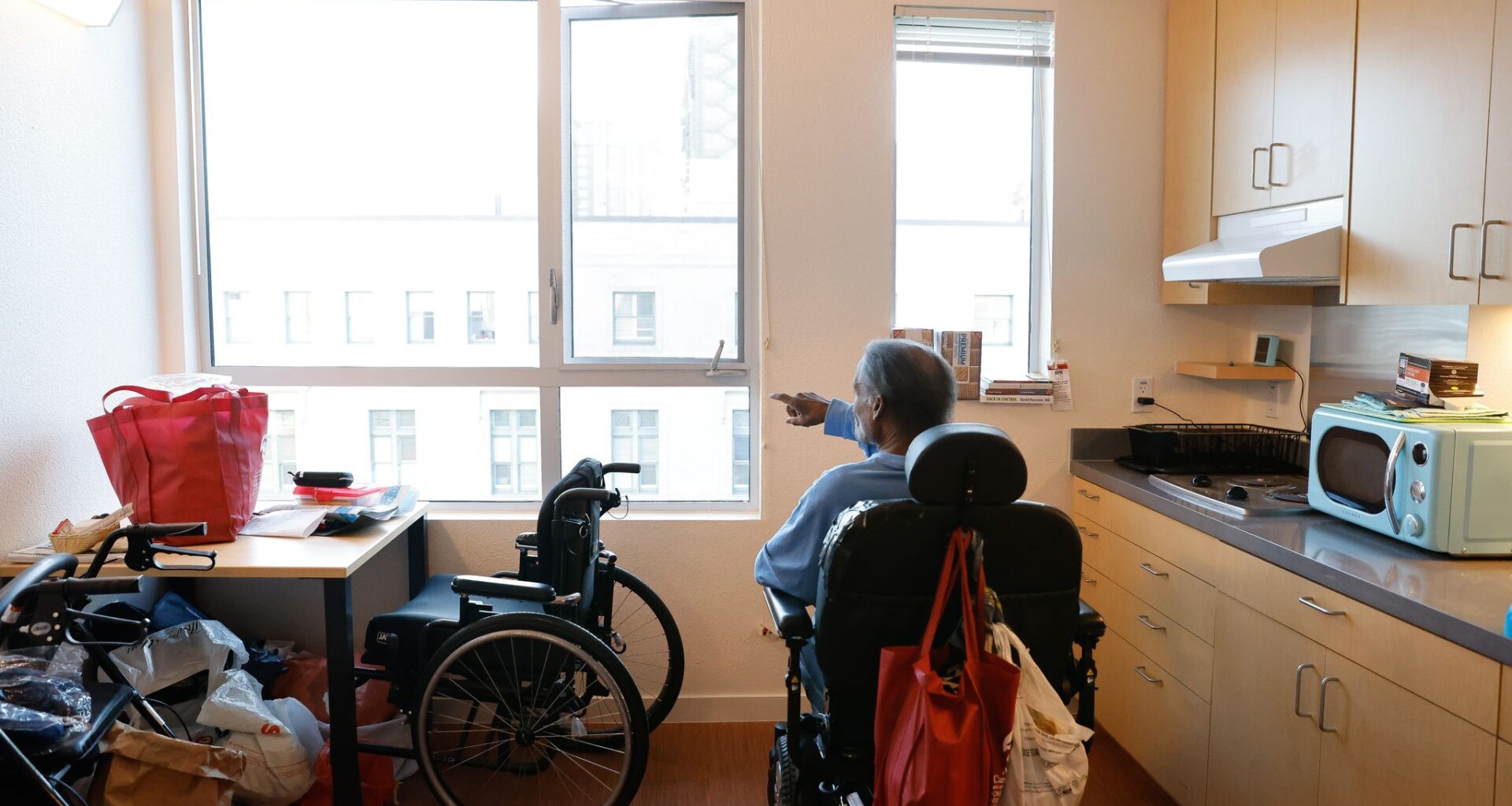
Merlin NW takes in the view out of the windows of his apartment at 1064 Mission, a new permanent supportive housing building on Mission Street for formerly homeless seniors and adults in San Francisco.
Lea Suzuki/The Chronicle
A group representing thousands of Bay Area physicians is urging San Francisco officials to revise a proposal to expand drug-free supportive housing.
The San Francisco Marin Medical Society has asked Supervisor Matt Dorsey to make changes to his legislation that it says are necessary to protect patients. Dorsey has criticized the requested changes, saying they mischaracterize the intent of the proposal.
The Board of Supervisors is slated to vote on the legislation on Tuesday. It would require the city to prioritize funding future supportive housing for the formerly homeless that bans on-site illicit drug use, allows eviction for violations and prioritizes “recovery.” Dorsey defines “recovery” as the “abstinence from illicit drugs,” which may include participation in a medication-assisted treatment program, outpatient or residential treatment, a contingency management program — which pays people to reduce or stop using drugs — or other recovery programs that best fit a person’s needs.
Article continues below this ad
Dorsey, who is in recovery for drugs and alcohol, has argued that the shift is necessary to expand options for residents seeking sobriety and to curb the overdose risk in permanent supportive housing, where about 26% of the city’s fatal overdose occur. Some sites average as many as two 911 calls per day, he said during a recent committee meeting.
“Only in (supportive housing) are 100% of residents forced to live in drug-tolerant communities, whether that’s what the resident wants or not,” he said.
San Francisco District 6 Supervisor Matt Dorsey speaks during a rally in support of Mayor Daniel Lurie’s Fentanyl State of Emergency Ordinance ahead of a hearing.
Stephen Lam/The Chronicle
In practice, the reach of the legislation would be very limited, as it only applies to new city-funded housing sites, but that hasn’t quelled concerns from medical professionals and other treatment providers.
San Francisco Chronicle Logo
Make us a Preferred Source to get more of our news when you search.
Add Preferred Source
In a letter sent to the board last month, the SFMMS — which represents more than 3,500 physicians in San Francisco and Marin counties— said it agrees that more drug-free housing options are needed in the city’s permanent supportive housing portfolio, but warned that evicting people over drug use undermines evidence-based addiction care.
Article continues below this ad
Dorsey’s ordinance, the organization said, goes against the principle of “flexibility,” by mandating “exclusive funding” for drug-free housing options and limiting the city’s ability to meet other housing needs, including for residents unwilling to discontinue drug use, for example.
The organization said it would oppose Dorsey’s legislation unless amended so that residents of abstinence-based supportive housing are not evicted for substance use unless alternative housing or a residential treatment placement has first been secured. The group is also calling for clearer definitions of “illicit drug use,” and for evictions only after multiple on-site incidents — and only in cases where a resident has stated that reducing their drug use is not a goal.
It also requested that the ordinance be limited to individuals or families in recovery or seeking recovery from substance abuse disorders who wish to live in drug-free housing.
In a rebuttal letter on Monday, the supervisor said that his legislation is a “modest, targeted, incremental and forward-looking policy reform” and features the same provisions as standard residential leases throughout the city. He called the policy changes requested by the doctors “problematic.”
He said the ordinance provides residents with a choice to “access an alternative to the solely drug-tolerant housing model now available to them.” For those who choose this alternative, a “single relapse is not grounds for an eviction,” Dorsey said.
Article continues below this ad
The standard for eviction would be when a “participant’s behavior substantially disrupts or impacts the welfare of the community,” he said, adding that the city’s health and homelessness departments would be tasked with developing regulations governing evictions from drug-free housing.
Dorsey added that his legislation would authorize the Board to waive its funding conditions when appropriate. He said the legislation would not dismantle the city’s Housing First policy, which prioritizes getting homeless people off the streets even if they’re not ready for treatment.
“What it would do is acknowledge that a single, harm-reduction-only model is insufficient to meet the full range of needs in our PSH population,” he said.
A man lays on the sidewalk along Leavenworth Street holding a pipe as he smokes crack.
Lea Suzuki/The Chronicle
The legislation comes as the Lurie Administration is making moves to shrink the city’s permanent supportive housing portfolio. In March, officials in the mayor’s office told housing providers that they were looking to close several buildings, though they have yet to release more details.
Article continues below this ad
Any new buildings that receive state funding would be exempt, because under state law, illicit drug use cannot be grounds for eviction. For decades, the city has applied that state law across its more than 15,000 permanent supportive housing units but that model, Dorsey argues, is “destabilizing and dangerous” for many tenants.
Supervisor Alan Wong, who supports the legislation, emphasized at a recent public meeting on the legislation that a “single relapse” would not “automatically trigger eviction” and that the city would be required to use “best efforts” to find alternative housing or shelter for someone at risk of losing their housing.
This is not the first time the Marin Medical Society and other addiction treatment providers have strongly opposed an abstinence-centered policy introduced by Dorsey.
A year ago, the supervisor attempted to amend the city code with a single-sentence stating that the city’s primary drug policy goal would be “the cessation of illicit drug use and attainment of long-term (addiction) recovery.” Dorsey initially defined “recovery” as “abstinence from illicit drugs” — a detail that dozens of treatment providers objected to.
Article continues below this ad
In the end, the supervisor relented and changed the definition to “the process by which an individual suffering from substance use disorder strives to make positive changes that become part of a voluntarily adopted healthy lifestyle.”