
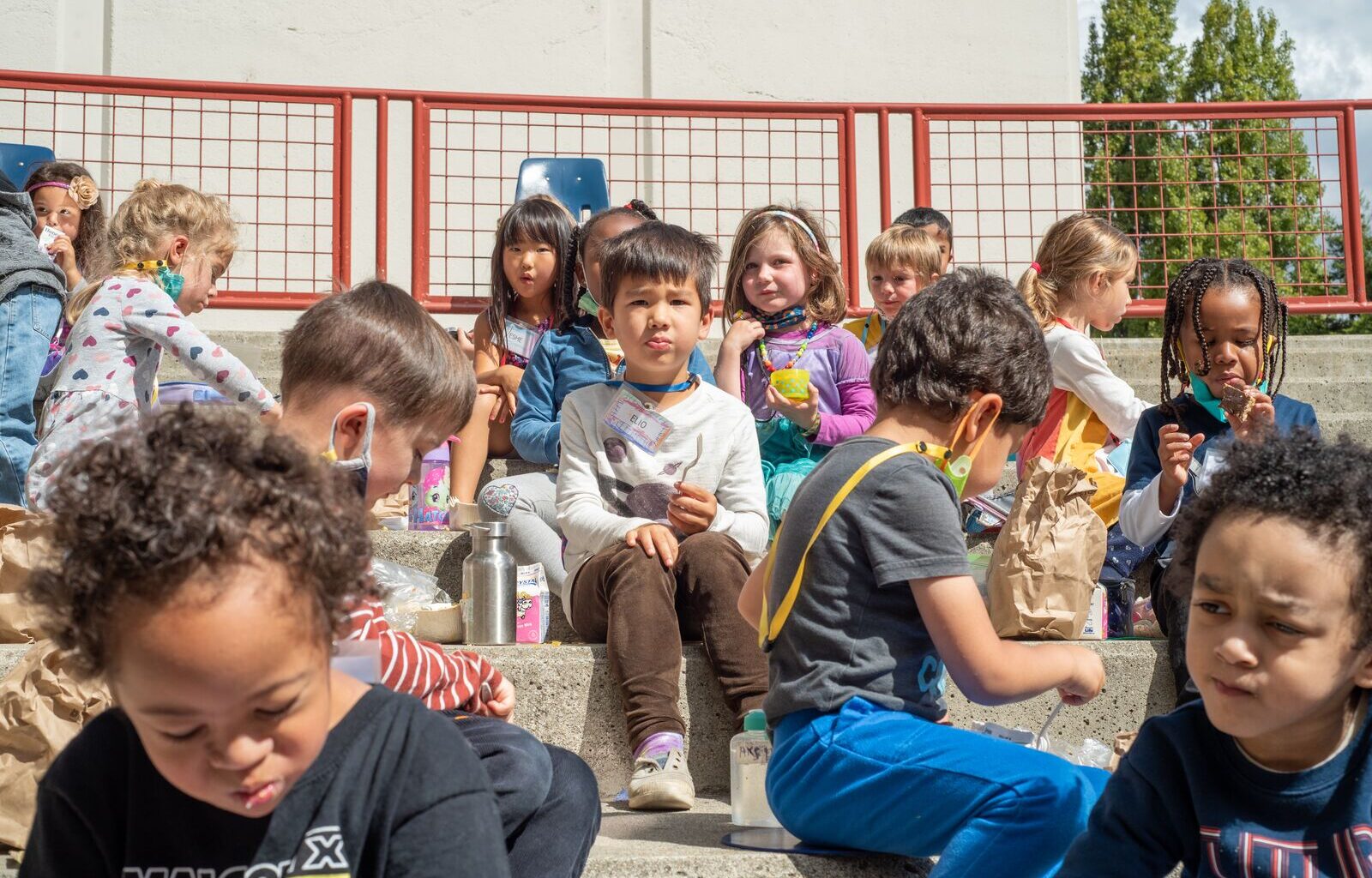
 Transitional kindergarten students at Malcolm X Elementary eat lunch at the school patio in this September 2022 file photo. BUSD’s TK programs are absorbing young students from local private preschools following state expansion. Credit: Ximena Natera, Berkeleyside/CatchLight Local
For most of Mitch Bostian’s 16 years leading the Berkeley School, a private school serving kids ages 4-14 that’s been around since the early 1960s, early‑childhood enrollment was consistently strong. With the exception of the pandemic, the preschool typically had around 80 children every year.
But in the last few years, as more Berkeley 4- and 5-year-olds have become eligible for transitional kindergarten (TK), enrollment in the school’s program has been falling. This year, it dropped to about 55 children, with Bostian projecting under 30 would sign up next year.
Facing a continued drop in enrollment, leaders at the Berkeley School decided in March to close its separate early childhood center and continue serving students at its main campus. Its last session will end on July 23. Families currently enrolled will receive help finding new placements, and those who registered for next year will receive refunds.
The Berkeley School is one of many private childcare centers facing a sea of change under California’s universal TK law (Assembly Bill 130), which passed in 2021 and, after a gradual ramp-up, now guarantees free TK for all 4‑year‑olds beginning this school year.
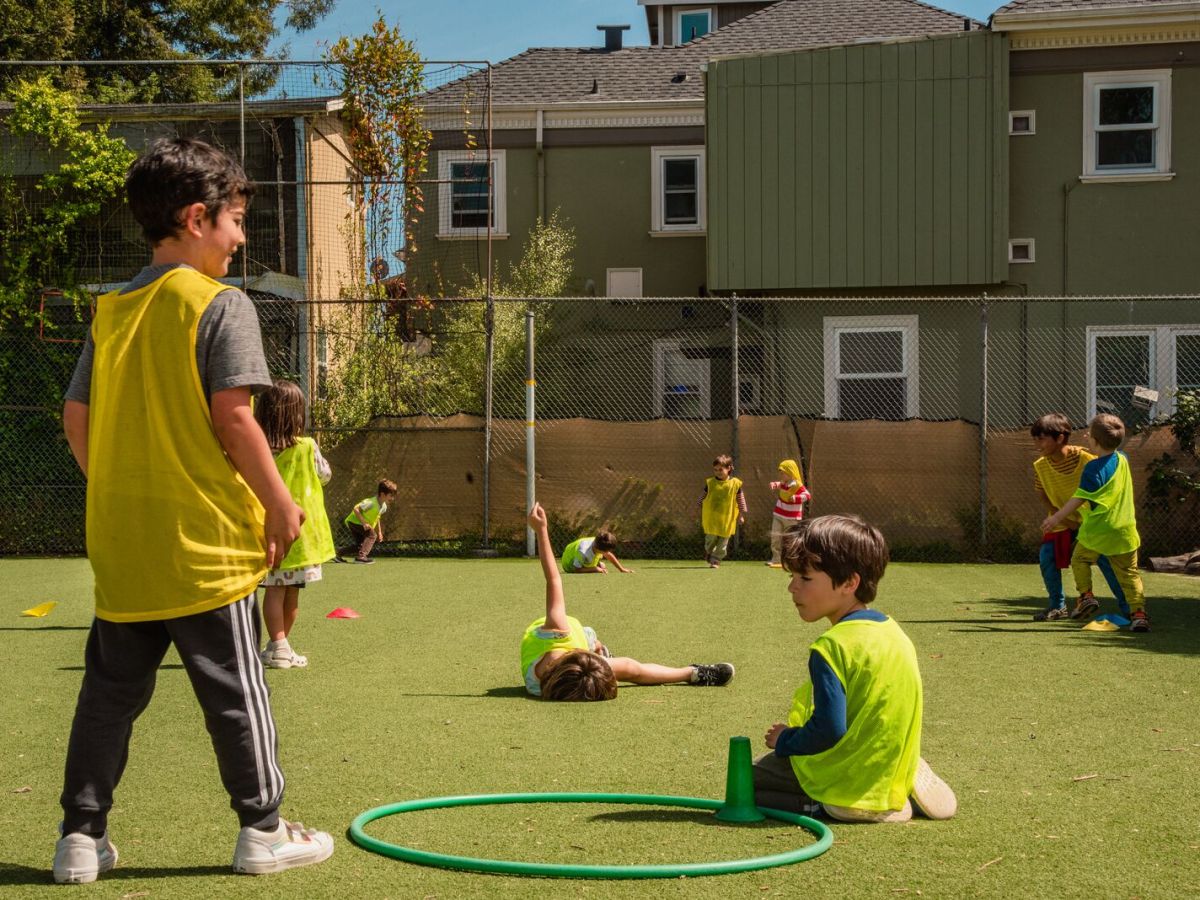
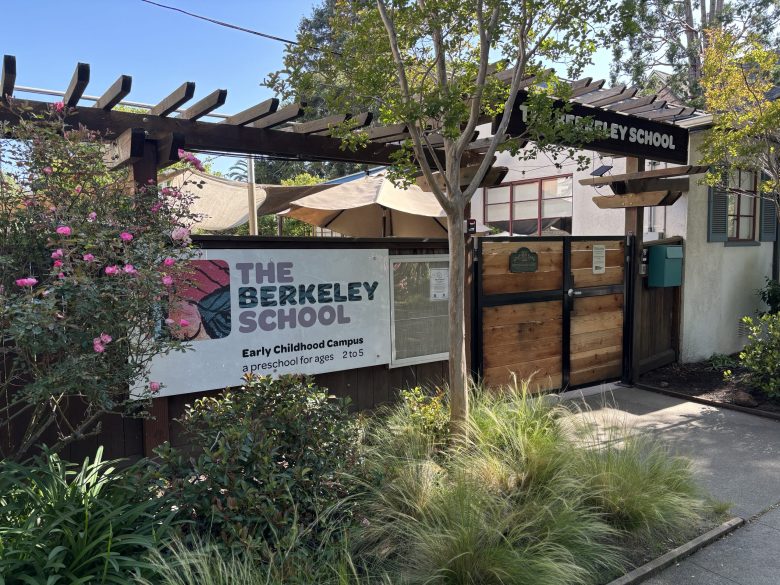 The Berkeley School revamped its programs and added new services to stay competitive with public TK, but ultimately decided to close the early childhood campus by the end of July. Credit: Zac Farber/Berkeleyside
Before the mandate, California’s private TK sector was already strained by rising costs, a lack of staff due to low workforce wages, uncertain state funds and the aftermath of the pandemic, making it harder for small centers to stay afloat.
As universal TK expanded, beginning in 2023, private providers saw 4‑year‑old enrollment plunge as they began competing with a free public program. In recent years, some private childcare providers have shifted to serving younger kids, while others moved their businesses to lower-cost areas, cut back their services, or closed altogether. Federal pandemic relief offered a temporary lifeline, but with those funds nearly gone and staff continuing to leave the field, independent schools are scrambling to survive.
In 2023, Berkeley’s Montessori Family School closed its pre-school site after 36 years, stating that it had “exhausted all options.” The Berkeley Hills Nursery School has laid off four teachers in five years and hasn’t enrolled a single 4‑year‑old for about a year. Last year, community members created a GoFundMe to relocate the bilingual daycare Mi Escuelita; the campaign stated the school was seeking to find a new home amid a “challenging and expensive” real estate market.
There is sparse data from the city and county tracking private childcare providers. Berkeley had 111 family childcare programs and centers in 2021, slightly down from 127 in 2019, according to a recent report, with most of the decline coming from a drop in in-home childcare centers during the pandemic. (Nearly half of the centers and about a quarter of the programs served families through state subsidies.)
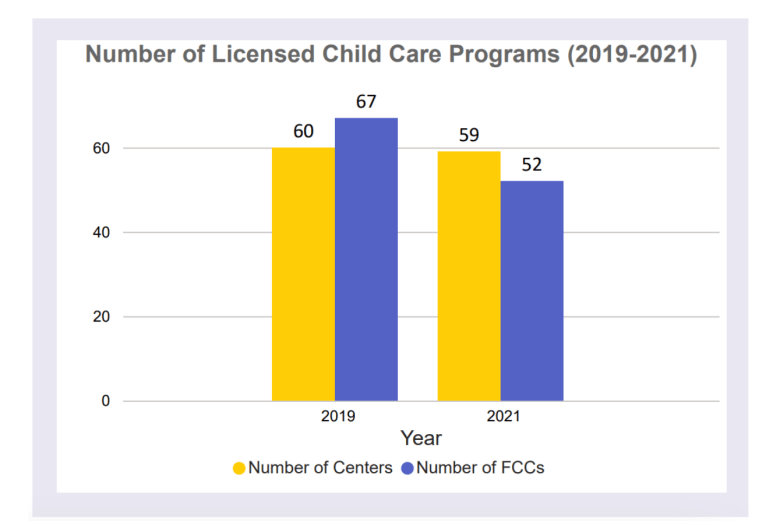 A First 5 Alameda report shows the decline of private early childhood programs in Berkeley before and during the pandemic. The chart distinguishes between childcare centers (yellow) and in-home family childcare sites (blue). Credit: First 5 Alameda
According to a 2025-26 report by First 5 Alameda, county childcare centers saw a steep decline during the height of the pandemic, but began recovering by 2024. There were over 2,400 family childcare programs and 560 centers in the county in 2023. Family programs rebounded but stayed below 2019 numbers. The county estimates that the cost of facilities to meet demand for childcare is between $2 and $4 billion.
Laura Hill, a policy director at the Public Policy Institute of California, said private providers everywhere are feeling the strain of TK expansion, but noted the state has made efforts to reduce impacts on these preschools.
Lawmakers anticipated that most eligible 4‑year‑olds would shift into free public TK, so they created new subsidies to help private preschools pivot toward serving younger children, who are “far more expensive to care for,” Hill said. Ideally, public TK would cater to 4 and 5-year-olds, while independent programs would expand to serve infants and toddlers up to age 3.
But many private preschools say they’re struggling financially to make that transition as TK absorbs older preschoolers — pointing to difficulties, as the Los Angeles Times has reported, in hiring qualified teachers, securing required credentials and permits, and finding staff willing to work with younger age groups, who require less supervision and resources.
Hill said more research is needed to determine whether state incentives for 2- and 3-year-olds are alleviating childcare needs in California and supporting independent programs.
“The rollout is good in some instances and not quite there yet in others,” Hill said.
Bostian is a supporter of universal early education — a “great thing,” he calls it — but he said the disruption it means for programs across the East Bay shouldn’t be overlooked.
“It’s a tough time in the independent private preschool industry,” he said. “Many schools that used to operate at a scale like ours have needed to downsize.”
Berkeley school district’s TK program has been running more smoothly than during bumpy rollout
School districts have been under increasing pressure to expand their early childhood education offerings. The Berkeley Unified School District (BUSD) grew its TK program from four sites about a decade ago to 10 as of this year.
The district also offers childcare services through the Berkeley Child Development Centers at Franklin Preschool and Hopkins Early Childhood.
Since the 2017 school year, early childhood enrollment in BUSD has nearly tripled from 133 TK students to 377 this year, according to district data. Officials said capacity in these programs is limited as BUSD adjusts to meet state standards, including a maximum of 24 students per class and a 10:1 student-to-adult ratio. Schools serving TK students also need to ensure teachers are credentialed for early childhood education and that classrooms provide age-appropriate furniture and bathrooms.
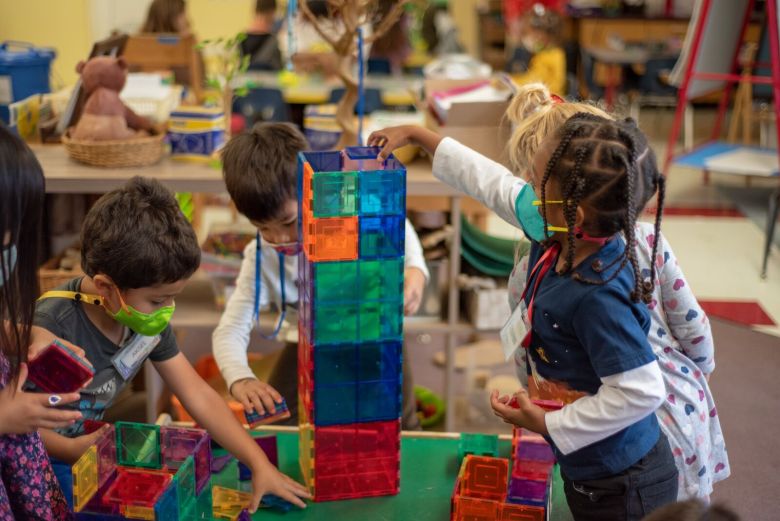 Children in a Malcom X Elementary School transitional kindergarten class play with magnetic tiles on Sep. 20, 2022. Credit: Ximena Natera, Berkeleyside/ CatchLight
Not all 4-year-olds in Berkeley are enrolled in the state’s TK program. In California, compulsory education doesn’t begin until age 6 (first grade), giving families the option to enroll their children in private early‑childhood programs, place them in daycare or keep them at home. Hill said there is no way to fully determine where younger kids are before they enter the public school system.
At first, private providers took advantage of the Berkeley school district’s bumpy rollout — marked by staffing shortages and limited after-school care — to highlight what they already did well, including operating in environments designed to serve young children and offering longer school days.
Preschool in BUSD typically runs to about 2 p.m., depending on the school. District officials said additional TK spots caused a surge in demand for after‑school care, with most students on the after‑school waitlist in TK or kindergarten. Bostian said some families who tried public TK early on returned to the Berkeley School because they needed full‑day care to accommodate the typical workday.
But Bostian said they didn’t see that pattern this year. He said public TK is now “more thoroughly rolled out and more widely understood,” and districts like BUSD have made “robust” efforts to provide after-school care for young students after preschool.
BUSD officials said in an email Tuesday that all interested families with eligible 4-year-olds have been able to enroll in the district’s TK program. BUSD follows standard enrollment priorities, including attendance zones, parental choice and keeping siblings together. If a site is full, the district may offer placement at a school with spaces still available.
Berkeley Hills Nursery plans to cut class for 4-year-olds next year
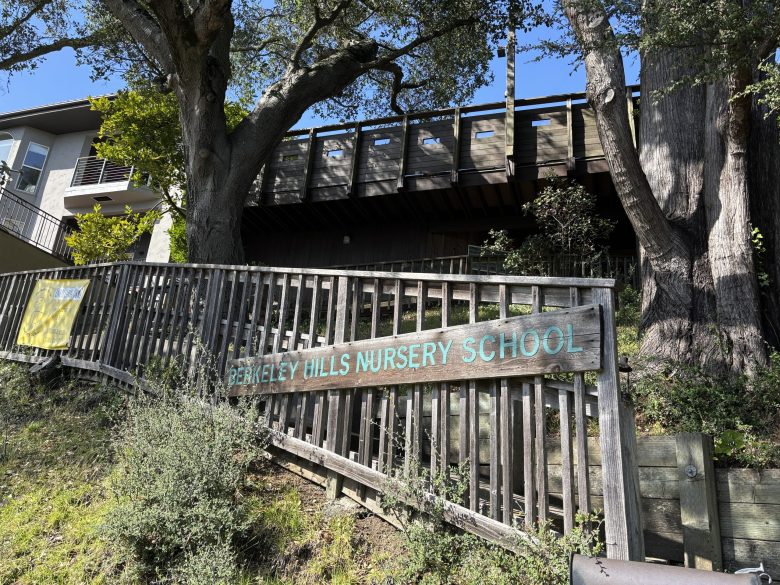 Enrollment at the Berkeley Hills Nursery School has been decreasing since the pandemic, and leaders say the center is not sustainable without grants. Credit: Zac Farber/Berkeleyside
At Berkeley Hills Nursery School, a nonprofit daycare that serves children 2 years, 9 months through kindergarten, director Kathleen Ventura Berland said the school began enrolling younger children in the early 2020s because older cohorts of 4- and 5‑year‑olds “vanished” as universal TK expanded. With all 4-year-olds gone, some families have opted to leave because their children would not be among peers their own age.
Before the pandemic, the Berkeley Hills Nursery School enrolled about 40 students in two classrooms supervised by six teachers. Currently, it operates one combined classroom with 12 children and two teachers.
Berland said federal pandemic relief kept the school afloat, and a Measure C grant allowed it to break even, but the school is not sustainable without grants. Berland said they are not expecting to offer a class available to 4-year-olds next year.
“I don’t think it looks very good,” she said. “Most of the small programs will probably cease to exist.”
Berland said families would lose access to smaller class sizes and ratios, developmentally appropriate care and full-day options. She said the rollout might have been easier if facility upgrades, including child-size restrooms and play areas, had been in place before the expansion and if the state had worked under a mixed-delivery system to publicly fund private care as well as TK.
These schools tried to stay competitive with district’s TK program but it wasn’t enough
Both the Berkeley School and the Berkeley Hills Nursery School had revamped their programs and added new services in an attempt to stay competitive with public TK.
In preparation for a younger student cohort, the Berkeley Hills Nursery updated furniture and items like toys and books — some of which were acquired from a nearby preschool that recently closed. Berland said many toddler programs shut down, unable to recover from pandemic enrollment dips. (Researchers note that California’s early care and education system was still recovering from the impacts of the pandemic as recently as 2024.)
Meanwhile, the Berkeley School, which serves students up to eighth grade, opened its dedicated TK site in 2020-21 at 2030 Francisco St. to meet increasing demand from working parents. Bostian said the school received fewer applications this year, however, especially from new families.
He said the school added year‑round options, expanded financial aid, adjusted its program hours to appeal to working families, and began enrolling younger children, including 2‑year‑olds. It also offered a mixed-age TK-kindergarten classroom for children ages 4 to 6, which received “significant interest,” Bostian said.
But enrollment continued to decline, forcing the school to consolidate its preschool and main campuses. Bostian said some staff members are unsure whether they can maintain a career in early‑childhood education. Some educators have left the private sector to work in public schools (which tend to pay more but require more training), and others have pivoted to different industries.
Early childhood educators in the East Bay feel the pinch
Emily Becerra Sigel, who taught for 15 years, was a preschool teacher at the Berkeley School through last June before she moved to a communications role within the organization.
“It’s a fragile ecosystem, and the last few years have been very telling,” Becerra Sigel said. “I definitely have a lot of hard feelings about leaving teaching.” She said most of her teacher colleagues are searching for roles similar to the close-knit preschool community they had at the Berkeley School.
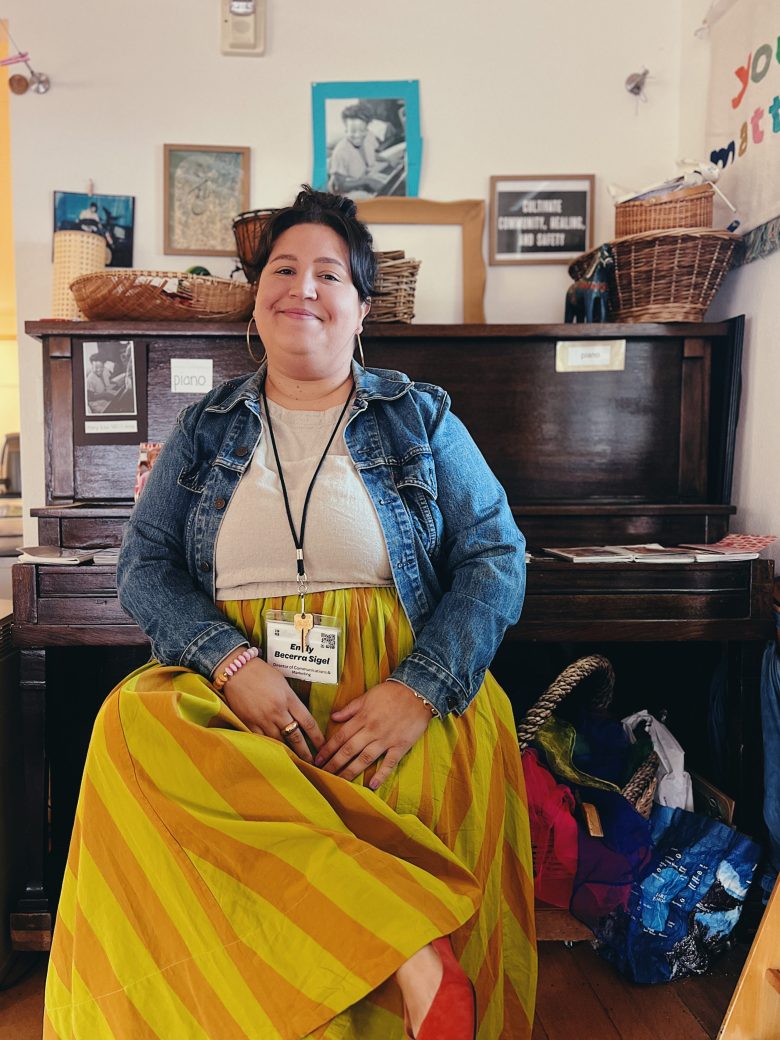 Emily Becerra Sigel was a preschool teacher at the Berkeley School through last June before moving to a communications role within the organization. Courtesy: The Berkeley School
But wages in the childcare industry, which is largely driven by women and people of color, tend to be lower, complicating the workforce situation. According to a county report, 547 early childhood educators worked in Berkeley in 2021, with the median wage at $19 an hour.
Despite the low pay, educators in the industry believe in the importance of early childhood education. Becerra Sigel, who is also a parent and has a son enrolled at the preschool where she works, said these programs are “incredibly important” for children and families enrolling in school for the first time. Research has shown that participation can lead to improved social-emotional learning outcomes, such as stress management and empathy for others. Becerra Sigel said private and public programs should work together.
“We all believe in [universal TK]. We also know that preschools offer something really unique and special that public schools might not be able to,” she said. “We don’t want to lose these crucial parts of this early childhood ecosystem.”
Related stories
More Berkeley 4-year-olds are becoming eligible for transitional kindergarten
September 23, 2022Sept. 26, 2022, 7:57 a.m.
For the first time, 4-year-olds can enroll in Berkeley’s transitional kindergarten program
May 9, 2023May 11, 2023, 3:22 p.m.
Still looking for after-school care in Berkeley? Here’s a guide to your options
August 12, 2025Aug. 20, 2025, 11:26 a.m.
“*” indicates required fields