
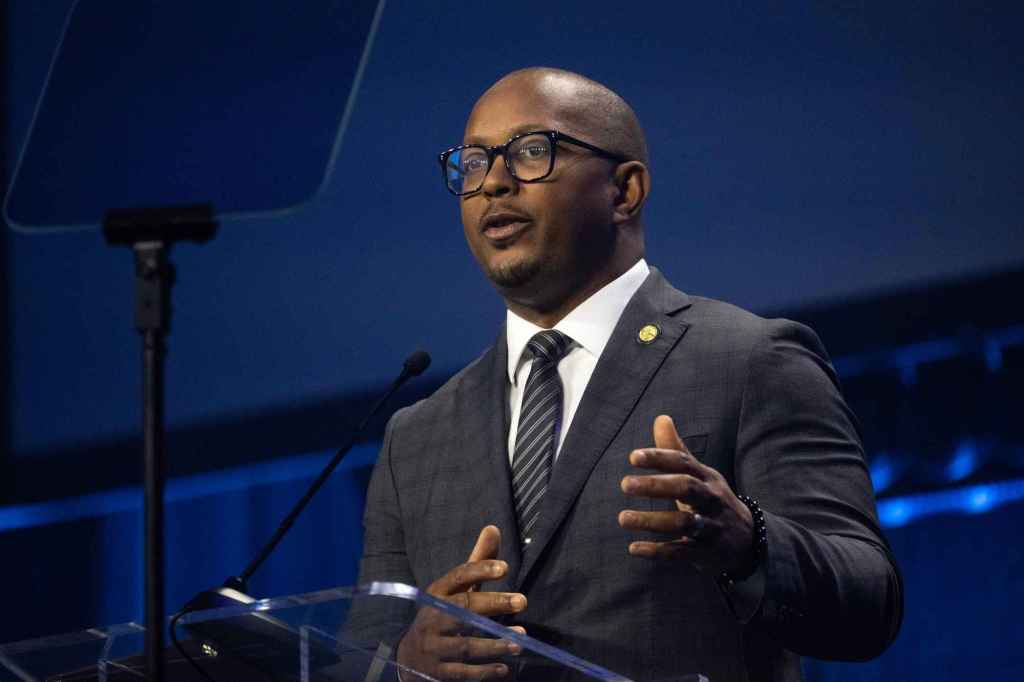
Ahead of the June primary election, the Southern California News Group compiled a list of questions to pose to the candidates who wish to represent you. You can find the full questionnaire below. Questionnaires may have been edited for spelling, grammar, length and, in some instances, to remove hate speech and offensive language.
Name: Rex Richardson
Current job title: Mayor, City of Long Beach
Age: 42
Incumbent: Yes
Other political positions held: Long Beach City Councilmember, District 9
City where you reside: Long Beach
Campaign website or social media: joinrexrichardson.com
One of the main issues local leaders are grappling with is Long Beach’s current and long-term fiscal position. With major budgetary concerns on the horizon, explain your top priorities for Long Beach’s financial future and the mayor’s role in achieving those goals. (Please answer in 200 words or less.)
To secure a fiscally sound future in Long Beach, we need to continue focusing on generating sustainable revenue through economic growth, investing strategically and deploying programs that deliver measurable returns for residents.
Since taking office, we have grown Long Beach’s economy by attracting over 4,100 high-paying jobs in the advanced manufacturing and technology sectors, securing more than $16 million annually through the LA County Affordable Housing Solutions Agency and County Measure A, and Measure LB is projected to generate $15 million in new annual city revenue. We’ve proven we can raise revenue, invest it wisely and make it work for the people of this city.
We will continue diversifying Long Beach’s economy by reducing our dependence on volatile revenue streams like oil by 2030 while expanding our base in aerospace, tourism, health care and advanced manufacturing. We will also protect core services, particularly public safety, homelessness prevention and youth investment — because cutting such programs creates far greater costs down the road. We will continue leveraging the $1.1 billion Elevate ’28 infrastructure investment to generate lasting economic returns that outlive the Olympic moment.
Fiscal responsibility is not just about managing a budget. It’s about building a city that generates opportunity, and that’s exactly what Long Beach is doing.
Explain your plan to bolster local economic development, increase jobs and support both local and large businesses in Long Beach. (Please answer in 200 words or less.)
Long Beach was named the most business-friendly city in Los Angeles County for a reason. We’re making sure that economic growth reaches every corner of this city.
Through our Grow Long Beach Initiative, we have attracted over 4,100 family-supporting jobs to our city, secured more than 1 million square feet of new office space for the advanced manufacturing and aerospace industries and launched the Acceler8 by ’28 initiative targeting 8,000 new jobs by 2028. Major employers like Ford Motor Company, Rocket Lab and Blue Shield of California have chosen Long Beach, and they are not the last.
We have never lost sight of the businesses that were here first. The Legacy Business Grant Program supports 60-plus longstanding small businesses. The Back to Business plan invested $9 million in local relief, and we’re launching the nation’s first Tariff Emergency Relief Grant Program to help businesses navigate global trade disruptions. The $25 million Launch Beach Strategic Growth Fund is seeding 100 new local startups, and the Long Beach Center for Economic Inclusion is opening entrepreneurship pathways for communities historically left out.
Our approach is simple: New industries and legacy businesses must grow together because a thriving Long Beach must work for everyone.
Homelessness and affordable housing continue to be a top issue for Long Beach residents. What is your position on the city’s current efforts to reduce homelessness and increase affordable housing availability, and how do you plan to improve these efforts? (Please answer in 200 words or less.)
Stable housing isn’t just about a roof. It’s about dignity, opportunity and a future you can plan for. When I was younger, the stability a two-bedroom apartment provided changed everything for my family. That experience is why homelessness and affordable housing are not just policy priorities; they’re personal.
Long Beach seniors on fixed incomes, working parents stretched thin and young adults who want to stay in the city they grew up in are who we are building for. Long Beach achieved a sustained 17% reduction in street homelessness through 2025 by expanding shelter capacity by 84% and building the city’s first municipal homeless shelter.
Since becoming mayor, we have approved more than 5,000 new housing units, the most in any three-year period since the 1980s. Among the 14 largest cities in the state, Long Beach had the third-lowest rent increase over the past three years. We have also provided $25,000 first-time homebuyer grants to residents.
But we’re not done. Through Upstream LB, we are investing more than $15 million annually in prevention, crisis solutions and permanent housing, and as chair of the LA County Affordable Housing Solutions Agency, I have guided $100 million annually for homeless prevention and $250 million for new affordable homes countywide. Every resident deserves a stable, affordable place to call home.
Long Beach residents have been sounding the alarm about the presence of federal immigration enforcement agents and operations in the city. Where do you stand on ICE/CBP actions, and how to plan to address residents’ concerns about this issue? (Please answer in 200 words or less.)
Long Beach is a city that takes care of its own.
When the federal government began targeting immigrant communities, we didn’t wait. We strengthened the Long Beach Values Act twice in 2025, ensuring that no city resources are used to enforce federal immigration policies that tear families apart. We launched the Neighbors Supporting Neighbors Fund, raising $200,000 to support immigrant families facing federal threats. And through the Defending Our Long Beach Values Plan, we committed $5 million to legal services, “Know Your Rights” training, eviction defense and direct relief for undocumented families and small businesses.
Our position on ICE and CBP operations in Long Beach is clear: Our city will not be complicit in actions that terrorize our residents and destabilize our communities. Immigrant families, many of whom have lived, worked and built lives here for decades, deserve to feel safe in their own city.
Through Upstream LB, we have also secured protections for seniors and families at risk of losing their homes due to federal funding cuts. Washington may fail our communities. Long Beach will not.
Many cities in the region have struggled hiring and retaining police officers, with some implementing hiring bonuses and other incentives to bolster their ranks. What would you like to see the city do to ensure sufficient law enforcement capacity? (Please limit your answer to 200 words or less.)
Building and maintaining a world-class police department requires more than good intentions. It requires sustained investment, competitive compensation and the infrastructure to recruit and train the best candidates available. That’s exactly what we have delivered in Long Beach.
Since taking office, we have recruited more than 250 new police officers, the largest three-year hiring effort in department history. We opened a state-of-the-art police academy training campus capable of training 100 recruits at a time, giving us the capacity to build our ranks at a scale this city has never seen before. We secured Measure A to protect public safety staffing and prevent more than 100 additional cuts to the department.
But recruitment alone is not enough. Retention happens when officers feel valued, supported and proud of the department they serve. That means competitive compensation, strong benefits, clear pathways for advancement and a department culture built on accountability and community trust. We created the Police Oversight Commission to strengthen transparency because a department that is accountable to its community is one that officers are proud to be part of.
Long Beach is not struggling to fill its ranks. We are setting the standard for how it gets done, and we will keep raising that bar.
Caroline Menjivar, SD-20 candidate, 2026 primary election questionnaire
Michael Gates, California attorney general candidate, 2026 primary election questionnaire
Rob Bonta, California attorney general candidate, 2026 primary election questionnaire
Gloria Romero, California lieutenant governor candidate, 2026 primary election questionnaire
Alice Stek, California lieutenant governor candidate, 2026 primary election questionnaire