
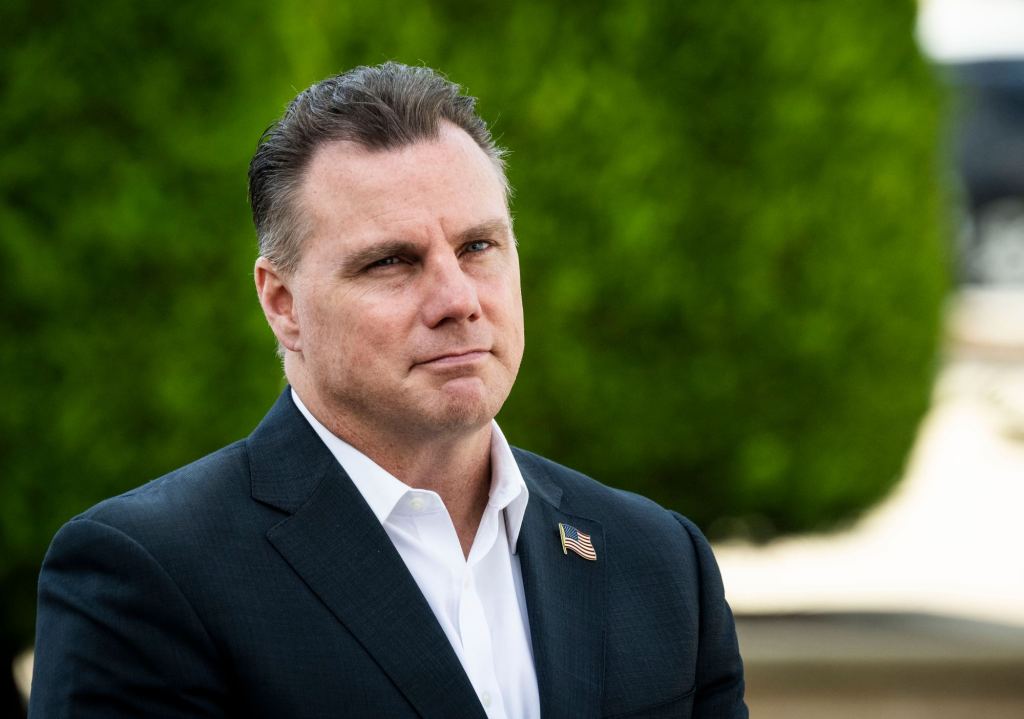
Ahead of the June primary election, the Southern California News Group compiled a list of questions to pose to the candidates who wish to represent you. You can find the full questionnaire below. Questionnaires may have been edited for spelling, grammar, length and, in some instances, to remove hate speech and offensive language.
Name: Michael E. Gates
Current job title: Former Deputy U.S. Attorney
Age: 51
Political party affiliation: Republican
Incumbent: No
Other political positions held: Former Huntington Beach City Attorney
City where you reside: Huntington Beach
Campaign website or social media: www.Gates4AG.com
The state of California sued President Donald Trump’s administration more than 120 times during his first term. Since Trump’s return to the Oval Office, the state has filed more than 50 lawsuits. As attorney general, do you intend to be more or less aggressive in challenging the president or his administration? How would you decide when it’s appropriate for the state to challenge federal authority? (Please answer in 250 words or less.)
Rob Bonta has turned the Office of the Attorney General into a political and press operation — not a law enforcement operation. For the past 18 months, Bonta has used his office to score political points and attempt to build a political brand, while letting serious problems here at home fester.
That stops once I win this race in November. As our next attorney general, I will bring the focus back to protecting Californians on our streets and in our communities. As the state’s top cop, we must be laser-focused on keeping residents safe and ensuring that our own state government doesn’t overstep its legal bounds. That means investigating claims of waste, fraud and abuse within state and local government, and stopping an out-of-control bureaucracy from passing illegal regulations that increase our cost of living.
What do you see as the biggest legal challenge facing California at this moment, and how would you, as attorney general, address it? (Please answer in 250 words or less.)
The biggest legal challenge facing California is the collapse of public confidence in our systems. Too many Californians believe there is one set of rules for criminals, political insiders and government bureaucracies; and another set for everyone else. When people stop believing the law will be enforced fairly, the whole system starts to break down. Just look at the hundreds of billions of waste, fraud and abuse that have been uncovered in the past few months alone — the attorney general is responsible for policing this, and he has failed miserably.
As attorney general, I would restore the office to its core mission: public safety, accountability and the rule of law. I created Huntington Beach’s criminal prosecutor program to treat quality-of-life crimes seriously, and the city saw a double-digit crime reduction in the downtown area. That experience shaped my view that consistent enforcement matters.
I would aggressively prosecute crime, pursue waste, fraud and corruption, support law enforcement and ensure the Department of Justice is focused on protecting communities rather than chasing political causes. Californians do not need more excuses. They need an attorney general who will enforce the law.
In 2024, voters approved Proposition 36 to increase penalties for certain drug and retail theft crimes and make available a drug treatment option for some who plead guilty to felony drug possession. How would you, as attorney general, support the implementation of Proposition 36? Would you ask the legislature to allocate more funding for behavioral health treatments? And how would you ensure that money is used properly? (Please answer in 250 words or less.)
California voters sent a clear message when they passed Proposition 36: They are tired of excuses and want real accountability for repeat theft and drug crimes, along with a meaningful path to treatment. I would make implementation of Proposition 36 a top priority.
That starts with issuing clear guidance to district attorneys and law enforcement on best practices for enforcement, charging and diversion options. I would also work closely with local prosecutors, sheriffs, police chiefs and treatment providers to identify where implementation is working and where gaps remain.
California has spent enormous sums on behavioral health programs that too often lack transparency and measurable outcomes. If taxpayers are asked to invest more, they deserve proof that the money is actually helping people get sober, complete treatment and avoid reoffending.
That means performance metrics, regular public reporting, independent audits and claw-backs when programs fail. We cannot let the homeless industrial complex continue its takeover of this system without showing any results. Proposition 36 should not become another Sacramento promise with no follow-through. It should be enforced seriously, funded responsibly and judged by results.
How would you ensure the office of attorney general stays independent from political pressure, whether that’s from within the state or the federal government? (Please answer in 250 words or less.)
The attorney general’s office must be guided by the law, not by political pressure from Sacramento, Washington or interest groups. Independence starts with a simple principle: The attorney general represents the people of California. Period.
I have spent my career taking on difficult and politically sensitive cases — including against powerful state interests — when I believed the law and the Constitution required it. That is the mindset I would bring to this office. In Huntington Beach, I did not back down from fights over housing mandates or voter integrity laws just because they were controversial.
As attorney general, I would insist on transparent legal standards for major decisions and make sure enforcement priorities are grounded in statute and constitutional authority.
Independence does not mean avoiding tough decisions. It means making them for the right reasons. Unlike the current attorney general, I believe that this office should never be weaponized for politics. My obligation would be to the law and to the people of this state.
Do you believe the attorney general’s office should take a stronger role in enforcing housing and homelessness laws in cities that resist development or shy away from anti-camping ordinances? (Please answer in 250 words or less.)
The attorney general’s office should play a stronger role in making sure housing and homelessness laws are enforced fairly and consistently, but that role must respect constitutional limits and local control. Local governments have real authority, and that should be respected.
At the same time, cities cannot simply allow dangerous encampments to grow or refuse to address conditions that threaten public safety and quality of life.
On homelessness, I believe enforcement and treatment must go together. Anti-camping laws matter because public spaces should be safe and usable for everyone.
The attorney general should ensure laws are followed, challenge obvious abuses and support practical solutions that restore order without turning every local dispute into a Sacramento power grab.
What do you see as the attorney general’s role in regulating artificial intelligence? (Please answer in 250 words or less.)
The first job of the attorney general is to enforce the laws already on the books when AI is used to break them. If an AI tool is used to scam consumers, impersonate people, violate civil rights, exploit children or mislead the public, the office should act aggressively.
My approach would be to target actual harms, protect constitutional rights and avoid turning the office into an anti-innovation bureaucracy. California can lead on responsible AI without treating every new technology as a legal emergency. We should protect people from abuse while also preserving room for growth, competition and legitimate innovation.
In your opinion, has California been aggressive enough in pursuing climate litigation? Why or why not? And similarly, what legal strategies would you like to deploy, as attorney general, in ensuring corporations are held accountable for climate impacts? (Please answer in 250 words or less.)
California should enforce environmental laws aggressively when there is actual fraud, actual pollution or actual violations of law.
In my view, the attorney general’s office should focus on cases where corporations broke the law, misled regulators or consumers or caused concrete, provable harm. That is where the state is strongest legally and where taxpayers are best served. Broad, novel theories that stretch the law for political effect may generate headlines, but they do not always produce durable results.
I also believe environmental enforcement should be connected to real quality-of-life issues Californians face, including protecting beaches, water supplies, natural habitats and local communities from harmful impacts and overdevelopment. Those are legitimate state interests, and the office should take them seriously.
As attorney general, I would pursue environmental violations where the evidence and the law justify action. But I would do so with discipline. The office should bring strong cases, not speculative ones. Californians deserve environmental protection that is lawful, effective and accountable, not just another arena for political grandstanding.
When the law leaves room for interpretation, what guiding principles shape your thinking about how to enforce a law? (Please answer in 250 words or less.)
When the law leaves room for interpretation, my guiding principles are the text of the law, the Constitution, legislative intent, public safety and equal application. I start with the words on the page. If the text is clear, that governs. If it is ambiguous, I look at the broader legal structure, precedent and what interpretation best fits the Constitution and the purpose of the law.
I also believe prosecutors and government lawyers should exercise humility. The fact that the law leaves room for interpretation does not mean the attorney general should always choose the most expansive view of state power. Government authority should be exercised carefully, especially when individual rights or local control are at stake.
Another key principle is consistency. Californians should not have to guess whether the law will be enforced one way for friends of the political class and another way for everyone else. Equal treatment under the law matters.
Finally, I ask a practical question: Does this interpretation promote order, fairness and public confidence in the justice system? The attorney general is not a legislator. The role is to faithfully enforce the law, not rewrite it. When judgment is required, it should be guided by restraint, clarity and fidelity to the rule of law.
If you had the ability to unilaterally change one state law, what would it be? How do you believe that would improve justice or the lives of Californians? (Please answer in 250 words or less.)
If I could change one state law, I would give every city in California clear authority and funding to create a local misdemeanor prosecutor program like the one we built in Huntington Beach.
For too long, California has treated so-called low-level crime as if it does not matter. But the crimes people see every day — theft, vandalism, trespassing, public drug use and other quality-of-life offenses — have a major impact on whether families feel safe and whether businesses can survive.
In Huntington Beach, we created a local prosecutor program because we understood that when everyday crimes go unchecked, disorder grows and public confidence erodes. We took these offenses seriously, enforced the law consistently and helped drive down crime. That experience showed me that accountability works. When there are real consequences, behavior changes. Communities become safer.
State law should make it easier for cities to partner with law enforcement and prosecute these offenses quickly and effectively. A statewide law authorizing and funding local prosecutor programs would give communities another tool to restore order, improve public safety and respond to local problems before they spiral into larger ones.
That would improve the lives of Californians in a very practical way. It would help reduce repeat petty crime, support local businesses, improve quality of life in neighborhoods and send a clear message that the law still matters.
Justice starts with enforcing the law in the places where people live their daily lives.
How do you think taxpayers could better understand the work of this office? (Please answer in 250 words or less.)
Taxpayers would better understand the work of the attorney general’s office if the office were more transparent, more disciplined and more focused on measurable results. Too often, Californians hear about press conferences and lawsuits but do not get a clear picture of what the office is actually accomplishing for public safety, consumer protection and accountability.
As attorney general, I would publish regular public reports that explain in plain English what the office is doing, how taxpayer dollars are being spent and what outcomes are being achieved. That includes crime initiatives, major litigation, consumer enforcement, fraud recoveries, legal opinions and grants or settlements involving public funds.
I would also push for performance metrics that matter to ordinary Californians: prosecutions, convictions, fraud recovered, response times, backlogs reduced and audits completed. People should be able to see whether the office is improving safety and accountability, not just generating headlines.
I would actually use the California constitutional powers given to the Office of the Attorney General under Article V, Section 13, to ensure all 58 district attorneys and sheriffs are prioritizing crime fighting and protecting victims. No Californian should have to live under a district attorney like George Gascón ever again.
Most importantly, the office should return to basics. When the attorney general is focused on enforcing the law, protecting neighborhoods, supporting law enforcement and going after fraud and corruption, the public can better understand the mission. This is a serious office, and taxpayers deserve an honest accounting of how it serves them.
What’s a hidden talent you have? (Please answer in 250 words or less.)
I worked my way through law school — and for 10 years prior to that — as a graphic artist. I helped design several Xbox and PlayStation video games and TV commercials until I was a practicing attorney.
Caroline Menjivar, SD-20 candidate, 2026 primary election questionnaire
Vicente Sarmiento, OC Board of Supervisors District 2, 2026 primary election questionnaire
Jason Sams, OC Board of Education candidate, 2026 primary election questionnaire
Lisa Sparks, OC Board of Education candidate, 2026 primary election questionnaire
Rob Bonta, California attorney general candidate, 2026 primary election questionnaire