
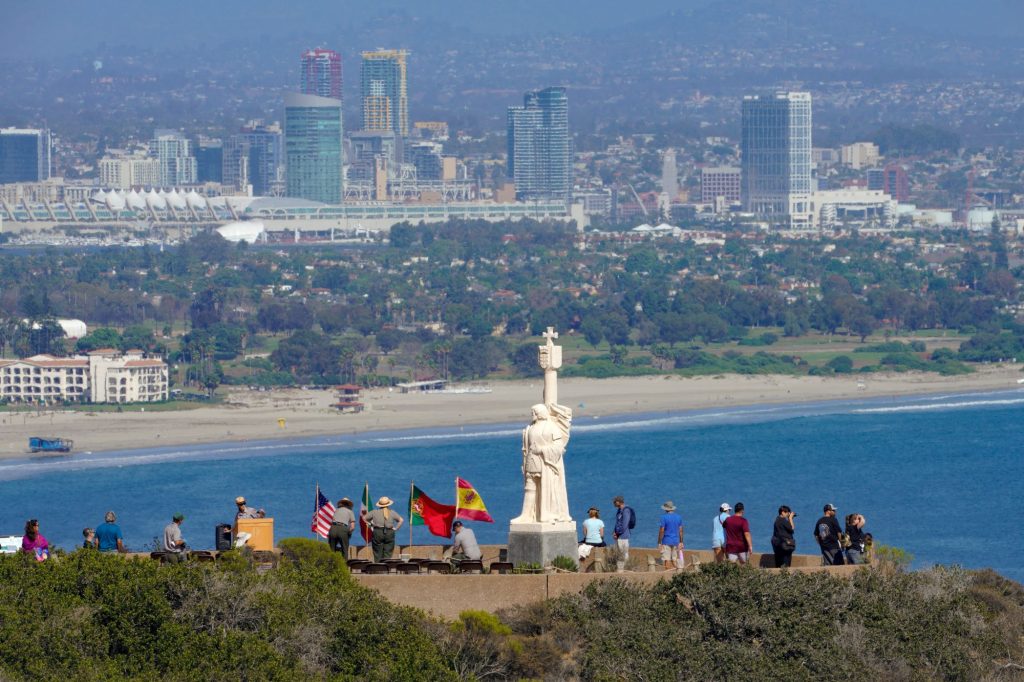
Sept. 28 was the 483rd anniversary of the arrival of the Spanish explorer Juan Rodriguez Cabrillo aboard the San Salvador at what we now call San Diego Bay. The San Salvador was the first European sailing vessel to reach the California coast.
Cabrillo National Monument was established in 1913 by President Woodrow Wilson. The Cabrillo/Spanish connection was prevalent in the original plans for Cabrillo National Monument, which were formulated in 1913.
Twenty years later, a fabricated shift began that asserted Cabrillo was Portuguese. The first reference to Cabrillo being Portuguese, as it relates to the Cabrillo National Monument, occurred in 1934. The first mention of the name João Rodrigues Cabrilho — note the different spelling of the final name — did not appear until 1935 and has never been verified as authentic.
The iconic statue at Cabrillo National Monument was commissioned by the Portuguese Secretariat of National Propaganda in 1939. Two bronze plaques displayed at the monument referring to Cabrillo as a Portuguese navigator were gifted by the Portuguese Navy in 1957 and 1988. The addition of the statue and plaques was not approved by Congress nor the director of the National Park Service, as required by federal statute.
In 2015, renowned Canadian historian and expert on 16th century Central America, Wendy Kramer, Ph.D., while conducting archival research, discovered several thousand pages of manuscripts with legal documents written by official scribes. Numerous documents were signed by Juan Rodriguez Cabrillo stating that he was a native of the Spanish village of Palma de Micer Gilio, now known as Palma del Río, Córdoba, Spain. Kramer was researching information about Guatemala in the 1520s and 1530s. Her findings were published in 2016 in The Journal of San Diego History.
Kramer’s paper — “Juan Rodriguez Cabrillo, Citizen of Guatemala and Native of Palma del Rio: New Sources from the Sixteenth Century” — was peer reviewed by several historians including Carla Rahn Phillips, professor emeritus at the University of Minnesota, and Harry Kelsey, the former chief curator of history at the National History Museum of Los Angeles County and research scholar at the Huntington Library.
Robert Munson, former Cabrillo National Monument historian, verified and agreed with the historians’ peer review. Local historians Iris Engstrand and Molly McLain, then co-editors of “The Journal of San Diego History,” agreed with Kramer’s conclusion.
An April 25, 2018, letter from Cabrillo National Monument Superintendent Andrea Compton to the House of Spain acknowledged and accepted Kramer’s finding that Cabrillo was born in current-day Palma del Río, Córdoba, Spain.
Despite overwhelming evidence and scholarly acceptance, the Cabrillo National Monument refuses to affirm that Cabrillo was of Spanish birth. In fact, after Kramer’s findings, the Cabrillo National Monument inexplicably changed the birthplace of Cabrillo on its website from Spain to “the Iberian Peninsula.”
Why does the National Park Service promote the inaccurate history that Cabrillo may have been born in Portugal? Even Portugal did not recognize Cabrillo as a native on the famous Monument of the Discoveries (Padrão dos Descobrimentos) in Lisbon.
Why does the National Park Service refuse to update the information it disseminates to the public on its website, wayside exhibit and brochures? Why does it reference the name João Rodrigues Cabrilho when that person does not exist in the history of California? This name is a fake created by the government of Portugal and the Portuguese in California. Read the history of California.
The House of Spain in San Diego’s YouTube channel shows a short video about the Cabrillo National Monument history.
Where is any similar historical research and peer review acceptance of the Portuguese claims? Answer: There is none.
Latin American history experts with whom I have consulted unanimously agree Cabrillo was Spanish. They unanimously agree there is no reliable evidence supporting the position that Cabrillo was Portuguese.
The National Park Service needs to be honest in telling the story of Cabrillo. Give all visitors the objective truth.
Benayas is president of House of Spain in San Diego and lives in San Diego.